1500+ reviews

Small holes and sawdust get attention. The damage that changes repair costs is often the activity you can't see. Termites alone account for major U.S. losses. A USDA Forest Service bulletin says annual damage estimates are commonly around about $1 billion, with some estimates as high as $7 billion. That's why wood damage in Magnolia, Texas can't be judged by one clue.
The insects that damage wood don't all behave the same way. Some eat it. Some excavate it. Some need persistent moisture. Others can live inside dry lumber or arrive in furniture, trim, or firewood. If you're trying to sort out risk around Magnolia, look at five things first: the insect itself, any frass or mud tubes, nearby moisture, where the wood sits in the building, and when the activity showed up.
That's also where a real wood-destroying insect inspection earns its keep. In Texas real estate transactions, the state requires the WDIR process, completed by a licensed certified applicator or technician in the termite and wood-destroying insect category, and the report must document visible evidence of infestation or conducive conditions under Texas wood-destroying insect inspection rules. For Magnolia homes, rentals, and commercial sites, that distinction matters because old damage, active infestation, and harmless hitchhikers aren't the same problem.
1. Subterranean Termites (Reticulitermes flavipes)
Subterranean termites rank first here for structural risk and only mid-pack for inspection difficulty. In Magnolia, they are common, they stay hidden, and they can move from soil to framing for a long time before a room shows obvious damage. The usual pattern is hidden feeding first, visible evidence later.
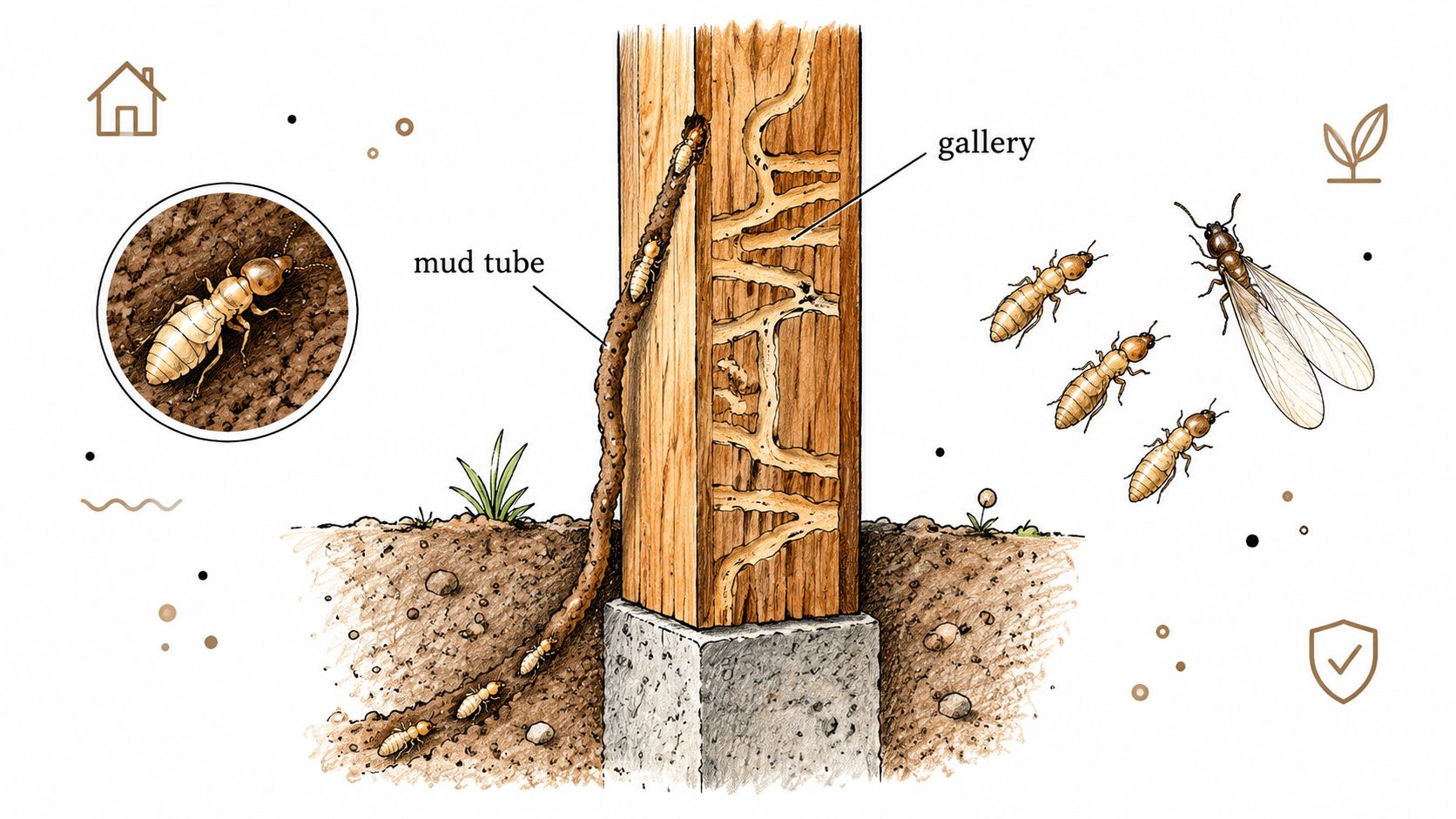
That risk is well established in termite literature and industry guidance. The practical problem is simple: the feeding happens out of sight, so the first clue is often mud tubing on a pier, soft trim near a bath trap, blistered flooring, or swarmers at a window after rain. By the time a homeowner notices hollow-sounding wood, the colony may have been active for months.
In Magnolia and nearby communities, I put the first inspection attention on slab cracks, expansion joints, plumbing penetrations, porch attachments, and pier-and-beam crawl spaces. Older homes on pier-and-beam foundations deserve extra scrutiny because support posts, subfloor framing, and skirting can hold clear evidence if moisture has been present. Newer homes are not exempt. Hidden leaks, mulch piled against siding, and foam or insulation details that cover the foundation edge can make termite entry harder to spot.
What Magnolia owners should document
Good documentation helps separate inspection from treatment. Inspection answers whether evidence is active, where the termites are entering, and how far the risk extends. Treatment answers how to stop the colony and reduce re-entry pressure.
- Follow the route: Mud tubes from soil to wood matter more than isolated surface scarring.
- Check wood-to-soil contact: Posts, siding, trim, lattice, and stair stringers should not stay buried in soil or mulch.
- Check moisture conditions: Wet crawl spaces, poor drainage, and leaking hose bibs often show up in the same areas as termite activity.
- Probe suspicious wood: Baseboards, window trim, sill plates, and subfloor edges that feel thin or break easily need closer inspection.
Practical rule: Spraying the visible tube is rarely the fix. Subterranean termite control works better when the entry points, soil contact, and monitoring plan are addressed together.
The main trade-off in treatment is speed versus coverage. A narrow spot treatment may make sense for very limited, confirmed activity, but it can miss connected foraging areas. A broader soil treatment or baiting plan usually gives better long-term control when activity is tied to the foundation or multiple entry points. If swarmers have shown up indoors, or tubes reappear after being removed, it makes sense to schedule a FullScope Pest Control inspection and review how to get rid of termites and protect your home before choosing the scope of work.
Repair decisions come after control, not before. Cosmetic patching can hide active evidence and make later inspection harder. If termites have affected finished flooring, the pest work and finish carpentry are separate scopes, and services such as wood floor restoration after termites may be part of the next step once the infestation is stopped.
A quick visual can help you compare tubes, galleries, and feeding patterns:
2. Drywood Termites (Incisitermes minor)
Drywood termites create a different inspection problem than subterranean termites. They can stay inside the wood itself, so the first clue in a Magnolia home is often debris at the surface rather than evidence at the slab or soil line. In my experience, they show up less often here than subterranean termites, but they are easier to miss early because there may be no mud tubes and no obvious moisture pattern pointing you to the source.
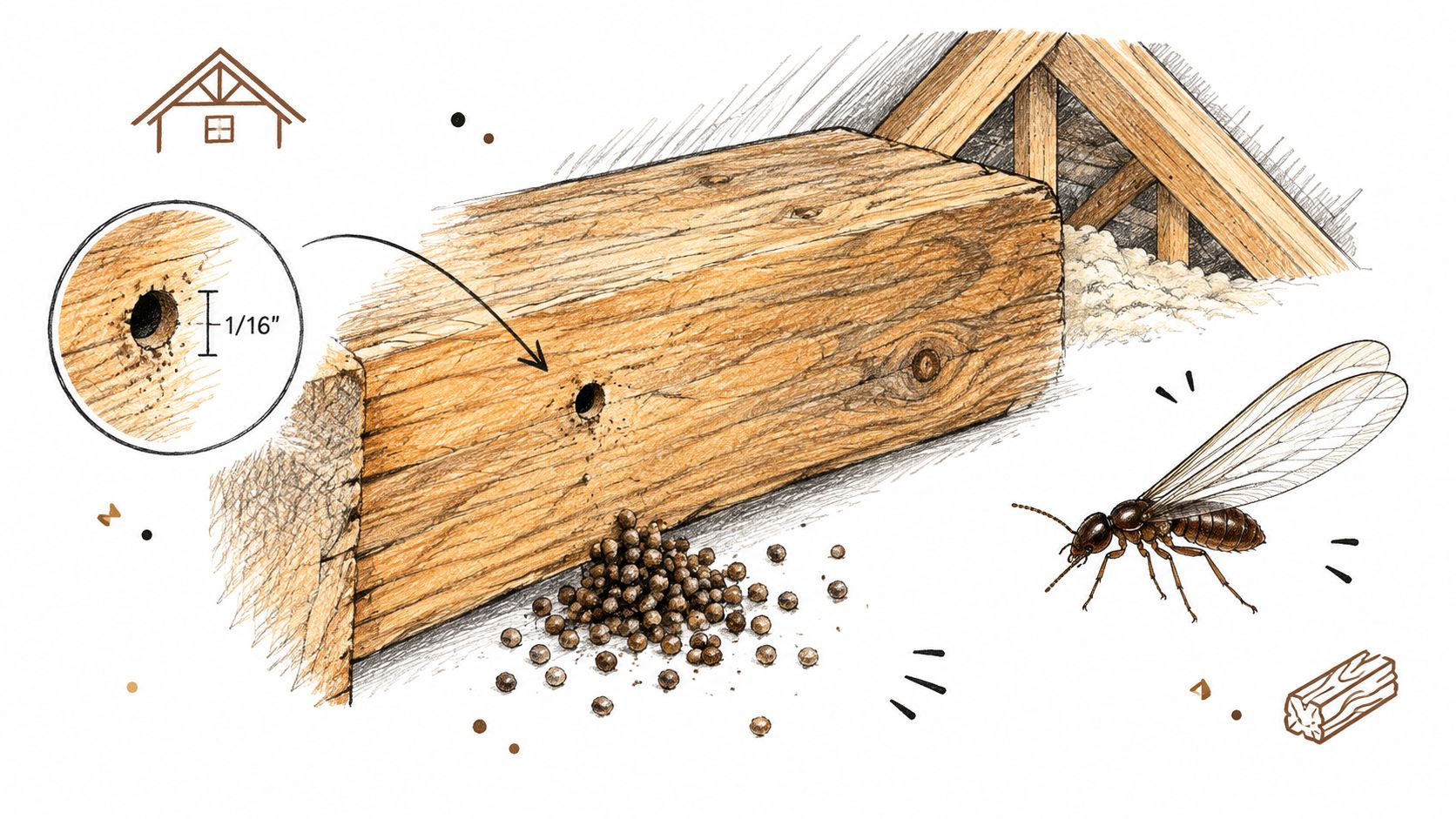
Their risk ranking sits in the middle to upper half for structure, but high for inspection difficulty. A small colony in trim or furniture may stay localized for a while. Hidden activity in fascia, eaves, roof framing, or a detached shop can go unrecognized much longer, especially in homes with stained wood details, attic heat, and areas that do not get routine close-up checks.
The field mistake I see most often is overreading pellet piles. Pellets matter, but only if the pattern fits drywood termite activity. Fresh frass usually collects below a kick-out hole, below a trim joint, or on a horizontal surface under the same member over and over. Old pellets, beetle frass, and plain deterioration can send you in the wrong direction if nobody checks the wood itself.
Risk clues worth documenting
Start with the wood members that stay dry but are easy to ignore.
Window and door trim, exposed rafters, fascia boards, porch ceilings, attic framing near vents, and stored wood furniture are common inspection points in this part of Texas. I would also look closely at pergolas, detached buildings, and salvaged lumber brought onto the property.
A few clues carry more weight than others:
- Recurring pellet piles in the same spot: Clean them up once, then monitor. If they return from the same crack, seam, or pinhole opening, that is stronger evidence than a one-time pile.
- Tiny kick-out holes with hard, sand-like pellets: Drywood termite frass is distinct when seen up close. It is dry, uniform, and pushed out of the wood, not mixed with mud.
- Hollow or thin-sounding finished wood: Probing matters, especially on trim and fascia that still looks intact from a few feet away.
- Items brought indoors: Used furniture, decorative wood pieces, and salvaged lumber can carry a localized infestation that has nothing to do with the framing.
Dry timber isn't always the villain. Extension guidance notes that some wood-borers brought in on firewood or lumber are only temporary nuisances and usually don't need pesticide treatment, while true wood-destroying insects in buildings do require intervention. See the University of Minnesota note on nuisance wood borers and seed insects in homes.
That distinction matters in Magnolia garages and workshops, where stored firewood or old boards may produce insect activity that looks alarming but does not mean the house is infested.
Treatment decisions depend on confirmation and access. Localized, confirmed activity in a reachable piece of trim or furniture may be a good fit for a targeted treatment or removal of the affected item. Suspected activity in enclosed framing, multiple upper-story members, or finished areas usually calls for a more careful inspection first, because opening walls or treating the wrong member wastes time and can still miss the colony. If pellets keep returning from the same area, or if upper framing and exterior trim cannot be checked safely from the ground, a FullScope Pest Control inspection helps separate old evidence from active drywood termite work before repairs begin.
3. Carpenter Ants (Camponotus species)
In the field, that distinction changes the response: carpenter ants follow moisture, so the nest is rarely where you see the ants. They excavate damp or decayed wood for galleries, which means visible ant traffic often points to a roof leak, wet wall void, failing trim joint, or another moisture problem that already needs repair.
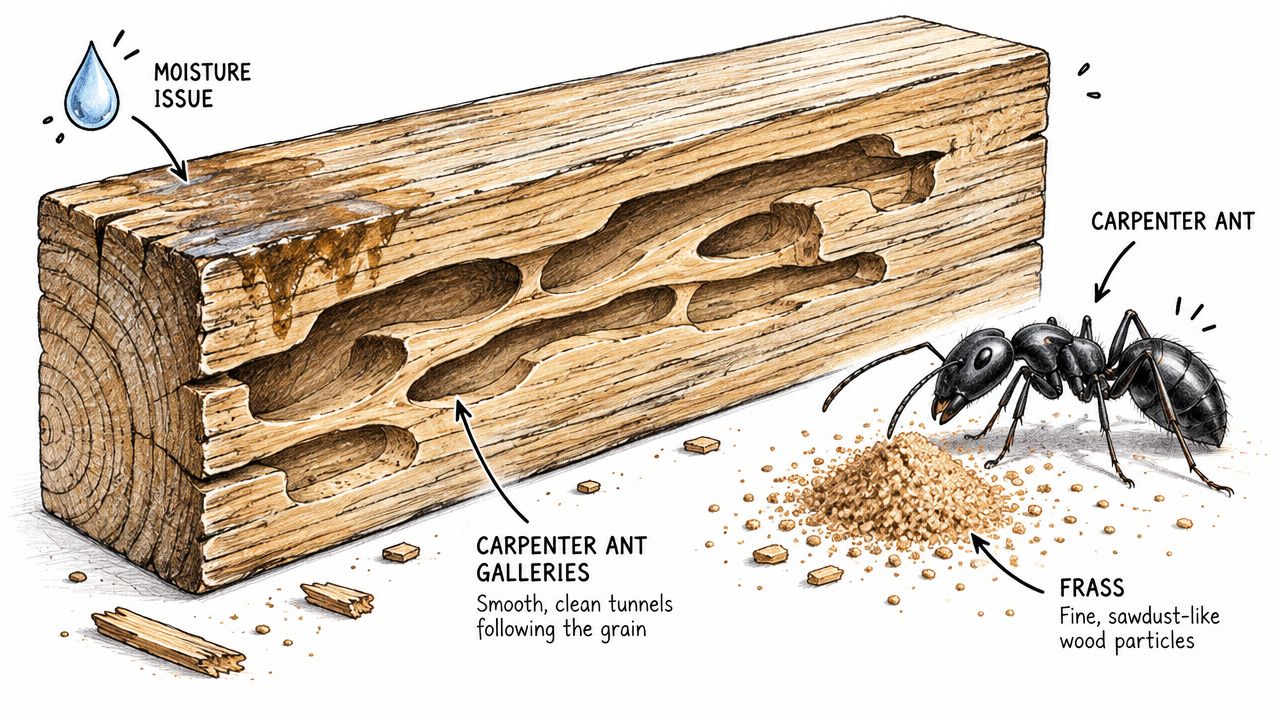
I rank carpenter ants in Magnolia as moderate structural risk and moderate inspection difficulty. They can be easier to identify than termites once you find clean, smooth galleries and coarse sawdust-like frass, but they waste a lot of treatment effort when the colony is split between a visible satellite site and a hidden parent nest outdoors or in damp framing.
The useful inspection question is simple: where does the trail end? If ants are moving to a wet soffit, soft fascia, or darkened framing near a leak, that points more toward a primary nesting area. If they show up in a bathroom wall, kitchen window, or upstairs room and the nearby wood is dry and sound, you may be looking at satellite activity feeding from a larger nest somewhere else.
That difference matters in Magnolia homes with repeated humidity and storm-related moisture issues. Gutter overflow, roof penetrations, fascia damage, and siding that stays shaded and pressed by vegetation are common setups. In pine-heavy neighborhoods, I also check stumps, timbers, wood piles, and fence lines close to the structure because the parent colony may be outside and only sending foragers or satellite ants indoors.
Spraying the ants you see can reduce activity fast. It does not solve the reason they are there.
A better response matches the evidence:
- Correct the water source first, especially roof, flashing, plumbing, or gutter defects tied to soft wood.
- Follow trails during active periods, usually evenings or humid days, to see whether ants are entering from exterior wood, attic voids, or a window line.
- Probe suspect members. Damp, crumbly, or previously decayed wood deserves more attention than dry structural lumber with no softness.
- Trim back contact points such as limbs, vines, stacked firewood, and dense mulch against siding.
If ant sightings keep returning after cleanup, if the trail disappears into enclosed framing, or if upper trim and attic transitions cannot be checked safely, a FullScope Pest Control inspection helps separate a nuisance foraging issue from nest-bearing wood damage. For homeowners comparing next steps, carpenter ant treatment guidance for homes is more useful than general ant advice because it focuses on locating moisture-linked nesting sites before treatment starts.
4. Powderpost Beetles (Lyctidae family)
Powderpost beetles rank high on inspection difficulty because the evidence shows up long before the insect does. The first clue in Magnolia homes is often a small pile of very fine, flour-like frass under a baseboard, window stool, shelf, or hardwood plank. By the time someone notices the pattern, the exit holes may already be filled, painted, or hidden by stain.
In my inspections, powderpost damage shows up in hardwood flooring, trim, doors, millwork, and furniture far more often than in framing. That lowers the structural risk compared with termites or old house borers, but it does not make the problem cheap. Refinished floors, custom trim, and built-ins can absorb plenty of money once active emergence keeps returning.
The main job is to confirm current activity instead of reacting to old damage. Fresh frass has a soft, powdery feel and reappears after cleanup. Old debris tends to sit in neglected corners with no new holes or dust. In humid pockets around Magnolia, especially rooms with poor HVAC balance, enclosed storage, or past moisture problems, I pay closer attention because hardwood stays more vulnerable when it cycles through damp conditions.
A practical inspection focuses on three questions:
- Is the damaged wood hardwood or softwood?
- Is frass fresh and recurring, or leftover from an older infestation?
- Is the affected piece decorative and replaceable, or part of a larger finished assembly that makes treatment more disruptive?
Those answers drive the trade-off. Small, isolated items may be better removed or replaced. Finished flooring or built-in millwork often calls for a closer inspection first, because surface sprays do little if the species is wrong, the activity is old, or the infestation extends deeper than the finish layer. If you need help sorting beetle exit holes from other wood pest signs, this wood borer identification help is a useful starting point.
Material choice also affects future risk. Some hardwood trim packages and exposed deck lumber details hold up well if they stay dry, but hidden moisture around thresholds, exterior doors, and shaded covered areas changes that equation. If frass keeps returning after cleanup, if damage involves installed hardwood finishes, or if you cannot tell whether the infestation is active, a FullScope Pest Control inspection helps separate cosmetic old damage from a beetle problem that still needs treatment or replacement.
5. Old House Borers (Hylotrupes bajulus)
Old house borers rank high on structural risk because they attack softwood members that carry load. In Magnolia homes, that puts roof framing, wall framing, and some subfloor systems in the conversation, not just trim or stored lumber. I place them below subterranean termites for overall local threat, but above several other beetles because active larvae inside structural pine can stay hidden for years.
Inspection is the hard part. Owners often mistake old house borer exit holes for old water damage and skip the inspection. By the time someone notices coarse frass, oval exit holes, or wood that feels thin under a probe, the insect may be gone or the damage may be deeper than the surface suggests.
Why confirmation takes work
Adults are short-lived. The larvae do the damage, and they stay buried in the wood. In older Magnolia houses with exposed attic framing or garage framing, I pay close attention to softwood members that show scattered emergence holes plus a rough, packed frass texture instead of the cleaner dust pattern seen with some other beetles.
A quiet attic can also give them away. Faint chewing or ticking in warm conditions points to activity worth checking, but sound alone is not enough to call the species.
Historic USDA research showed that southern homeowners were already spending heavily on termite and wood-destroying beetle control decades ago, including an estimated $143 million spent in 1970 by owners of single-family homes in 11 southern states to prevent and control subterranean termites and wood-destroying beetles, in 1976 dollars. That 1970s figure understates today's cost, but it shows how long wood-boring insects in structural lumber have been a recognized expense in the South.
The response depends on what the inspection finds. Surface evidence in one board does not justify treating every visible piece of wood in the house. If the affected member is still sound, treatment can focus on the infested area and on reducing conditions that let reinfestation go unnoticed. If framing or subflooring has lost strength, repair becomes part of the plan, and pest control alone will not solve the problem.
Magnolia conditions matter here. Heat speeds insect development, and garages, attics, and older additions with exposed softwood often show the clearest clues. If damage appears in framing, if you cannot tell whether emergence is current, or if multiple softwood members show similar signs, a FullScope Pest Control inspection helps separate old evidence from an active structural issue.
6. Wood-Boring Weevils (Euops and Xyleborus species)
Wood-boring weevils and similar borers can fool an inspection faster than their rank on this list suggests. I put them at moderate structural risk and high inspection difficulty because the insect often arrives after moisture has already weakened the wood, and the visible holes do not tell you whether you have a one-time hitchhiker or an active building problem.
In Magnolia, I look hardest at damp porch framing, crawl space timbers, utility room wood near plumbing, and outbuildings with roof leaks. Those are the places where Xyleborus-type ambrosia beetles and other small borers show up in wood that has stayed wet long enough to support fungal growth. If galleries are in structural members, the insect matters less than the reason the wood stayed damp.
Moisture decides the response
Use a simple rule first. If the insects emerged from firewood or stored lumber and you find no exit holes in framing, subfloor, trim, or posts attached to the house, treatment is usually unnecessary. If small borers are emerging from damp framing, siding, porch members, or crawl space wood, the moisture source is the target and any insect treatment is secondary.
The practical check is moisture content and location. Seasoned indoor wood with no leak history usually points to a transported insect that came in with wood products. Damp exterior wood, crawl space members, or areas with condensation, overflow, or rain intrusion point to an active moisture problem that can keep producing insect activity.
A useful scientific benchmark comes from field work in Northwest Turkey, where researchers used the Bevan Damage Classification across multiple locations and calculated a Bevan damage index from insect frequency and damage scale values, creating a repeatable way to compare severity rather than just noting presence or absence in this wood-destroying insect assessment study. That same approach works in the field here. Grade the damage, then decide whether the wood is still serviceable.
- Trace water before treating insects: Check roof edges, flashing, plumbing, HVAC condensation, grade slope, and crawl space humidity.
- Probe the member, not just the surface: Soft, crumbling, or hollow wood shifts the job toward repair or replacement.
- Treat selectively after inspection: Spot treatment can make sense where activity is localized and the wood still has strength. Replacement is often the better choice where galleries run through heavily deteriorated members.
If damage is limited to stored wood, cleanup and disposal may solve it. If similar holes show up across damp structural wood, or if you cannot tell whether emergence is current, a FullScope Pest Control inspection helps separate incidental insects from a moisture-driven structural issue.
7. Carpenter Bees (Xylocopa species)
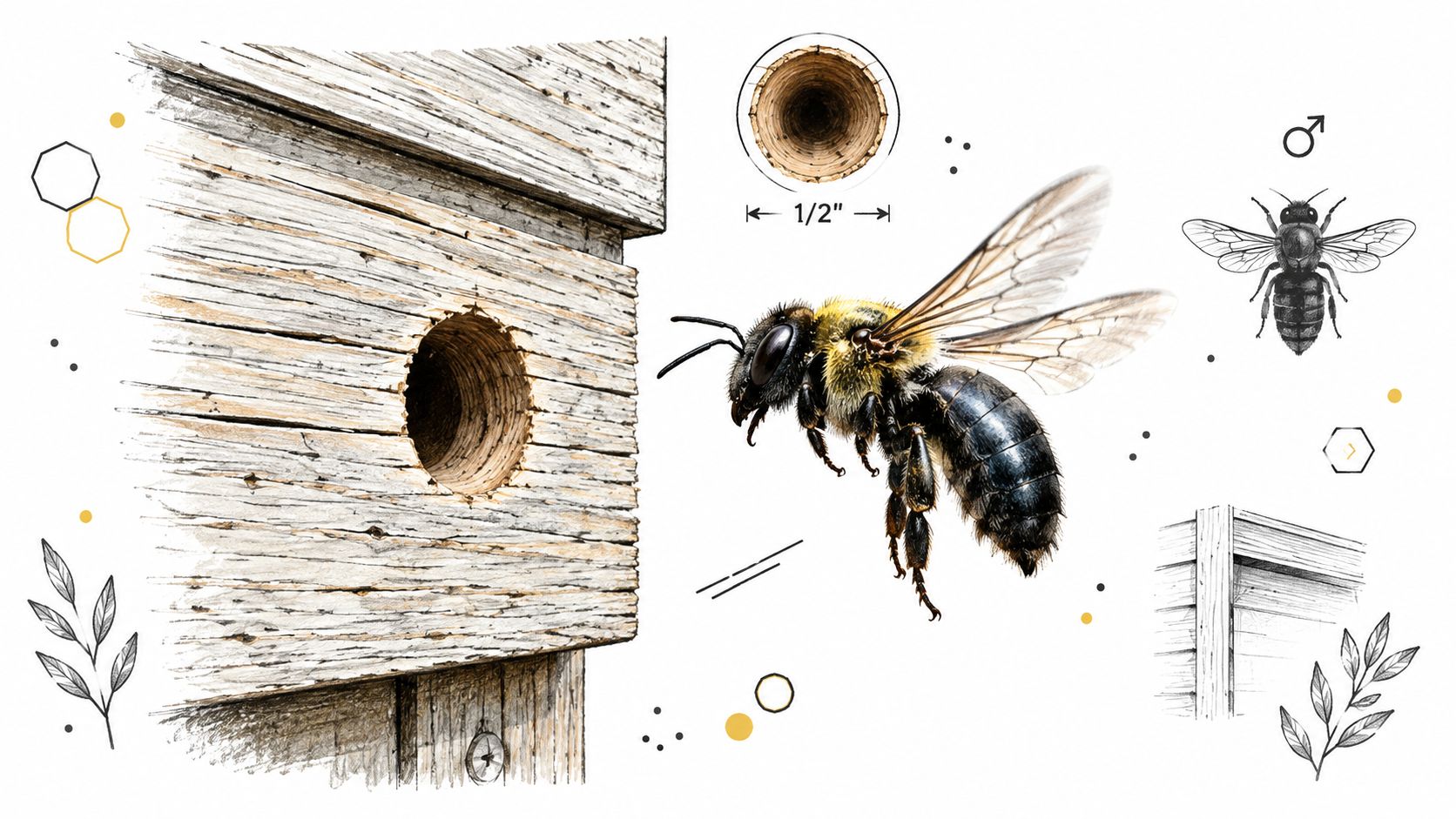
Carpenter bees rank low for immediate structural risk and high for recurring nuisance value. In Magnolia, they show up most often in exposed softwood on eaves, fascia, pergolas, porch ceilings, railings, and fence lines. One season of activity rarely threatens a house frame, but reused tunnels can spread through the same trim or outdoor wood year after year and leave enough surface damage to justify repair.
Identification is straightforward if the wood is accessible. Look for clean, round entry holes about the width of a fingertip, light sawdust beneath the opening, and yellow-brown staining from bee waste on the face of the board. Males often hover near the nest and bluff at people without stinging, while females do the boring.
The inspection question is simple. Is this limited to exposed exterior wood, or are multiple members showing repeat tunneling and weathering? Around Magnolia, I see the worst repeat activity on unpainted or sun-beaten softwood that stays dry enough to suit bees but exposed enough to invite another nesting cycle.
Best response by season
Timing matters more than product choice. Patch a hole while bees are still active and they often bore a new one a few inches away. Wait until activity slows, then treat the gallery if needed, plug it, and seal or paint the surface so the same piece of wood is less attractive next season.
Paint and solid sealers outperform bare wood. If a pergola, fascia board, or trim detail keeps getting hit, replacement with a harder or better-finished material can make more sense than repeated spot repairs. That is the practical trade-off. Localized treatment handles active holes, but surface protection does more to prevent a repeat call next spring.
A FullScope Pest Control inspection becomes useful when the damage pattern is unclear, holes keep reappearing after patching, or the affected wood is high enough or widespread enough that a close exterior inspection is hard to do safely.
Comparison of 7 Wood-Damaging Insects
| Pest | Implementation Complexity 🔄 | Resource Requirements ⚡ | Expected Outcomes ⭐ | Ideal Use Cases 📊 | Key Advantages / Tips 💡 |
|---|---|---|---|---|---|
| Subterranean Termites (Reticulitermes flavipes) | High 🔄, multi-step soil barriers, baiting & monitoring | High ⚡⚡⚡, specialized equipment, repeat visits, licensed techs | ⭐⭐⭐⭐, highly controllable with ongoing maintenance | Homes with soil-contact wood, pier-and-beam foundations, pre-sale WDI | Annual inspections; maintain 12–18" soil‑to‑wood gap; monitor swarmers |
| Drywood Termites (Incisitermes minor) | Medium 🔄, localized treatments or whole‑structure fumigation | Moderate–High ⚡⚡, targeted borates or costly fumigation when widespread | ⭐⭐⭐⭐, excellent success with fumigation; localized treatments effective early | Attics, furniture, dry structural members, used-wood introductions | Inspect for frass/exit holes; seal wood; inspect late summer swarm season |
| Carpenter Ants (Camponotus spp.) | Medium 🔄, nest location + moisture remediation needed | Moderate ⚡⚡, baiting, inspections, repair of moisture sources | ⭐⭐⭐, good elimination when nests and moisture addressed | Moist or decayed wood, attics, fascia, areas with leaks | Fix leaks/gutters; maintain 6–12" clearance; remove wood debris |
| Powderpost Beetles (Lyctidae) | Low–Medium 🔄, surface treatments, sealing, refinishing | Low–Moderate ⚡⚡, chemical treatments, refinishing, humidity control | ⭐⭐⭐, controllable if caught early; reinfestation possible | Hardwood floors, trim, furniture, older homes with original hardwood | Inspect for fine powder/frass; seal and finish hardwoods; control humidity |
| Old House Borers (Hylotrupes bajulus) | High 🔄, deep-framing access, long-term monitoring | High ⚡⚡⚡, structural access, chemical treatment, possible repairs | ⭐⭐⭐, manageable if detected early; may require structural repair | Older homes with kiln-dried softwood framing (1960s–1980s) | Listen for nocturnal ticking; keep wood moisture <12%; inspect framing |
| Wood‑Boring Weevils (Euops, Xyleborus spp.) | High 🔄, dense galleries; treatment + moisture remediation | High ⚡⚡⚡, often requires drying/replacement + targeted chemicals | ⭐⭐, treatment challenging if galleries extensive; replacement often needed | Water‑damaged posts, framing, decayed or moist wood areas | Prioritize drying/ventilation; replace heavily infested wood; inspect for exit holes |
| Carpenter Bees (Xylocopa spp.) | Low 🔄, simple prevention or gallery plugging | Low ⚡, painting/sealing or hole plugging; targeted trapping | ⭐⭐⭐⭐, prevention highly effective; nests removable | Decks, siding, trim, exposed softwood elements | Paint/seal wood annually; use hardwoods for exposed areas; plug holes in fall |
Turn Suspicious Wood Damage Into a Clear Plan
Start with the symptom, not the guess. Mud tubes, spring swarmers, or hollow wood near the foundation call for a prompt termite inspection. Pellet piles and tiny emergence holes point more toward drywood termites or beetles. Sawdust-like debris paired with a roof leak or soft trim often fits carpenter ants. Perfectly round holes in exposed softwood usually suggest carpenter bees.
Photograph the evidence before you disturb it. Get close shots of holes, tubes, pellets, frass, damaged wood grain, and the surrounding area. Don't scrub it clean first. Fresh evidence helps separate active infestation from old damage, and that's the difference between monitoring, targeted treatment, and unnecessary replacement.
Correct water problems right away. Leaks, poor drainage, clogged gutters, wet crawl spaces, and wood-to-soil contact keep showing up because moisture changes the whole risk profile. It also helps explain why some insects that damage wood become persistent structural issues while others are just temporary hitchhikers in firewood or stored materials.
Don't rely on surface sprays for hidden galleries. They may kill what's exposed without reaching the colony, nest, or larval activity inside the member. When framing is involved, when real estate is involved, or when activity keeps returning, a professional WDI inspection is the right next step. In Magnolia, that service area should be understood broadly, not just by the city name. Magnolia is associated with ZIP codes 77353, 77354, and 77355, and the city states that its limits are approximately 5 square miles, with an ETJ extending a half-mile beyond the limits and ZIP coverage extending beyond those boundaries. That's why pest service discussions should mention Magnolia, nearby neighborhoods, and connected Southeast Texas communities rather than treating one municipal boundary as the whole risk area.
FullScope Pest Control is one Magnolia-serving option for wood-destroying insect inspections, termite treatment, monitoring, and ongoing protection across nearby service locations such as Kingwood, Conroe, and Porter. If the damage pattern is unclear, inspection first is the move that saves the most wasted effort.
For exterior wood upkeep after the pest issue is handled, choices like white wood stain vs paint affect how well exposed surfaces shed moisture and show future damage.