1500+ reviews

A Magnolia property manager can do everything right on paper and still get three pest complaints in one morning. A wet spring, a new construction edge, an overflowing dumpster, or one untreated apartment can move activity through connected buildings quickly. By the time residents start calling, the visible pest is often only the symptom.
That's why property management pest control needs to run as an operating workflow, not as a recurring spray appointment. Magnolia sits in southwestern Montgomery County and forms part of the Houston metropolitan area. The city proper grew from 1,393 residents in 2010 to 2,359 in 2020, according to the U.S. Census Bureau's Magnolia QuickFacts profile. The City of Magnolia's demographics page reports a 2024 population of 5,836, a materially higher figure that points to a service market changing quickly. The population figures come from different reporting sources and should not be treated as a single comparable series, but together they show why older maintenance routines can struggle to keep up.
Why Magnolia Property Managers Need a Smarter Pest Playbook
A manager working around the 77354 and 77355 corridors may notice the pattern after a wet spring. Residents in one building report ants near patio doors. A tenant in another building sees roaches beneath the kitchen sink. The maintenance team finds wasps around a pool enclosure, while a leasing employee mentions mosquitoes near a retention pond.
The first reaction is often to add a spray visit. That can knock down exposed insects, but it doesn't explain where the pressure began or why it keeps returning. New development west of Conroe and north of Tomball creates changing boundaries between managed properties, disturbed soil, drainage areas, and undeveloped lots. Older apartments, newer multifamily communities, retail sites, and light commercial buildings all present different entry points and sanitation risks.
Magnolia's location makes response geography part of the operating plan. The city is roughly 10.9 miles from Tomball, 17.3 miles from Conroe, and 36.2 miles from Houston, while Dobbin is roughly 12 miles away, according to Census Reporter's Magnolia location profile. A vendor's ability to reach a site consistently matters when an issue involves several units or requires a follow-up inspection.
Why calendar spraying falls short
Calendar spraying treats time as the trigger. IPM treats evidence as the trigger. Integrated pest management emerged from the development of integrated control after World War II. In 1952, Michelbacher and Bacon introduced the term “integrated control” for combining biological and chemical methods, and the broader IPM framework was standardized later in the 1960s and 1970s, as documented in this history of integrated pest management.
The modern approach uses monitoring, sanitation, habitat modification, thresholds, exclusion, and selective chemical treatment. Federal policy moved toward that model when President Nixon directed agencies to advance IPM in 1972, followed by a federal IPM coordinating committee in 1979, according to historical IPM teaching materials from the University of Minnesota.
For an owner, the financial argument is straightforward. Repeated spraying without correcting access routes creates recurring labor, resident disruption, and vendor visits without solving the source. A documented inspection-first program gives ownership a clearer record of what was found, what was corrected, and why a treatment was or wasn't authorized. Managers who also review building consumption and maintenance patterns may find utility submetering from Axis Meter Solutions useful for broader property operating oversight.
The operational framework is consistent with the importance of pest control in property management, but the local execution matters more than the label. Magnolia properties need a playbook that connects inspection findings to work orders, resident communication, vendor accountability, and follow-through.
The Inspection-First IPM Workflow That Actually Works
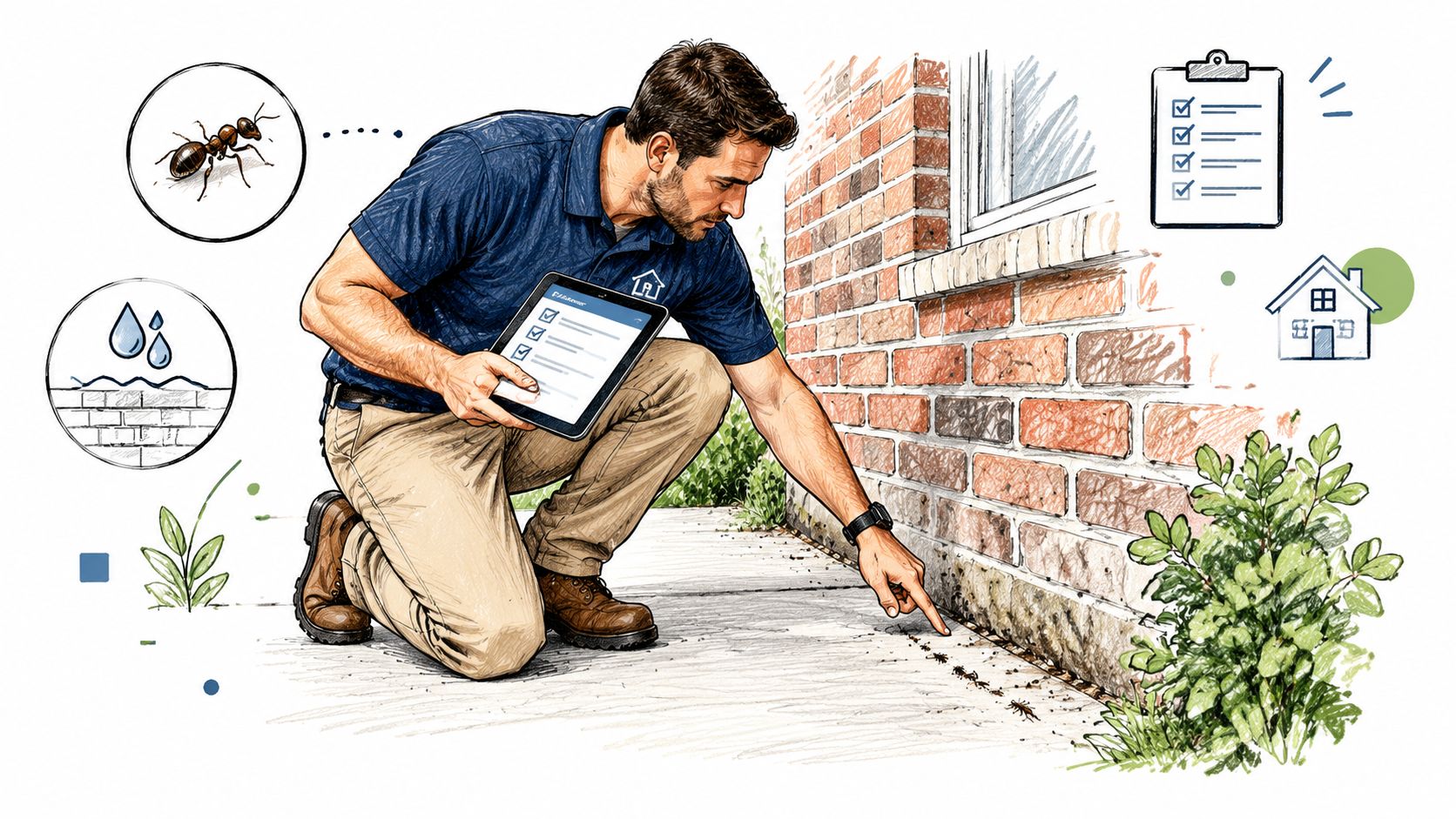
Start outside, then move inward. A manager who begins with a complaint-driven interior spray may miss the overflowing dumpster, irrigation leak, vegetation touching the wall, or gap beneath a service door that keeps feeding the problem.
Run the property in a defined sequence
Use the same route every time so technicians and on-site staff can compare findings. A practical workflow looks like this:
Inspect the exterior perimeter. Check foundation transitions, pipe penetrations, door sweeps, utility entries, wall cracks, roofline access, mulch, irrigation, drainage, and vegetation contact. Photograph conditions that maintenance can correct.
Sample apartments by risk. Don't wander randomly through units. Select apartments based on complaint history, adjacent activity, move-in or move-out status, visible moisture, sanitation concerns, and proximity to known source areas. Record the unit number, room, pest evidence, and likely contributing condition.
Check common areas. Inspect trash rooms, laundry rooms, stairwells, mail areas, mechanical spaces, storage rooms, kitchens, leasing offices, and amenity buildings. German cockroaches and rodents don't respect the boundary between a resident unit and a shared service space.
Walk dumpsters and outdoor zones. Look for spilled food, standing water, damaged lids, dense groundcover, irrigation overspray, and harborage beside fences or retaining walls. Magnolia's humidity can keep these areas productive for pests when housekeeping and drainage lag behind.
Set an action threshold. A single ant trail may call for sanitation and exclusion. Repeated cockroach evidence across connected units may justify baiting, monitoring devices, and a coordinated inspection. A threshold should reflect pest type, location, vulnerability, complaint frequency, and the risk of spread.
Turn findings into work, not just reports
The vendor's service ticket should identify the building, unit or zone, observed evidence, corrective action, product used if any, and required follow-up. “Treated apartment” isn't enough. A useful ticket says that food debris was removed, a pipe gap was sealed, monitors were placed beneath a sink, and the manager must verify the repair.
The lightest effective tool may be a bait station, gel bait, exclusion repair, sanitation correction, moisture repair, or targeted crack-and-crevice application. Broadcast spraying should not become the default because it's familiar. Research on multifamily housing found that a single-visit IPM intervention reduced cockroach counts more effectively at three and six months, lowered kitchen allergen levels, and used less pesticide than routine controls, as reported in this multifamily IPM study.
Use a shared spreadsheet, property-management platform, or vendor portal. The format matters less than consistency. The manager should be able to filter findings by building, unit, pest, open corrective action, and follow-up date.
Practical rule: If the service report doesn't tell you what changed at the property, it's only a receipt for a visit.
After treatment, verify completion. Require dated photos where appropriate, technician notes, product labels, and a clear statement of unresolved conditions. The manager closes the ticket only after maintenance or the vendor confirms that the assigned action is complete.
This integrated pest management practices guide provides useful background for building a program around inspection, prevention, and targeted treatment.
A visual walkthrough can help train leasing, maintenance, and assistant managers to recognize what technicians document:
How Often to Inspect and Treat by Building Type
There isn't one correct schedule for every Magnolia property. A newer garden-style community with strong housekeeping may need a different cadence from a Class B or C complex beside active construction. A small HOA has fewer shared spaces, while a retail or industrial site may have food, loading, drainage, and storage risks that require tighter coordination.
The schedule below is a practical starting point. It isn't a substitute for inspection results, lease obligations, product labels, or the judgment of a licensed professional.
Inspection and Treatment Cadence by Building Type
| Building Type | Routine Interior Inspection | Exterior Perimeter Sweep | Escalate to Monthly When |
|---|---|---|---|
| Garden-style apartments near FM 1488 | Monthly for Class B and C communities. Quarterly for newer Class A properties with clean records. | Biweekly during peak mosquito and termite swarm windows. | Complaints cluster by stack, adjacent construction disturbs soil, sanitation remains open, or monitors show continuing activity. |
| Small HOA communities | Quarterly common-area and representative-home inspections. | Quarterly, with additional checks after drainage or landscape changes. | Multiple homes report the same pest, common entry points remain unsealed, or turnover reveals repeated activity. |
| Single-story retail along 1774 | Monthly interior inspection focused on food, receiving, waste, and utility penetrations. | Monthly, with focused checks around doors, dumpsters, and vegetation. | A food or health inspection is approaching, pest evidence appears in service areas, or staff reports repeat sightings. |
| Light industrial near the Conroe corridor | Monthly inspection of offices, break rooms, docks, storage, and mechanical areas. | Monthly, with additional attention to loading zones and perimeter harborage. | Rodent evidence, stored materials, drainage problems, or nearby construction changes the site boundary. |
A reactive-only contract can make sense for a low-risk site with few occupants and strong internal housekeeping. It becomes a poor fit when one source unit can affect neighboring apartments, when a commercial tenant has regulatory exposure, or when construction keeps altering the perimeter.
Scheduled IPM visits give the manager a baseline. The manager can then move from quarterly to monthly service when findings, complaints, construction, or incomplete corrections justify it. The goal isn't to buy more treatments. It's to match inspection frequency to risk, then reduce frequency when the property earns that reduction through clean findings and completed repairs.
Independent property-manager guidance published for 2026 recommends at least annual inspections, with quarterly inspections for multifamily, high-density, or previously troubled properties, while apartment and condominium guidance commonly suggests two to four inspections per year. Those recommendations appear in this property manager pest control checklist. For Magnolia's denser or historically troubled properties, a quarterly baseline is more defensible than waiting for complaints.
Choosing and Managing a Local Southeast Texas Vendor
A national account can offer standardized billing and centralized scheduling. It may also route a Magnolia property through a system that treats local response as a dispatch problem. For multifamily and commercial sites, I prefer a Magnolia-anchored Southeast Texas vendor that can build route familiarity and respond without treating every visit as a new diagnosis.
A technician who regularly travels Highway 249 may recognize recurring site conditions around the north Houston corridor. That local familiarity can help with slab construction common in newer subdivisions off FM 1488, soil disturbance near active development, and termite pressure along creek corridors feeding toward Lake Conroe. It doesn't replace inspection or licensing, but it can improve the questions asked during the inspection.

What belongs in the RFP
Ask vendors to provide more than a treatment menu. The proposal should show how the company will inspect, document, communicate, and escalate.
- Verify licensing. Confirm the company and applicators through the Texas Department of Agriculture Structural Pest Control Service. Request current license information before onboarding.
- Review insurance. Ask for general liability and pollution coverage appropriate to the property types and treatment activities. Your insurance adviser can help establish required limits.
- Test route density. Ask how often the company already works in Montgomery County and whether Magnolia, Conroe, and Tomball routes can support reliable follow-up.
- Confirm commercial support. You need access to a commercial account manager, not only a residential route technician who can't resolve documentation or coordination issues.
- Require reporting standards. Specify photos, product labels, unit numbers, open recommendations, and follow-up dates in the contract.
Onboarding should include a joint walk of every building. Tie service tickets to your existing unit numbering, not a vendor's private location labels. Require monthly reports with photos and product information, then hold quarterly business reviews that examine trends, unresolved repairs, repeat complaints, and response performance.
A written escalation path matters when service slips. It should state who receives urgent notices, who approves additional work, how missed visits are corrected, and when ownership is informed. High technician turnover, no digital reporting, vague service notes, and resistance to bait-station rotation logs are valid reasons to reconsider the relationship.
Managers comparing providers can use this guide to finding a pest exterminator near you as a general vendor-evaluation reference. FullScope Pest Control is one local option offering residential and commercial pest services, termite work, mosquito management, rodent services, and inspection-based programs in north Houston and nearby Southeast Texas communities.
Documentation, Compliance, and Tenant Communication Templates
Good documentation serves three audiences at once. It gives the owner a defensible operating record, gives the vendor clear work instructions, and gives residents a reliable explanation of what will happen inside their homes.
Maintain a safety data sheet file, a product label binder or digital label log, service reports organized by property and date, and a pest-activity log organized by unit, building, and zone. The activity log should capture the resident's description, date received, pest type if known, location, urgency, access status, sanitation or moisture observations, and final disposition.
Build a usable compliance file
Keep the following together, with access limited to staff who need it:
- Product records: Current labels, safety data sheets, application notes, and treatment restrictions.
- Applicator records: Applicator identity, license information, training records, application details, and required service documentation.
- Property history: Inspection reports, photographs, work orders, resident notices, corrective actions, and vendor follow-ups.
- Treatment verification: Areas treated, products used, preparation completed, re-entry instructions, and unresolved conditions.
The Texas Department of Agriculture maintains structural pest control licensing and regulatory information through its Structural Pest Control Service resources. Managers should have the vendor confirm current recordkeeping obligations rather than relying on a generic checklist. Federal Worker Protection Standard requirements may also apply when pesticides are used in covered agricultural or related work settings, including certain renovation or related operations. Ask the applicator and compliance adviser whether posting and notification rules apply to the exact work being performed.
Give residents clear, specific notices
A treatment notice should state the date, time window, rooms or areas affected, preparation instructions, pets and children requirements, ventilation or re-entry directions, contact person, and what happens if the resident can't provide access.
A 72-hour interior notice might read:
“Your apartment is scheduled for pest inspection or treatment on [date] during [time window]. Please remove food, dishes, pet bowls, and personal items from the treatment area. Secure pets and follow the attached preparation and re-entry instructions. Contact [name and phone] by [date] if you need an access accommodation.”
A termite swarm advisory should explain that flying termites or discarded wings require prompt reporting, but residents shouldn't disturb evidence before inspection. A bed bug response letter should outline access, preparation, adjacent-unit inspection, laundering or containment instructions, and follow-up expectations. Coordinate that letter with applicable TDHCA and HUD guidance, lease terms, and local requirements rather than copying a generic internet form.
For quarterly prevention, give residents a short tip sheet covering food storage, leak reporting, trash handling, door sweeps, clutter reduction, and prompt reporting. Add a triage block to maintenance requests:
- Pest type or description
- Exact room or exterior zone
- First date observed
- Live pest, damage, droppings, bites, nest, or swarm evidence
- Nearby units or common areas affected
- Access restrictions
- Photos, if safe and permitted
Retain records according to TDA requirements, product-label obligations, insurance requirements, lease and local rules, and the owner's document-retention policy. If those requirements differ, follow the longest applicable period and confirm it with counsel or the compliance professional supporting the property.
Handling Emergencies and Seasonal Pressure in Montgomery County
Magnolia's pest calendar is operational, not decorative. Spring rain can expose fire ant activity. Subterranean termite swarms commonly demand attention from February through May, with a smaller fall flight. Roof rats may move indoors as overnight temperatures drop in November, while mosquitoes intensify from May through October around retention ponds and wet areas near the FM 1488 corridor.
Magnolia Seasonal Pest Pressure Calendar
| Season | Primary Pest Pressure | Pre-Season Prep Action |
|---|---|---|
| Spring | Fire ants, subterranean termite swarms, ants, moisture-driven invaders | Inspect foundations, mulch, utility penetrations, drainage, irrigation, and swarm-prone structures. |
| Summer | Mosquitoes, ants, roaches, wasps, perimeter pests | Correct standing water, inspect dumpsters and pool areas, trim vegetation, and confirm resident reporting channels. |
| Fall | Smaller termite flight, wasps, rodents preparing for shelter | Seal gaps, inspect roof and attic access, audit storage, and remove abandoned harborage. |
| Winter | Roof rats and other rodents moving indoors, overwintering roaches | Check doors, vents, rooflines, pipe penetrations, food storage, and mechanical spaces. |
Four calls that need disciplined first steps
Bed bug report: Take the complaint seriously without declaring an infestation from bites alone. Ask where activity was seen, protect privacy, schedule inspection, identify adjacent or vertically connected units for consideration, issue preparation instructions, and document every contact. Escalate to a qualified vendor when evidence is present or the property lacks trained inspection capacity.
Active termite swarm: Ask the resident to preserve insects or wings if possible, photograph the location, and avoid disturbing concealed areas. Notify the manager, maintenance lead, owner contact, and vendor. An inspection should determine whether the swarm is interior, exterior, associated with a structure, or coming from a nearby source.
German cockroach sighting in a restaurant before a health inspection: Notify the food-service manager immediately, inspect receiving, storage, drains, equipment voids, and employee areas, and document sanitation corrections. Request emergency vendor service when live activity or evidence is confirmed. Don't rely on a quick aerosol application that may scatter activity or leave the source untouched.
Wasp nest at a pool: Close or isolate the affected area, notify the amenity manager, photograph the nest from a safe distance, and arrange treatment by a trained professional. Reopen only after the site is inspected and safe for occupants.
Prepare at the start of March, June, September, and December. Review open work orders, refresh notices, inspect high-risk zones, confirm emergency contacts, and verify that vendors can supply reports and follow-up during seasonal spikes.
Putting Your Magnolia Pest Program on a Quarterly Cadence
A quarterly cadence keeps pest management from disappearing beneath leasing, turns, capital projects, and maintenance emergencies. Each quarter should produce visible deliverables, not merely another invoice.
Quarterly Pest Management Cadence for Magnolia Properties
| Quarter | Primary Focus | Key Tasks | Documentation |
|---|---|---|---|
| Q1 | Rodent exclusion and overwintering roach checks | Inspect doors, vents, rooflines, pipe penetrations, trash rooms, kitchens, and storage before construction activity increases edge pressure. | Baseline inspection, open-repair list, resident notice refresh, vendor route confirmation. |
| Q2 | Termite swarms and rising fire ant activity | Inspect swarm-prone structures, foundations, mulch, drainage, irrigation, and exterior common areas. Treat only where inspection supports action. | Swarm reports, treatment records, product labels, photos, maintenance completion notes. |
| Q3 | Mosquitoes and perimeter pests during peak heat | Check retention ponds, standing water, vegetation, dumpsters, pool areas, and exterior doors. Review monitoring and treatment trends. | Mosquito and perimeter log, complaint summary, vendor scorecard, tenant prevention sheet. |
| Q4 | Rodent re-entry, wasp removal, and storage audits | Seal re-entry points, remove stored clutter, inspect roof and attic access, and review vacant units and maintenance areas. | Year-end trend report, unresolved-risk register, next-year service cadence, ownership review. |
The manager's quarterly review doesn't need to be elaborate. Block 30 minutes to compare Magnolia, Conroe, and Tomball properties by complaint type, repeat units, open exclusion work, inspection findings, emergency calls, and vendor follow-through. The purpose is to identify patterns before they become a building-wide problem.
New subdivisions off FM 1488 and Highway 249 increase the amount of edge habitat and construction disturbance around established properties. That doesn't mean every site needs more chemical treatment. It does mean boundary inspections, drainage checks, and communication with construction or grounds contacts deserve a permanent place on the calendar.
Use quarterly holds for vendor scorecard reviews, service-report audits, tenant-notice updates, and seasonal preparation. Put the meetings on the calendar before leasing turnover and vendor handoffs begin. A program that depends on someone remembering the next inspection will eventually become reactive again.
Operating standard: Treat the calendar as a commitment to inspect, verify, and correct. Treatment should follow the evidence, not replace the process.
A Magnolia property manager who wants fewer repeat complaints should start with the next inspection route, not the next spray date. Map every building, assign clear thresholds, close sanitation and exclusion work, notify residents early, and require the vendor to prove completion with usable records. Schedule a quarterly review for your Magnolia, Conroe, or Tomball portfolio now, and use it to build a documented IPM program that ownership, staff, vendors, and residents can follow.