1500+ reviews

Routine termite inspections in Magnolia and nearby Southeast Texas communities typically run $75 to $150, while a real-estate WDI report usually adds $50 to $100 on top, so the document you need dictates the final price. A homeowner standing at the kitchen counter comparing three quotes can easily mistake different scopes of work for different levels of honesty.
That confusion is common around Magnolia, including homes near FM 1488, Pinehurst, Stagecoach, and the surrounding Montgomery and Waller County communities. One company may be pricing a quick preventive inspection, another may be quoting a formal report for a lender, and a third may be including difficult crawlspace access or detached structures. The right question isn't, "What do termite inspections cost?" It's, "What am I receiving for that fee?"
Why Magnolia Homeowners Get Three Different Quotes
A Magnolia homeowner calls three pest companies about the same single-family home off FM 1488. The first company quotes $75, the second says $125, and the third gives a $175 estimate. None of those prices automatically signals a problem. Each provider may be inspecting the same house while promising a different deliverable.
The $75 quote may cover a routine visual check, a discussion of conducive conditions, and treatment recommendations. The $125 quote may include a Texas Wood Destroying Insect Report, commonly called a WDI or T-47 report, for a pending sale. The $175 quote may account for crawlspace access, an attached garage, and detached structures that the first company never included.
Practical rule: Compare the scope beside the price. A lower number often means fewer areas inspected or less documentation, not necessarily a lower standard of work.
Magnolia's local conditions also affect how an inspector approaches a property. Subterranean termites are a serious concern in Southeast Texas, and a home with a crawlspace, damp soil, wood-to-ground contact, or blocked foundation access demands more attention than an easy-to-walk slab property. The inspector may need to enter the crawlspace, examine plumbing penetrations, check porch supports, and document inaccessible areas. That takes more time and creates more liability when the customer needs a written opinion for a transaction.
The paperwork matters just as much as the inspection itself. A routine assessment may be useful for a homeowner deciding whether to monitor, correct moisture, or pursue treatment. A formal WDI report must serve a buyer, seller, title company, or lender, so the provider has to document the property and findings in a way that satisfies the transaction.
Home-service businesses also need clear marketing language so customers understand what a “free inspection” includes and what it doesn't. The pest control AI-driven content tactics resource from Transactional LLC offers useful context for explaining service differences without reducing every offer to a headline price.
The rest of the pricing question becomes easier once you separate routine inspections, transaction reports, reinspections, and complex properties.
Routine Inspections vs Real-Estate WDI Reports
A routine termite inspection answers a homeowner's practical question: Is there visible evidence of termite activity, damage, or conditions that make the property more vulnerable? The inspector typically reviews accessible areas, records observations, and recommends treatment, monitoring, repairs, or further evaluation. The report may appear on company letterhead, but it isn't automatically the form a lender or title company needs.
A real-estate WDI report serves a different purpose. In Texas transactions, the Texas-prescribed form documents wood-destroying insect findings for the property address and transaction. A licensed pest-control operator completes and signs the report, records inspected areas and limitations, and identifies evidence, damage, conducive conditions, and recommendations. Because the document carries formal transaction significance, it generally costs more than a basic preventive visit.
The price difference comes from more than printing a form. The operator must follow the required reporting process, associate the findings with the property and inspection date, and accept greater responsibility for the accuracy of the documented opinion. Buyers, sellers, refinancers, title companies, and lenders may each have specific expectations, so confirm the required report before booking.
Compare the deliverables before choosing
| Feature | Routine Inspection | Real-Estate WDI Report |
|---|---|---|
| Primary purpose | Home maintenance and early risk identification | Sale, refinance, title, or lender documentation |
| Typical audience | Homeowner or property manager | Buyer, seller, agent, title company, or lender |
| Report format | Company findings and recommendations | Texas-prescribed transaction report |
| Scope emphasis | Visible activity, damage, moisture, and conducive conditions | Documented findings, inspected areas, limitations, and recommendations |
| Price pattern | Usually the lower-cost service | Usually higher because of formal paperwork and liability |
For planning purposes, paid standalone inspections commonly fall around $75 to $150, while free inspections are also common when a company expects to quote treatment work, according to market guidance on home-buying termite inspections. When a lender requires a WDI or NPMA-33-style report, the documentation can add about $50 to $100, bringing the transaction-related total to roughly $100 to $200.
Magnolia customers often need both services at different stages. A buyer may order a formal report during the purchase, while an owner later requests a routine inspection to monitor moisture and termite risk. A useful explanation of the transaction document is available in this wood-destroying insect report guide. Don't let a company quote one service while your agent or lender expects the other.
What Drives the Price Up or Down
Termite inspection pricing in Magnolia moves with four practical variables: property size, access, report purpose, and follow-up requirements. The national picture supports that separation. A 2026 analysis of 401 licensed-inspector quotes found an average inspection price of $133, with a typical routine range of $110 to $156. The same analysis placed real-estate transaction inspections at $100 to $325 and WDO inspections at $150 to $300, because those services involve broader coverage or formal documentation. See the licensed-inspector pricing analysis for the underlying comparison.
Property size and structures
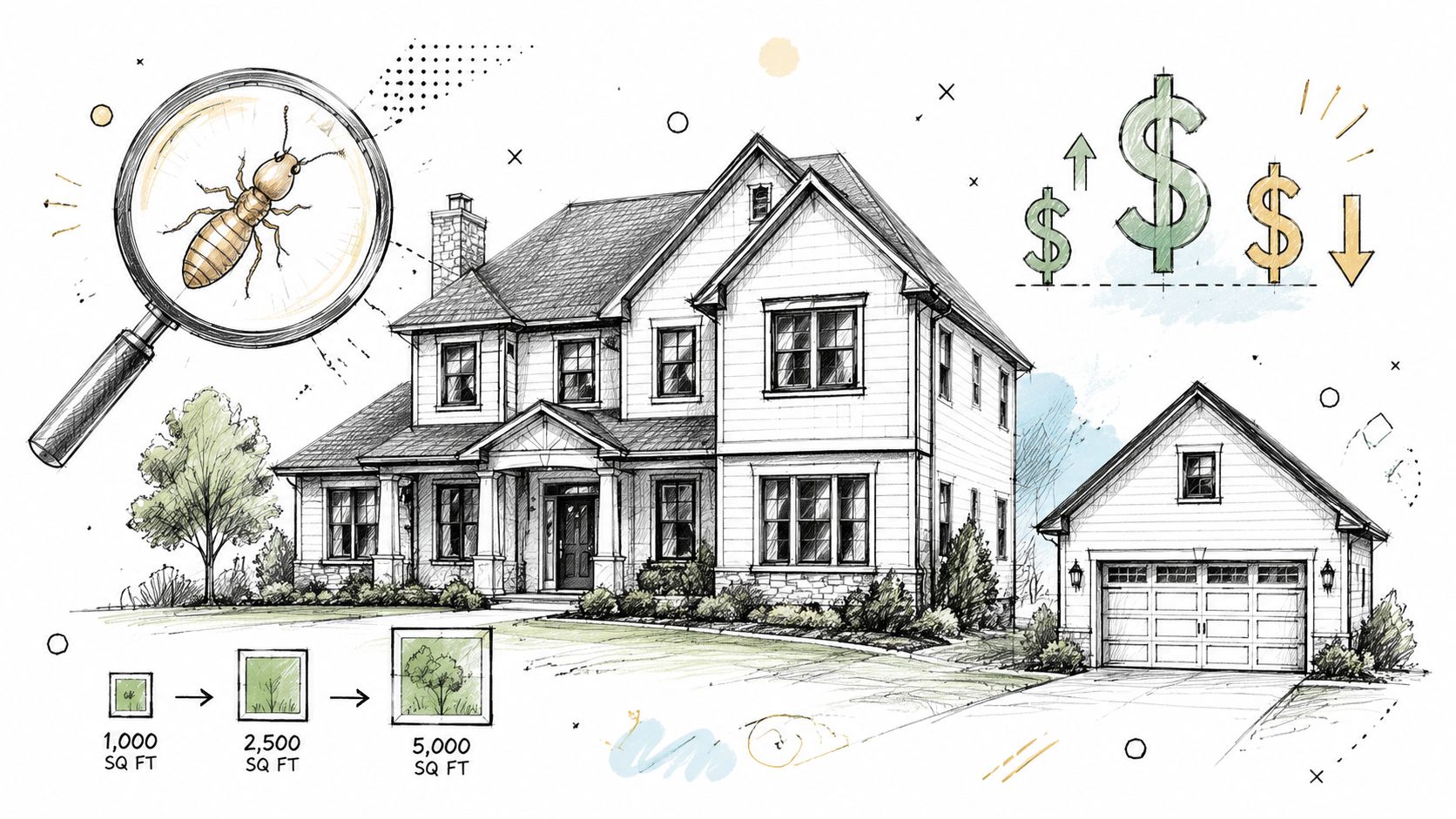
A compact home with straightforward access takes less inspection time than a large rural property with an attached garage, detached garage, barn, shop, shed, or guest house. Outbuildings also create a scope question. If the customer wants them inspected, the provider must include the additional travel through the property, access checks, and documentation.
Square footage isn't the only measurement that matters. A modest home with several detached structures can require more work than a larger, uncluttered house.
Foundation and access
Pier-and-beam foundations with tight crawlspaces can slow the inspection considerably. Slab homes create a different challenge when finished floors, built-in cabinets, or wall coverings limit visibility around plumbing penetrations and foundation edges. Attics, garages, decks, and blocked utility areas also affect what the inspector can see and document.
Magnolia-area crawlspace homes often land toward the higher end of a routine quote because subterranean termite evidence and moisture conditions may concentrate below the living space. The provider should identify inaccessible areas instead of implying that hidden construction was examined.
Report type and liability
A walk-through is generally the floor price. A T-47 WDI report or a broader WDO-style inspection adds documentation and responsibility. Consumer pricing guides commonly place inspections in the $75 to $300 range, with formal or bundled services reaching higher levels, as summarized by Rottler's termite inspection pricing guide.
Reinspection and travel
A treatment-plan reinspection may be included in an existing service agreement, while a standalone post-treatment clearance or warranty-transfer inspection is a separate service. Ask for that fee before treatment begins. Travel to outlying communities such as Pinehurst or Stagecoach can also affect a company's mobile minimum.
Pest businesses that combine inspection, treatment, and recurring services can learn from the guide to landscaping recurring income by Pipeline On, particularly its emphasis on defining what a recurring service includes.
A short video can help homeowners visualize why access and inspection conditions matter:
What the Inspector Actually Checks and Documents
A professional termite inspection should go beyond walking around the front elevation and glancing at the foundation. The inspector looks for visible evidence, conditions that invite activity, damage, and limitations that prevent a complete assessment. Those categories matter because a clean visual inspection doesn't guarantee that concealed framing is free of termites.
Inside a Magnolia home, the inspector may review baseboards, interior walls, window and door areas, plumbing penetrations, utility spaces, and accessible attic sections. Outside, the inspection commonly follows the foundation, porch steps, deck supports, fence contact points, wood piles, mulch beds, and locations where soil meets structural wood. Accessible garages, sheds, and other detached structures should be included only when the quoted scope covers them.
Moisture and evidence
Subterranean termites need dependable moisture, so the inspector pays close attention to leaks, poor drainage, damp crawlspaces, condensation, and wood touching soil. Depending on the provider and scope, the inspector may probe suspicious wood, tap trim, or use a moisture meter. Tools support the visual assessment, but they don't turn concealed construction into an open book.
Common observations include mud tubes, shed wings, frass, distorted wood, bubbling paint, hollow-sounding trim, and surface deterioration. The report should distinguish active evidence, old or previous evidence, and visible damage. Those findings aren't interchangeable, and treatment recommendations should explain the difference.
| Inspection Area | What the Inspector Evaluates | What Gets Documented |
|---|---|---|
| Foundation and soil line | Mud tubes, wood-to-soil contact, moisture, and access | Evidence, conducive conditions, and limitations |
| Interior rooms | Baseboards, walls, windows, doors, and plumbing areas | Visible activity, damage, and locations |
| Crawlspace or attic | Structural wood, moisture, ventilation, and accessibility | Areas inspected and spaces not accessible |
| Exterior structures | Porches, decks, garages, sheds, fences, and wood piles | Included structures, findings, and exclusions |
| Property diagram | Locations of evidence and conditions | Marked findings and recommendations |
A routine report generally provides findings and next steps. A Texas transaction WDI inspection uses the state-prescribed process and records the areas reviewed, evidence found, conducive conditions, and recommendations. It should also state what the inspector couldn't access. Homeowners who want a fuller explanation can review this complete guide to termite inspection.
For broader prevention advice, the prevent a pest infestation guide from Pinnacle Property Media provides useful property-maintenance context. The most valuable report isn't the one with the most alarming language. It's the one that shows where the evidence is, what remains uncertain, and what action fits the finding.
Sample Cost Scenarios for Magnolia Properties
A price becomes useful only after the purpose and property conditions are clear. A routine annual inspection for an average single-story Magnolia home generally falls around $75 to $150, a range also used for Texas planning in state termite guidance. That service commonly focuses on visible evidence, moisture concerns where warranted, and recommendations for treatment or prevention.
A real-estate report is a different purchase. The total often lands around $125 to $250, depending on whether the inspection fee, prescribed documentation, delivery, and transaction handling are included. Some companies advertise a free inspection, then charge separately for the report. Others put both items into one written price.
| Scenario | Typical Service | Estimated Total | What Can Change the Price |
|---|---|---|---|
| Routine annual inspection | Visual assessment, moisture review where warranted, findings, and recommendations | $75 to $150 | Home size, access, foundation, travel, and included structures |
| Real-estate WDI report | Inspection plus Texas-prescribed transaction documentation | $125 to $250 | Report format, lender requirements, delivery, outbuildings, and access |
| Post-treatment reinspection | Follow-up review to support clearance or closing documentation | $50 to $150 | Treatment product, contract terms, timing, and whether a new report is required |
| Complex Magnolia property | Larger rural home, pier-and-beam structure, outbuildings, or restricted access | $200 to $400 or more | Second visit, difficult crawlspace, commercial scope, and documentation burden |
The broader market supports the higher complex-property range. Inspection guidance places larger or difficult structures around $200 to $400 or more, while commercial quotes may reach $200 to $500 or more, as described in this termite inspection cost breakdown. Those figures shouldn't be applied automatically to an ordinary Magnolia house. They reflect the extra time and liability created by access, size, and scope.
Ask what the total includes
Before scheduling, request an itemized quote that answers these questions:
- Report content: Are diagrams, photographs, findings, and recommendations included?
- Delivery: Will the report go to the buyer, seller, title company, lender, or all requested parties?
- Follow-up: Is a reinspection included, discounted, or billed separately?
- Structures: Are detached garages, sheds, fences, barns, or guest houses covered?
- Administrative charges: Are there separate filing, electronic delivery, or transaction fees?
In Magnolia, the Texas-prescribed transaction report doesn't guarantee every structure on the property. Accessible primary dwellings or places of business are covered, while detached structures such as sheds, detached garages, fences, and guest houses are excluded unless specifically added, according to Magnolia termite service guidance.
Why the Cheapest Inspection Is Not Always the Best Deal
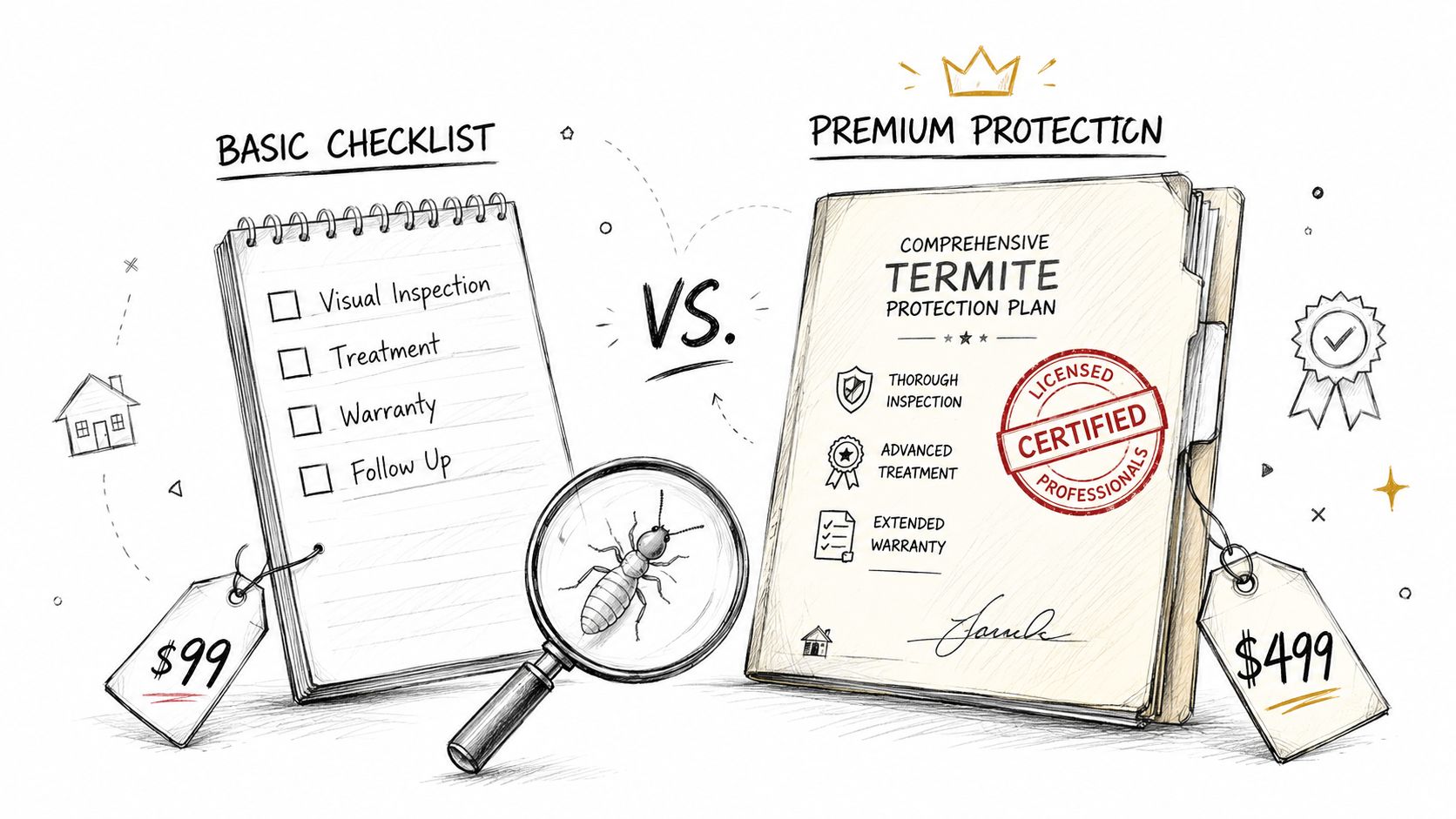
A free termite inspection can be perfectly legitimate when the company clearly explains the exchange. The provider may waive the inspection fee because it expects to propose treatment. The problem starts when “free” describes only the initial visit, while the homeowner later discovers separate charges for the WDI form, photographs, diagrams, electronic delivery, lender copies, or reinspection.
A cheap exterior-only check may also fail to answer the question a buyer is asking. If the inspector doesn't enter accessible interior rooms, plumbing areas, crawlspaces, attics, attached garages, decks, or included outbuildings, the customer should receive a clear limitation rather than a broad impression that the entire property was cleared.
Judge the process, not the sales pitch
A responsible inspector should show or describe the evidence, identify its location, and separate current activity from old damage or a condition that merely increases risk. Treatment may be appropriate, but a professional explanation should also identify when correction of moisture, removal of wood contact, monitoring, or additional access is reasonable.
Use this checklist while comparing quotes:
- Credentials: Who performs the inspection, and is the person properly licensed for the work?
- Scope: Which rooms, crawlspaces, attics, attached structures, and detached structures are included?
- Documentation: Is the deliverable a routine company report or a formal transaction WDI report?
- Limitations: Will inaccessible areas appear in writing?
- Follow-up: What does a reinspection cost, and what warranty or transfer terms apply?
- Treatment pressure: Can the provider explain the recommendation without demanding an immediate decision?
A higher fee isn't automatically evidence of a better inspection either. If the company can't explain its process, identify the report you'll receive, or give you the total follow-up cost, the premium may buy only a larger invoice.
Value test: The best quote makes the scope, qualifications, limitations, and total price understandable before the inspector arrives.
Getting an Accurate Quote in Magnolia and Southeast Texas
Start with three written quotes, but give each provider the same property information. Ask for pricing based on the square footage under roof, foundation type, attached garage, detached structures, inspection purpose, and whether a Texas Wood Destroying Insect Report is required.
Magnolia service-area questions should be specific. Tell the company whether the property is in Magnolia city limits or in a nearby community such as Pinehurst or Stagecoach. Local service pages commonly identify Magnolia with ZIP codes 77353, 77354, and 77355, as reflected in Magnolia-area termite service information. A property outside those areas may involve a different travel policy or mobile minimum.
Use the same quote checklist
- Describe the structure. Give the home's size, slab or pier-and-beam foundation, crawlspace access, attic access, garage details, and outbuildings.
- State the purpose. Say whether you're scheduling preventive maintenance, buying, selling, refinancing, transferring a warranty, or checking after treatment.
- Name the required document. Ask whether the lender, title company, or agent needs a Texas WDI report, and have the provider confirm the exact form.
- Verify credentials. Confirm the applicator's license through the Texas Department of Agriculture Structural Pest Control Service search before booking.
- Request the delivered total. Ask whether the quote includes on-site time, written findings, diagrams, photos, electronic delivery, travel, and administrative fees.
- Clarify follow-up. Get the reinspection timing and fee in writing, especially when a transaction depends on clearance after treatment.
Ask whether moisture meters, thermal imaging, or borescope tools are included or billed separately. Tools don't replace a careful visual inspection, but knowing what the technician will use helps you compare like with like.
You can also review this termite inspection cost guide before calling providers. It helps frame the difference between a routine inspection and a formal report, which is often the source of the biggest quote discrepancy.
FullScope Pest Control is one option serving north Houston and nearby Southeast Texas communities, with termite inspections, wood-destroying insect reports, monitoring, and treatment services among its offerings. Whether you choose that company or another licensed provider, compare the complete written scope rather than the advertised starting price.
Magnolia homeowners can request an itemized termite inspection quote from a licensed Texas pest professional today. Provide the property location, foundation type, square footage, outbuildings, and report purpose upfront, then ask for the total cost, exclusions, and reinspection terms in writing before scheduling.