1500+ reviews

A small pile of gritty debris beside a Magnolia baseboard can trigger an expensive question: is a carpenter ant excavating a nest, or is a termite consuming the house? Pale winged insects near a window create the same worry, especially after a warm spring rain. The insect matters, but the more useful question is what kind of wood damage and moisture condition you're looking at.
In Montgomery County homes, common discoveries include shed swarmers by a back door, fibrous frass below a bathroom baseboard, or a soft spot in a porch beam. A reliable diagnosis combines body shape, antennae, wing pattern, gallery construction, and debris, then connects those clues to the wood's location and moisture history.
What a Homeowner in Magnolia Just Found
A homeowner may notice the problem while sweeping the garage, checking a back porch, or opening a bathroom cabinet. The debris might look like coarse sawdust. The insects might be dark, pale, winged, or already dead on the windowsill. From a standing position, those clues can feel interchangeable, but they point to different service decisions.
Carpenter ants and termites are often confused because both can appear around wood and both produce winged reproductive insects. Their biology, however, is different. Carpenter ants excavate wood to create nesting galleries, while termites consume cellulose in wood as food, a distinction documented by University of California Integrated Pest Management guidance on carpenter ants.
A porch beam that feels soft may reflect moisture damage before any insect arrived. A bathroom baseboard with frass may indicate a nest in damp framing. Shed wings near a door may show a swarm event, but the wings alone won't tell you whether the colony is inside the structure, below the slab, or outside and attracted to light.
Practical rule: Treat the insect as a clue, not the entire diagnosis. The wood condition often explains why the pest is present and what must change for control to last.
Start with the three visible clues
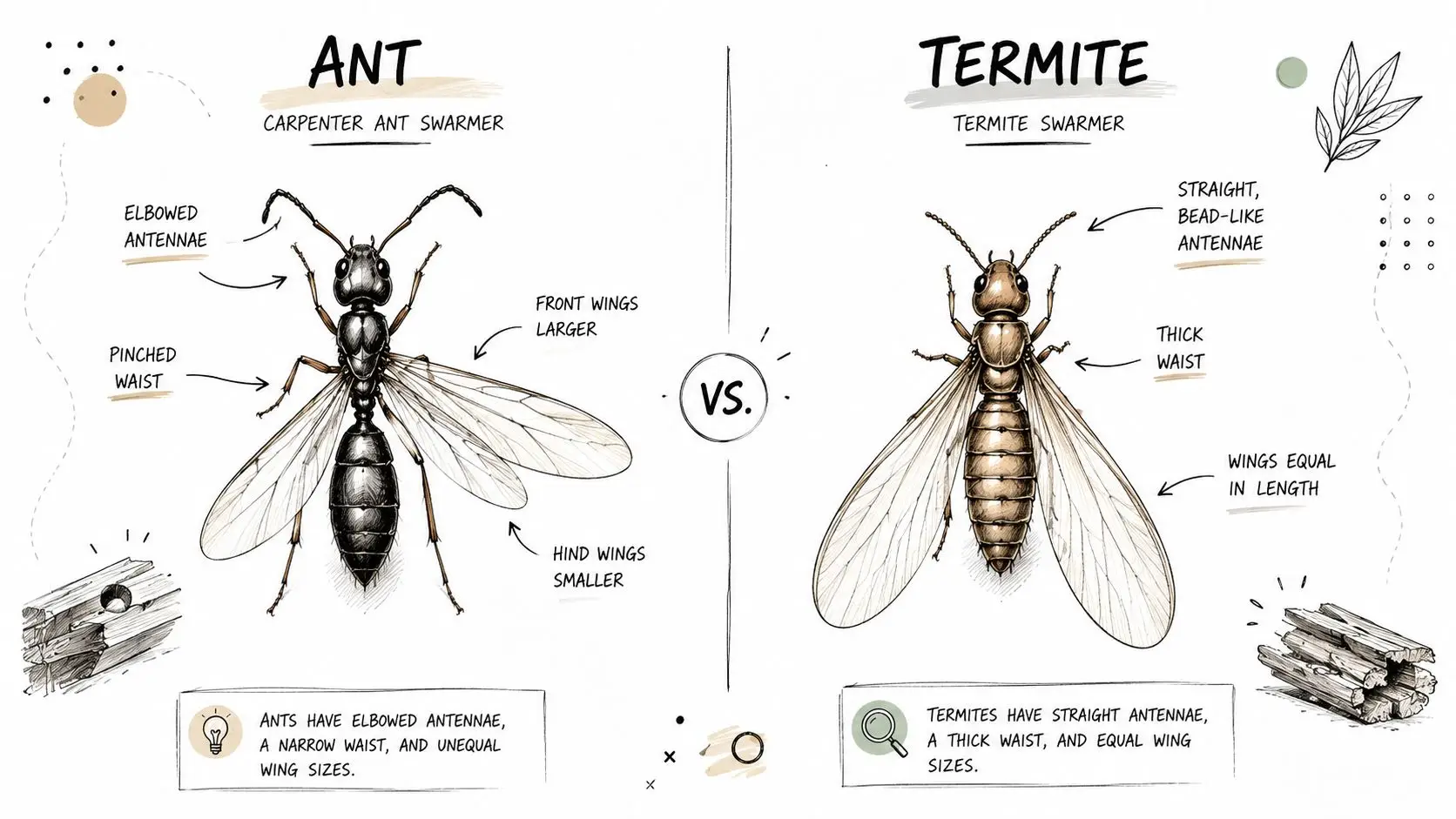
- Body structure: Carpenter ants have a narrow, pinched waist. Termites have a thicker body without that constriction.
- Antennae: Carpenter ant antennae are elbowed. Termite antennae are straight.
- Wings and debris: Ant swarmers have unequal wing lengths, while termite swarmers have two pairs that are about equal. Fibrous frass favors carpenter ants, while mud tubes and packed galleries favor subterranean termites.
A photograph can help narrow the possibilities, but it has limits. A crushed insect may hide the waist. A close-up may omit the wings, antennae, foundation, or moisture source that makes the difference. If the finding involves structural wood, preserve the evidence and arrange an inspection instead of relying on a quick visual guess.
Two Wood Pests, Two Very Different Habits
Carpenter ants are wood-nesting insects, not wood-eating insects. They excavate galleries in damp, softened, or decaying wood, often using a moisture-compromised joist, window header, soffit, porch component, tree, stump, or fence post as a nesting site. Their galleries are usually smooth and clean, and the colony pushes fibrous material out through small openings.
Termites use wood differently. Subterranean termites maintain a soil-connected colony and travel through protected mud tubes to reach structural timber. They consume cellulose and commonly hollow wood along the grain, which can leave serious thinning behind surfaces that still look intact. The University of Massachusetts comparison of termite and carpenter ant control describes this difference in both feeding behavior and gallery pattern.
| Trait | Carpenter Ant | Subterranean Termite |
|---|---|---|
| Relationship with wood | Excavates wood for nesting | Consumes cellulose as food |
| Typical gallery appearance | Smooth, clean galleries, often across the grain | Grain-following damage, often packed or lined with mud |
| Moisture relationship | Strongly associated with damp or decayed wood | Relies on moist soil and protected humidity |
| Common evidence | Coarse, fibrous frass near kick-out holes | Mud tubes, hollowed wood, or packed galleries |
| Body structure | Pinched waist and elbowed antennae | Thick body and straight antennae |
| Winged forms | Front wings longer than hind wings | Two wing pairs about equal in length |
Why the nesting location matters
A carpenter ant colony can occupy a moisture-damaged section of framing, while additional satellite nests may occur outdoors in trees, stumps, or fence posts. The visible ants may be foraging from a nest that isn't directly behind the baseboard.
Subterranean termites usually depend on a route between soil and wood. Foundation edges, crawl spaces, plumbing penetrations, porch connections, and other concealed transitions deserve attention because the colony may remain underground while workers feed inside the structure.
Drywood termites also occur in Texas coastal areas, but inland Southeast Texas homes more often require careful evaluation for subterranean activity and moisture-conducive conditions. The important distinction isn't colony size. It's whether the insect is using the wood as shelter or as a continuing food supply.
That biology explains the practical severity gap. Carpenter ants can create extensive tunnel networks, but their excavation is closely tied to nesting behavior and pre-existing wood deterioration. Termites can continue consuming sound cellulose, which raises a more direct concern about ongoing structural loss. Maryland's pest guidance on termites and ants also emphasizes that carpenter ants may signal hidden moisture intrusion rather than represent an isolated insect problem.
Reading the Body, Wings, and Antennae
Most homeowners don't find termite workers or carpenter ant workers during a swarm event. They find winged reproductives, shed wings, or a few dead insects near a window. That makes three physical checks especially useful.
Check the waist first
A carpenter ant has a distinct, narrow waist between the thorax and abdomen. It looks segmented and pinched, similar to the body plan people associate with ants. A termite has a broad, more uniform body with no obvious constriction.
Don't judge by color alone. Both groups can include dark or pale reproductive forms, and size can overlap. The waist is more dependable than a quick impression from across the room.
Inspect the antennae
Carpenter ant antennae are elbowed, with a visible bend near the head. Termite antennae are straight and bead-like. If the insect is intact, this feature can separate the two even when lighting makes the body color misleading.
Workers are harder to use for this comparison because termite workers are usually hidden and wingless. Carpenter ant workers may forage indoors, but a homeowner is more likely to notice swarmers during a seasonal emergence. The Colorado State University field guidance on carpenter ants identifies antennae, waist shape, and wing proportions as key markers.
Compare the wing pairs
Termite swarmers have two pairs of wings that are about equal in length. They often shed them, so equal-length wings collected in a pile near a sill or doorway deserve attention. Carpenter ant swarmers have longer front wings than hind wings and may retain them longer before shedding them individually.
If you find a specimen, place it in a sealed jar with rubbing alcohol. A clear piece of tape can preserve a small insect when a jar isn't available, and a photograph with a coin beside the insect can show relative scale. Avoid crushing the sample because flattening can destroy the waist and wing-length clues.
For more visual examples of the distinction, see this guide to winged termites and winged ants. A photo can support triage, but a licensed inspection is the safer choice when insects appear repeatedly indoors or when wood damage is visible.
What the Wood and the Debris Are Telling You
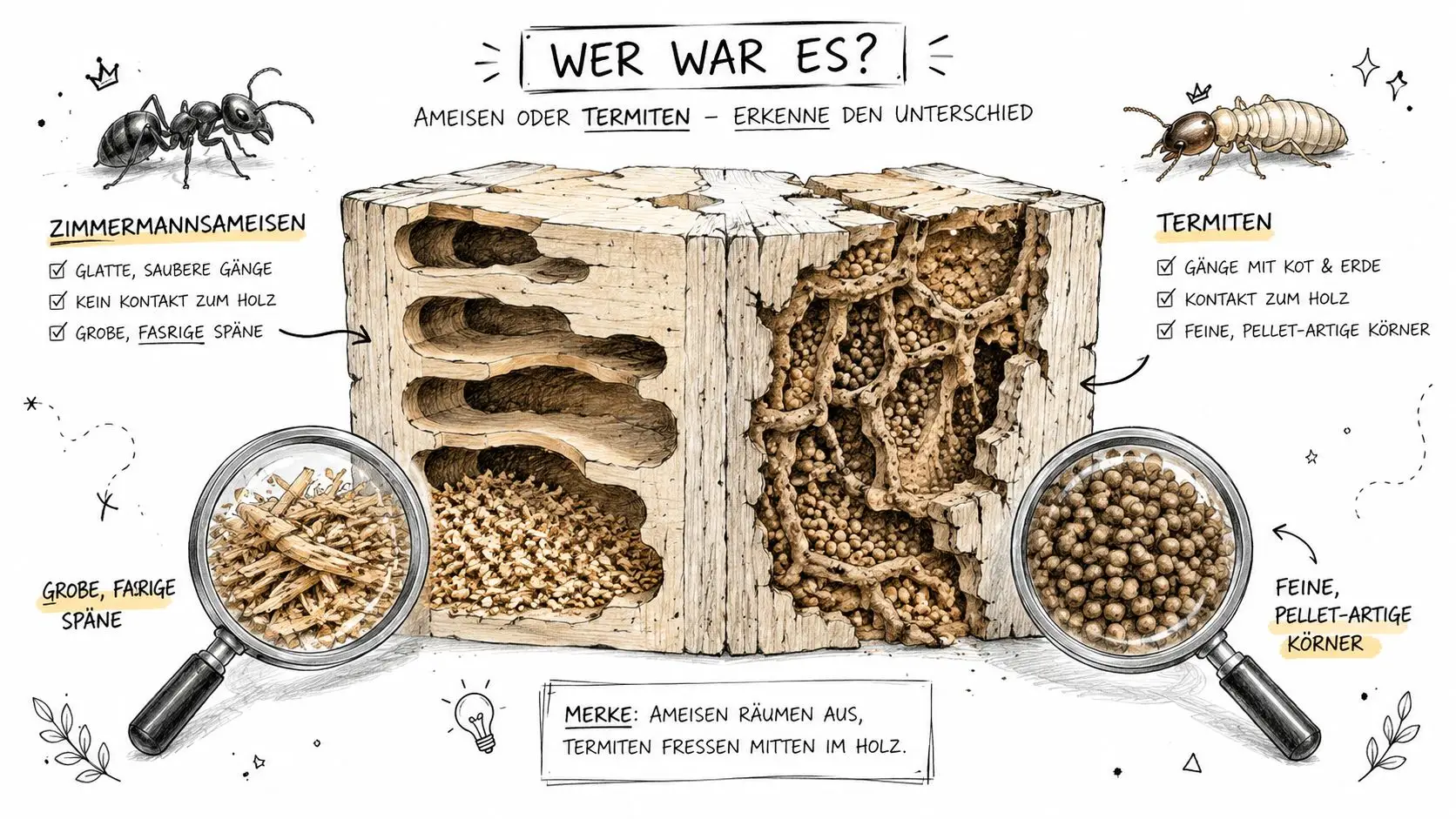
Once the insect is gone, the wood often preserves the better evidence. Carpenter ant galleries tend to be smooth and clean, sometimes cutting across the grain. The excavated material can look like coarse, fibrous sawdust, often mixed with dead insects or body fragments and pushed through small kick-out openings.
Termite damage follows a different logic. Subterranean termites commonly create mud-covered travel routes along foundations, joists, or other protected surfaces. Their galleries may be thin, papery, and packed with dried mud, while the wood is hollowed along the grain. This pattern reflects feeding and shelter behavior, not simple nest excavation.
Match the debris to the location
A frass pile below a damp bathroom wall suggests a different investigation from mud tubes on a foundation. Examine the surrounding material before sweeping it away.
- Coarse fibrous frass: More consistent with carpenter ant excavation, particularly when it collects beneath a small opening.
- Mud tubes: Strong evidence of subterranean termite movement when found along the foundation, crawl-space supports, or structural transitions.
- Packed galleries: More consistent with termite activity than the smooth, open galleries associated with carpenter ants.
- Hard, sand-like pellets: Can indicate drywood termite fecal material beneath infested wood.
The surrounding moisture context matters just as much. Dry interior framing, damp subfloor lumber, weathered exterior trim, and a leaking bath wall create different diagnostic scenarios. UC Agriculture and Natural Resources' carpenter ant pest note cautions against oversimplifying the diagnosis from a single visual clue and supports specimen collection or licensed inspection when the distinction affects treatment.
The following video can help homeowners understand the visual difference, but it shouldn't replace an inspection of concealed framing.
If you find a tube, don't scrape it away before documenting its location and condition. Photograph the tube, the adjacent wood, and any moisture source. Guidance on what to do after spotting a termite mud tube can help you preserve the evidence for the technician.
Why Southeast Texas Humidity Changes Both Problems
Magnolia homes don't experience carpenter ant and termite pressure in a dry, isolated environment. Moisture can enter through roof leaks, plumbing penetrations, poor drainage, crawl-space ventilation, bath exhaust problems, or weathered exterior assemblies. Once wood stays damp, carpenter ants gain easier nesting material and termites gain a protected route into cellulose.
Carpenter ants are particularly useful as a building-condition warning. They often excavate wood that has already been weakened by moisture or decay, including framing near bathrooms and kitchens, window headers, soffits, and porch components. Their presence may mean the nest needs treatment, but it may also mean the roof, flashing, plumbing, or drainage needs repair.
Local conditions change the inspection
Subterranean termites depend on soil contact and sustained humidity. In Magnolia and nearby communities such as The Woodlands, Tomball, and Conroe, inspectors pay close attention to slab edges, pier-and-beam vents, plumbing penetrations, porch connections, and other areas where damp soil or concealed moisture can meet wood.
Spring rain can make swarming more noticeable, but visible swarmers aren't the only measure of risk. A quiet crawl space with damp subfloor lumber may deserve more attention than a single insect found beside an exterior light. The Magnolia ZIP-code directory identifies Magnolia service locations under 77353, 77354, and 77355, with each listed in Montgomery County.
The commercial and structural issue is coexistence. One structure can have carpenter ants exploiting a wet wall cavity while subterranean termites use a separate soil-to-wood route. A technician who only sprays visible ants may miss the leak. A technician who only looks for mud tubes may miss the carpenter ant nest and the decayed framing supporting it.
Moisture changes the treatment equation: Removing the insect without correcting the wet wood leaves the property prepared for another infestation.
A useful report should therefore connect three observations: what insect was identified, what pattern the wood shows, and why the wood became suitable. That connection produces a more durable plan than a generic perimeter application applied without examining the structure.
Treatment Paths for Carpenter Ants and Termites
When evidence points to carpenter ants, the treatment path starts with the parent colony and the moisture condition that supports it. In a Magnolia attic or crawl space, that usually means tracing where the insects are working, then checking the wood around a leak, condensation line, or decayed board. A porch spray may knock down a few foragers, but it will not solve the nest if the colony sits in a tree, wall void, or other hidden site.
Carpenter ant control starts with the building
The first correction may involve replacing decayed framing, sealing a roof or plumbing leak, improving crawl-space or attic ventilation, or trimming vegetation away from siding. After that, the technician follows the foraging trail and looks for the parent colony, which may be outdoors in a tree, stump, fence post, or another exterior feature.
Targeted options can include bait stations, dust formulations in suitable voids, or a non-repellent perimeter application. The method depends on nest location, access, construction, occupants, and whether damaged wood must be removed. Practical guidance on how to get rid of carpenter ants can help connect the treatment to the condition that drew them in.
Termite treatment requires a defined protection plan
Subterranean termite work may use an in-ground liquid barrier, a bait-station monitoring and feeding program, or a combination. Trenching and treating soil, drilling where appropriate, and documenting inaccessible areas call for a written scope, not an improvised spray. A Texas Wood-Destroying Insect inspection report can establish findings and conducive conditions before a contract is signed.
Drywood termite treatment is different again. Depending on accessibility and distribution, options may include whole-structure fumigation, localized heat or gas treatment, or spot applications. The correct path depends on confirmed species and the extent of the infestation.
| Pest | Primary Treatment | Moisture Correction Needed? | Typical Residential Cost Range |
|---|---|---|---|
| Carpenter ant | Locate the colony, use targeted bait, dust, or perimeter treatment, and replace compromised wood | Usually, especially where damp or decayed wood is present | Obtain a written local estimate |
| Subterranean termite | Soil-applied liquid barrier, bait monitoring, or a combined program | Yes, where drainage, leaks, or damp access points support activity | Obtain a written local estimate |
| Drywood termite | Localized treatment or whole-structure approach based on distribution | Helpful for building preservation, though the pest is associated with infested wood | Obtain a written local estimate |
The brief does not provide verified Magnolia price data, so quoting a dollar range here would create false precision. Treatment price varies with construction, access, infestation location, and warranty terms. Ask for an inspection report, treatment map, product information, retreatment terms, and a clear list of exclusions before authorizing work.
FullScope Pest Control is one local option offering termite protection, wood-destroying insect inspections, carpenter ant services, and targeted pest management across Southeast Texas. Compare its written scope with other licensed providers rather than choosing from a verbal price alone.
Next Steps for Magnolia and the Surrounding Service Area
Start by preserving the evidence. Put an intact insect in a sealed jar with rubbing alcohol, or secure a specimen with clear tape. Photograph the insect, the debris, the damaged wood, and the nearest possible moisture source. Note leaks, condensation, damp soil, overflowing gutters, or plumbing fixtures within the surrounding area.
Use the right type of appointment
If swarmers appeared indoors, recurring insects are present, or wood feels hollow or soft, request a Wood-Destroying Insect inspection report from a licensed Texas structural pest control applicator. A WDI inspection is a documented evaluation for wood-destroying organisms and conducive conditions. It isn't the same as a general pest visit designed to treat visible activity.
A Magnolia-area inspection generally examines accessible attic areas, crawl spaces, the perimeter, garage, porches, and adjacent wood structures. It can't evaluate concrete slab penetrations hidden beneath flooring or areas blocked by stored belongings. Clear access improves the inspection and gives the technician a better chance of connecting insect evidence with the building condition.
The service area should be described precisely. 77354 is Magnolia's primary ZIP code, according to the Texas city directory listing for Magnolia. A separate ZIP reference distinguishes 77354 and 77355 as standard delivery ZIP codes and identifies 77353 as a PO Box ZIP, a useful distinction when planning visits to physical addresses. Parts of 77354 also border Pinehurst, The Woodlands, and Tomball, as noted by this Magnolia-area ZIP boundary reference.
| Service | Typical Magnolia Cost | Covers | When to Choose |
|---|---|---|---|
| WDI inspection and report | Request a licensed local quote | Accessible wood, attic, crawl space, perimeter, garage, and visible conducive conditions | Swarmers, suspected termite evidence, a property sale, or visible wood damage |
| General pest inspection | Request a licensed local quote | Broader pest activity and accessible harborage conditions | You see ants or seasonal invaders without clear structural evidence |
| Carpenter ant treatment | Request a written treatment estimate | Nest tracing, targeted treatment, and moisture recommendations | Frass, smooth galleries, or ants associated with damp wood |
| Termite treatment | Request a written treatment estimate | Species-specific barrier, bait, or localized plan | Mud tubes, termite swarmers, packed galleries, or confirmed feeding |
| Follow-up protection | Review the proposed service schedule | Monitoring, retreatment terms, and condition checks | The property has recurring moisture or termite exposure |
For ongoing property marketing and contractor visibility, a resource such as find local SEO for contractors can help service businesses explain their coverage and inspection options clearly. For homeowners, the practical priority remains simpler: choose a provider that documents what it found, where it found it, and what the proposed treatment won't cover.
Maintain gutters and downspouts before spring rains, monitor crawl-space humidity with a dehumidifier, correct leaks promptly, and keep wood away from soil contact. Schedule a yearly WDI inspection when the property has a history of wood-destroying insect activity or persistent moisture. If you find fresh frass, mud tubes, shed wings, or a soft structural member, don't sweep away the evidence and wait. Contact a licensed Magnolia-area inspector, request a written diagnosis, and approve treatment only after the moisture and wood conditions are included in the plan.
If you've found winged insects, frass, mud tubes, or questionable wood around a Magnolia property, contact a licensed Southeast Texas pest professional for a documented inspection. Share the ZIP code, the location of the evidence, and any moisture history so the technician can determine whether you need carpenter ant nest tracing, a termite WDI report, or both.