1500+ reviews

You're standing at the kitchen sink in a Magnolia home, wiping up the same trail again, and the bugs are still there by dinner. They're small enough to make you second-guess yourself, fast enough to disappear into a crack, and annoying enough that every crumb, pet bowl, and damp baseboard suddenly feels suspicious. In Southeast Texas, that's usually the moment homeowners start calling everything “ants,” even when the actual problem might be a baby termite, a moisture-driven trail, or one of several tiny ant like bugs that look similar until you check the right details.
What matters first is not the color. It's whether you're dealing with a true ant, a look-alike, or a sign of a bigger issue hiding in the wall or crawlspace. Magnolia homes give these pests plenty of cover, from humid slab edges and AC condensate to pantry corners and pet-food stations, so a quick guess based on size alone usually leads to the wrong treatment and more repeat visits. The good news is that a magnifier, a few minutes of observation, and a little local context will narrow the field fast.
What Counts as a Tiny Ant Like Bug
A Magnolia homeowner spots a pinhead-sized line near the sink, along a pantry baseboard, or by a pet bowl, wipes it away, and sees it again by evening. That call is familiar in north Houston because warm weather, indoor moisture, and small gaps around slab edges, utility runs, and crawlspace access give tiny insects plenty of ways in.
A working definition for Magnolia homes
For field work, tiny ant like bugs means insects small enough to get lumped together at a glance, often under 5 mm long, where body shape matters more than color. True ants are one of the most abundant animal groups on Earth, with a 2022 synthesis estimating about 20 quadrillion ants worldwide and roughly 2.5 million ants per person (PubMed synthesis). That scale helps explain why ants show up so often, but it also explains why the kitchen trail can feel nonstop instead of occasional.
In the U.S., ants are widespread enough that homeowners run into them regularly, yet only a small share of species commonly invade houses (National Geographic ant facts). In Magnolia, that usually means the bug on the counter is more likely to be one of a few indoor specialists than some odd one-off from outdoors.
Practical rule: if the insects are tiny, persistent, and follow a line to moisture or food, treat the problem as an identification job first, not a spraying job.
Why local homes keep seeing them
Magnolia sits in the north Houston service area, where warm stretches last long and indoor pests can keep foraging well past the point many homeowners expect. A clean kitchen does not automatically end the trail, because the colony may be feeding from a hidden moisture source, a pantry gap, or a wall void, not just a crumb on the floor. That is why the same line can keep coming back even after vacuuming and wiping.
The better question is simple. What am I looking at? Once that is answered, the response gets much more precise, and the wrong treatment path is easier to avoid.
The Magnifier Test That Tells Ants from Impostors
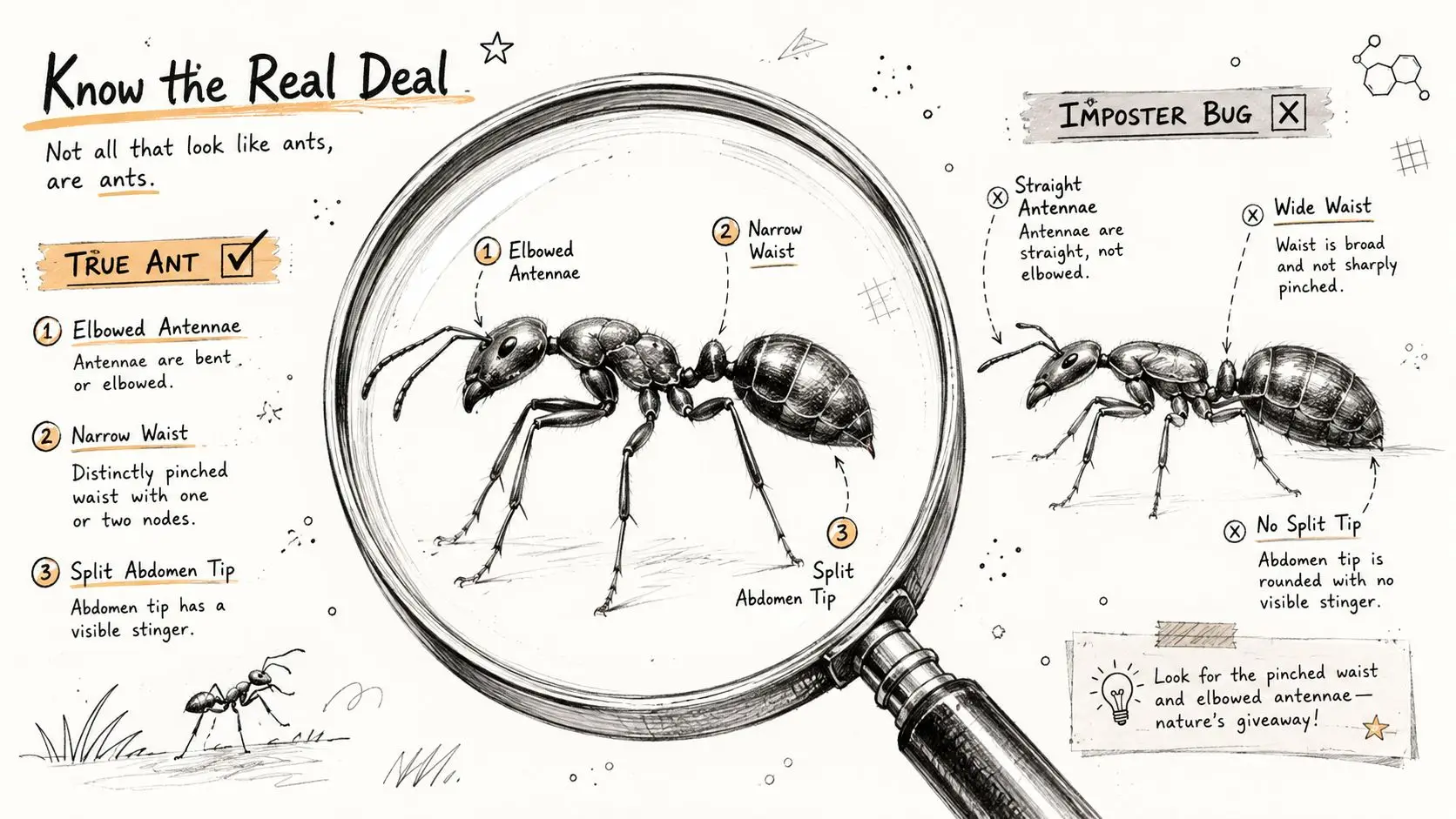
The quickest DIY ID check is simple. Put a 10x loupe or smartphone magnifier over the insect, then look at the waist and the antennae. Those two features usually tell you more than the color ever will, and that matters because tiny ants, termites, and ant mimics can all look “just brown” or “just black” from standing height.
What a true ant looks like
A true ant has a sharply constricted petiole, or waist, between the thorax and abdomen, and the antennae are elbowed rather than straight (field identification reference). Some ants have one petiole node, others have two, but both still show that narrow waist. Six legs attach to the mesosoma, which helps separate them from insects that only look ant-like at first glance.
Under magnification, that waist is the giveaway. The body narrows like a little hourglass, then opens again into the abdomen. If the antennae bend sharply at the base, you're probably looking at an ant, not a termite.
What a termite impostor looks like
Baby termites and other mimics usually show a broad waist and antennae that look more straight or bead-like. That difference matters because termites are not just nuisance insects, they can be tied to structural risk. If the insect has no pinched waist and the antennae don't elbow, don't assume it's a harmless ant because the body is tiny.
A quick photo helps later. Hold the camera low, turn on the flash if the insect is in shade, and try to capture the side view where the waist shows best. A clean profile shot beats a blurry close-up every time.
How to use the result
If the bug has the classic ant waist, move to species clues. If it doesn't, shift immediately to termite-risk thinking and inspect nearby wood, drywall edges, and baseboards. One narrow body part can save you from choosing the wrong treatment path.
The Six Tiny Pests You Are Most Likely Seeing
Most Magnolia calls fall into a short list. These insects overlap in size, but their colors, habits, and nest locations are different enough that a careful look usually narrows the field fast. That's also why a casual spray can miss the colony while the trail keeps rebuilding itself somewhere else.
| Species | Size | Color | Key Feature | Where You See Them |
|---|---|---|---|---|
| Pharaoh ant | 1.5 to 2 mm | Light yellow to reddish-brown | Very small workers, often in indoor trails | Kitchens, bathrooms, wall voids |
| Little black ant | About 1.5 to 2 mm | Glossy black | 12-segmented antennae with a three-segment club | Baseboards, counters, cracks |
| Ghost ant | About 1.5 mm | Pale body with translucent legs and abdomen | Nearly invisible on light surfaces | Countertops, sinks, potted plants |
| Thief ant | Very small, often mistaken for other tiny ants | Yellowish, greasy-looking | Often confused with juvenile ants | Cracks near food and moisture |
| Odorous house ant | Small indoor ant, often in trails after rain | Brown to black | Crushed odor often compared to coconut | Kitchens, sinks, moisture zones |
| Baby termite | Tiny immature termite | Pale, soft-bodied | Broad waist, straight-looking antennae | Wood, framing, baseboards |
Pharaoh ants and little black ants
Pharaoh ants are typically only 1.5 to 2 mm long and can be light yellow to reddish-brown (bugman identification guide). They love hidden indoor spaces and can turn up near sinks, cabinets, and wall voids. Little black ants are about 1.5 to 2 mm as well, usually glossy black, and commonly show up in kitchen edges and baseboards (Little Black Ants).
Ghost ants and thief ants
Ghost ants are around 1.5 mm long, with pale translucent legs and abdomens that make them disappear on light countertops. Thief ants are tiny, often greasy-looking, and commonly mistaken for small juvenile ants even though they're adults. In practice, those two are the kind people miss until the trail gets regular.
If you're comparing tiny pests on indoor plants as well as inside the home, the visual breakdown in Leaves & Soul pest guide can help you separate plant pests from true kitchen invaders without assuming every moving speck is the same species.
Odorous house ants and baby termites
Odorous house ants often show up after weather changes and can be recognized when crushed by a faint smell people describe as coconut-like. Baby termites are the one to take most seriously. They're not just another tiny ant-like bug, because their presence points toward wood and structure, not just crumbs and sugar.
A quick comparison for the field
Trails near moisture usually suggest ant activity first. Wood contact, mud tubes, or hollow-sounding trim pushes the thought process toward termites. In Magnolia homes, that distinction changes the whole response.
Warning Signs Beyond the Visible Bug
The insect on the counter is only part of the story. The house itself usually gives away more than the bug does, especially when the colony is established in a wall void, under a slab edge, or near a damp utility line. I pay close attention to the evidence homeowners usually ignore, because that evidence tells you whether you're dealing with a scout, a nesting colony, or something structural.
Look for more than a trail
Frass that resembles fine sawdust is a different warning from a line of live insects. So are swarmers near windows, which can indicate a more mature colony nearby. If you see mud tubes along the foundation, that's not an ant issue, that's termite behavior and it changes the inspection immediately.
Moisture is the other major clue. Sweating pipes, AC condensate pans, damp subflooring, and entry points near crawlspaces can keep a trail active long after the kitchen is wiped down. A tiny gap with a steady water source can support a colony better than a pantry full of food.
If the trail keeps returning to the same damp corner, the corner is part of the problem.
Use a short observation window
A 24 to 48 hour check is more useful than one frantic hour of cleaning. Watch whether the line fades after wiping or rebuilds at the same spot, and note whether the insects shift from one food source to another. That behavior often tells you more than the color does.
You can also set out an index card with a tiny dab of honey on one edge and a little tuna on the other. If the ants favor one bait consistently, that preference can hint at whether the colony is hunting sweets or protein, which helps narrow the likely species before treatment starts.
Read the pattern, not just the bug
Seasonal scouts come and go. An established colony keeps sending workers back, especially when a hidden nest is feeding in wall spaces or damp wood. That's why repeated trails after cleaning should be treated as evidence, not as a housekeeping failure.
Health and Structural Risks by Species
Not every tiny ant like bug carries the same consequence. Some are mostly a contamination nuisance, while others can be tied to structural damage that homeowners don't notice until the repair bill is much worse. The practical job is to separate the kitchen problem from the wood problem before the wrong remedy wastes time.
Contamination risks are real, but different from termites
Pharaoh ants are a concern in kitchens, hospitals, and food-handling settings because they can move through sanitary and unsanitary areas and end up on prep surfaces. Thief ants are especially frustrating because they can invade sealed food packages and contaminate what they chew through. Odorous house ants are usually more of a nuisance, but large numbers can still foul pantries and counters.
The main issue with these indoor ants is contamination, not structural damage. That's why the response should focus on trail control, exclusion, and baiting rather than blanketing the room with spray. For broader pest behavior around tree and environmental stress, manage eucalyptus tree problems is a helpful example of how outdoor conditions can influence insect pressure near structures, even though the pest category is different.
Baby termites are the serious look-alike
A baby termite is not just another tiny pale insect. It can signal an active colony feeding on wood, sometimes for a long time before swarmers appear. That's a structural-risk problem, not a food-contamination problem, and the inspection needs to move toward framing, trim, and hidden moisture paths instead of pantry cleanup.
Ant risk and termite risk are managed differently for a reason. Ants are usually handled by disrupting movement and eliminating what supports the trail. Termites require an evaluation of the structure itself.
One rule that keeps people out of trouble
If the bug has an ant waist and you're seeing it in the kitchen, treat it like an ant problem. If it doesn't, or if you're seeing wood damage signs, don't keep guessing. The wrong assumption costs time, and time is what hidden colonies use to spread.
Realistic DIY Steps for Magnolia Homeowners
DIY work helps when it's organized. Random spraying usually just scatters the problem, and in some cases it makes baiting less effective because the foragers never get a chance to carry anything back to the colony. The better approach is slower at the start and more effective by the end.
Start with observation, not chemicals
Give the trail 48 hours of observation if you can. Confirm the waist and antennae with the magnifier test, then wipe the route so you can see where it returns. Clean the pheromone trail, not just the visible insects, because the line often follows a chemical map left by the workers.
Seal the easy entry points
Caulk pipe penetrations, weather-strip thresholds, repair torn screens, and fix moisture problems around sinks and AC lines. The state guidance from the Illinois Department of Public Health stresses exclusion, entry-point control, and moisture management as central parts of ant control, and it also notes that reducing available food can make ants more likely to accept baits (Illinois ant guidance). In Magnolia, that moisture piece matters as much as the crumbs.
Use baits, not broad spray
Place gel or station baits labeled for the suspect species where the trail runs. Foragers have to carry the bait back to the colony, which is the whole point. Aerosol sprays often kill the workers you can see and leave the nest untouched.
For homeowners comparing DIY options, this practical breakdown on DIY ant killer and what will and won't work is useful because it separates quick contact kills from colony-level control.
Check whether the problem is winning
If the trail comes back at full strength in five to seven days, the colony is likely established and the DIY plan has reached its limit. At that point, more spray rarely changes the outcome. Sticky monitoring along known routes can show whether the pressure is shrinking or resetting after each cleanup.
When DIY Stops Working and FullScope Steps In
Some signs are too expensive to ignore. Termite swarmers or mud tubes indoors need a licensed inspection, not another round of kitchen bait. The same goes for trails that survive cleaning and baiting for more than two weeks, because by then you're no longer chasing a stray scout. You're dealing with an active source.
Where professional help becomes the practical choice
Food-handling businesses face a different standard altogether. If tiny ant-like insects show up in a prep area, the issue becomes compliance as much as nuisance. Pharaoh ants in healthcare or child-care settings are especially hard to dismiss because their small size and hidden nesting make them persistent.
That's where a local technician brings something a homeowner can't easily replicate, a structured inspection of entry points, moisture zones, voids, and the exterior pressure around the home. In north Houston, FullScope Pest Control works out of Cleveland, Kingwood, Conroe, and Porter, and serves Magnolia as part of the broader regional coverage. The company describes options that include one-time remediation, quarterly or biannual plans, termite inspections with WDI reports, and MistAway automatic misting systems for yard comfort.

Why integrated pest management beats spray-only service
A spray-only approach often treats the symptom in front of you. Integrated pest management looks for the colony, the food source, and the environmental condition that keeps the trail alive. That difference is why some Magnolia homes stay quiet after one treatment while others keep reliving the same issue.
The same logic applies outdoors. When external pressure is feeding repeated indoor activity, a technician may need to inspect more than the kitchen. For homeowners who want a broader decision guide, anti DIY guide when it's time to call in pest control professionals is a straightforward reference point for judging when the problem has crossed the line.
A local note for Magnolia homeowners
Magnolia, Texas sits in southwest Montgomery County and falls within the Houston-The Woodlands-Sugar Land metro area, so service availability often needs to account for both neighborhood-level issues and broader north Houston conditions. That's why a technician who understands local humidity, slab construction, and seasonal pressure can usually shorten the back-and-forth.
The same practical lens shows up in property services too. If you're weighing exterior spray or tree-related pressure around the home, R.E. and Sons Prescott spray shows how outdoor management can complement, not replace, indoor pest control.
Your 24-Hour Action Plan for Magnolia
Three-question rule: Are you seeing more than one species, is the trail still there after a 48-hour clean, and is there any sign of wood damage? If the answer is yes to any of those, stop guessing and move to inspection.
- Confirm the insect with the magnifier test, paying attention to the waist and antennae.
- Photograph the trail from the side and from overhead before wiping anything.
- Deep clean the route to remove pheromone residue, then watch whether it rebuilds.
- Seal obvious entry points around pipes, thresholds, and torn screens.
- Fix moisture problems under sinks, near AC drains, and around damp subfloor areas.
- Place labeled bait where the trail is active, not where it's convenient.
- Call a pro fast if you see mud tubes, swarmers, recurring trails, or indoor activity in a food business or care setting.
Tiny ant like bugs in Magnolia are manageable when you treat them like a biology problem, not a housekeeping failure. If the trail keeps coming back, or if the insect doesn't match a true ant under magnification, it's time to get a local inspection instead of another can of spray. Schedule a visit through FullScope's residential pest control in Magnolia, TX and get the identification, exclusion, and treatment plan handled before the next trail reappears.