1500+ reviews

A restaurant can serve excellent food and still fail at the most basic test of operation if pests get established. A staggering 90% of all pest infestations in the food industry occur within commercial facilities, with restaurants and food service establishments being the primary hotspots, according to a National Pest Management Association analysis referenced in the verified data above. That should change how you think about pest control. This isn't a side task for the closing crew. It's part of food safety, brand protection, and daily operating discipline.
New operators often treat pest issues like a cleaning problem. They aren't. They're a systems problem. Pests show up where receiving is loose, drains are neglected, doors don't seal, trash handling slips, and staff don't report early signs. Once that pattern starts, a bad week can turn into failed inspections, upset customers, contaminated product, and a reputation hit that takes far longer to fix than the infestation itself.
Food service pest control works when you stop chasing pests and start controlling the conditions that let them survive. That means tighter exclusion, smarter sanitation, cleaner receiving practices, documented monitoring, and a licensed professional who understands food service compliance.
Why Pest Control Is Your Most Important Ingredient
If you own or manage a restaurant, pest control belongs in the same category as handwashing, refrigeration, and temperature logs. It affects whether you stay open.
The hard truth is simple. Pests don't care how good your menu is. They care about grease under equipment, moisture around drains, gaps under doors, cardboard piled in dry storage, and deliveries that arrive carrying a problem you didn't create. In food service, those conditions show up fast because kitchens run hot, wet, and busy.
What operators get wrong
Many owners think pest control starts when someone sees a roach or a mouse. By then, you've already missed the early warning stage. Good food service pest control starts before the first visible pest. It starts with how the building is sealed, how the dish area is cleaned, how trash leaves the building, and how incoming shipments are checked before they cross into storage.
The other mistake is assuming this is a janitorial issue. Sanitation matters, but a spotless line won't save you if a receiving clerk wheels in infested cardboard or a back door sits with daylight under it every night.
Practical rule: If a pest can eat, drink, hide, or enter, your operation has given it a reason to stay.
What's actually at risk
The risk isn't limited to nuisance sightings. A pest issue in food service can trigger:
- Health code trouble: Inspectors look for signs of active pest activity and conditions that support it.
- Food contamination: Pests move through trash, drains, wall voids, and food areas without respect for your prep zones.
- Brand damage: One customer photo can undo months of marketing.
- Operational disruption: Staff lose time, product may need to be discarded, and management gets pulled into crisis mode.
Operators who stay ahead of pest pressure don't rely on luck. They build routines that remove hiding places, tighten entry points, and catch trouble at receiving before it spreads inside.
Understanding the Integrated Pest Management Framework
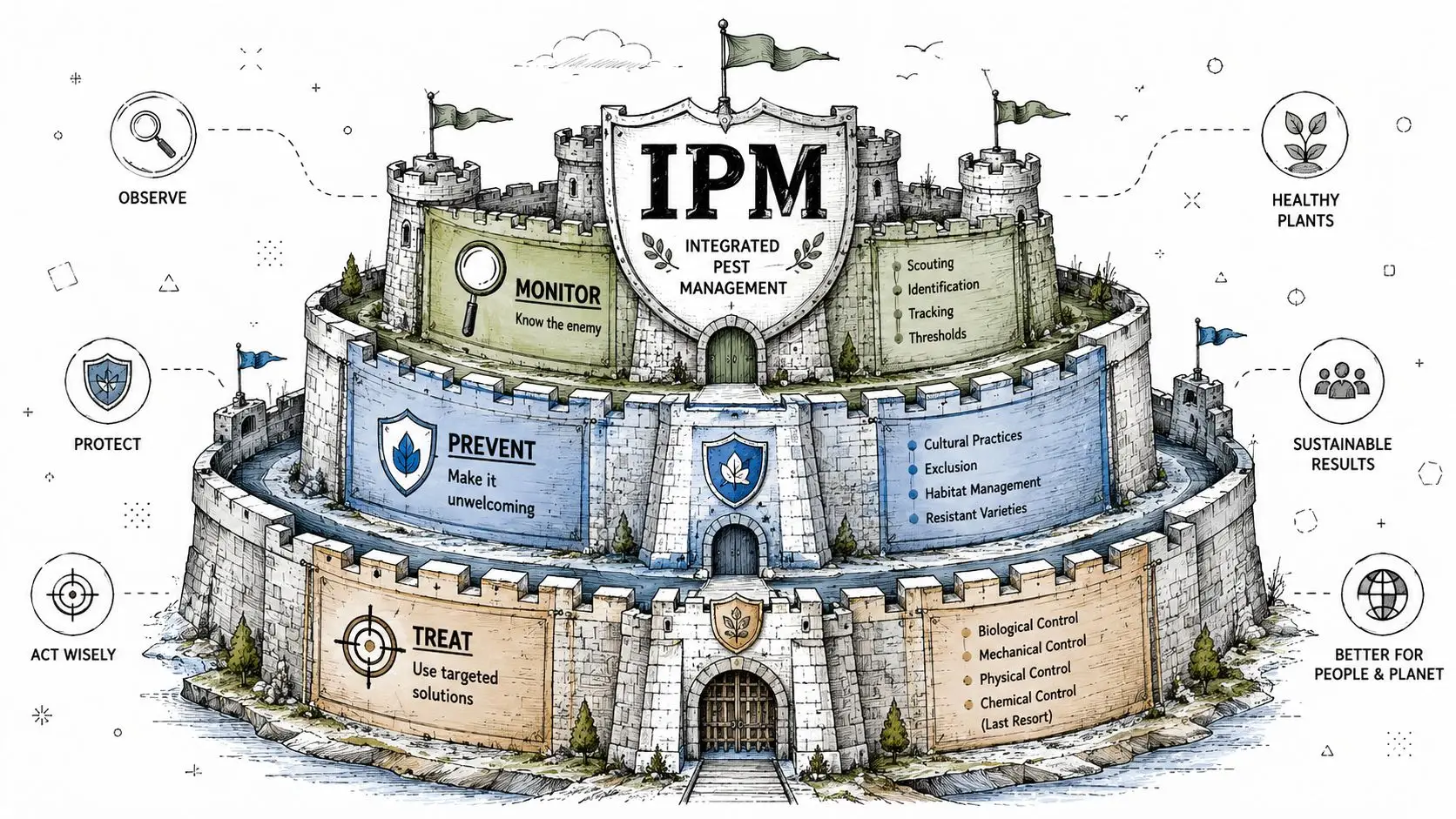
Integrated Pest Management, or IPM, is the standard that makes sense in food service because it treats pest control as an operating system, not a spray schedule. Consider it akin to defending a fortress. You scout the perimeter, close weak points, cut off supplies, and use treatment only where it fits safely and legally.
Inspection means you stop guessing
Inspection is where real pest control begins. A proper inspection doesn't just ask, "Did we see anything?" It asks where pests could enter, where they could breed, where they could feed, and why the building is allowing it.
In restaurants, that usually means focused attention on:
- Receiving areas: Cardboard, pallets, produce containers, and vendor drop zones
- Drains and mop sinks: Moisture plus organic residue is a reliable pest attractant
- Back doors and dock doors: Frequent traffic creates repeated exclusion failures
- Storage rooms: Especially cluttered shelving, forgotten stock, and packaging debris
- Employee areas: Break rooms, lockers, and unmanaged food storage often get overlooked
Exclusion is stronger than repeated treatment
Many operators still think pest control equals chemical application. That's outdated thinking in a food environment. Exclusion does more of the heavy lifting over time. If the building is open, treatment becomes expensive maintenance of a preventable problem.
That same logic applies in larger facilities. If you want a useful parallel, the principles behind achieving pest-free warehouses carry over well to restaurant receiving and storage. The spaces are different, but the discipline is the same. Control access, reduce harborage, inspect goods, and document what you find.
Sanitation removes the reason pests stay
Sanitation in an IPM program isn't about making the place look clean. It's about removing food residue, moisture, shelter, and nesting material. Staff can wipe visible counters and still leave enough buildup behind fryer lines, under shelving, inside floor drains, and around trash casters to support ongoing activity.
That's why food-safe methods matter. Operators reviewing food-safe pest control options should look for prevention-first programs that combine monitoring, exclusion, sanitation guidance, and carefully targeted treatment around operational realities.
IPM works because it treats the cause, not just the sighting.
Treatment has a place, but it isn't the foundation
Treatment still matters. It just isn't the first or only tool. The National Environmental Health Association outlines that a benchmark schedule of monthly treatments is often required for high-traffic restaurants to maintain a 99% pest-free status, as reflected in the verified data above. In practice, that means busy kitchens usually need regular professional attention because traffic, heat, moisture, waste, and deliveries constantly reintroduce risk.
A compliant treatment plan should fit the operation, not disrupt it. The provider should know where products can and can't be used, how to work around food handling areas, and when trapping, baiting, exclusion, or sanitation corrections will do more than another broad application.
Building Your Fortress Against Pests
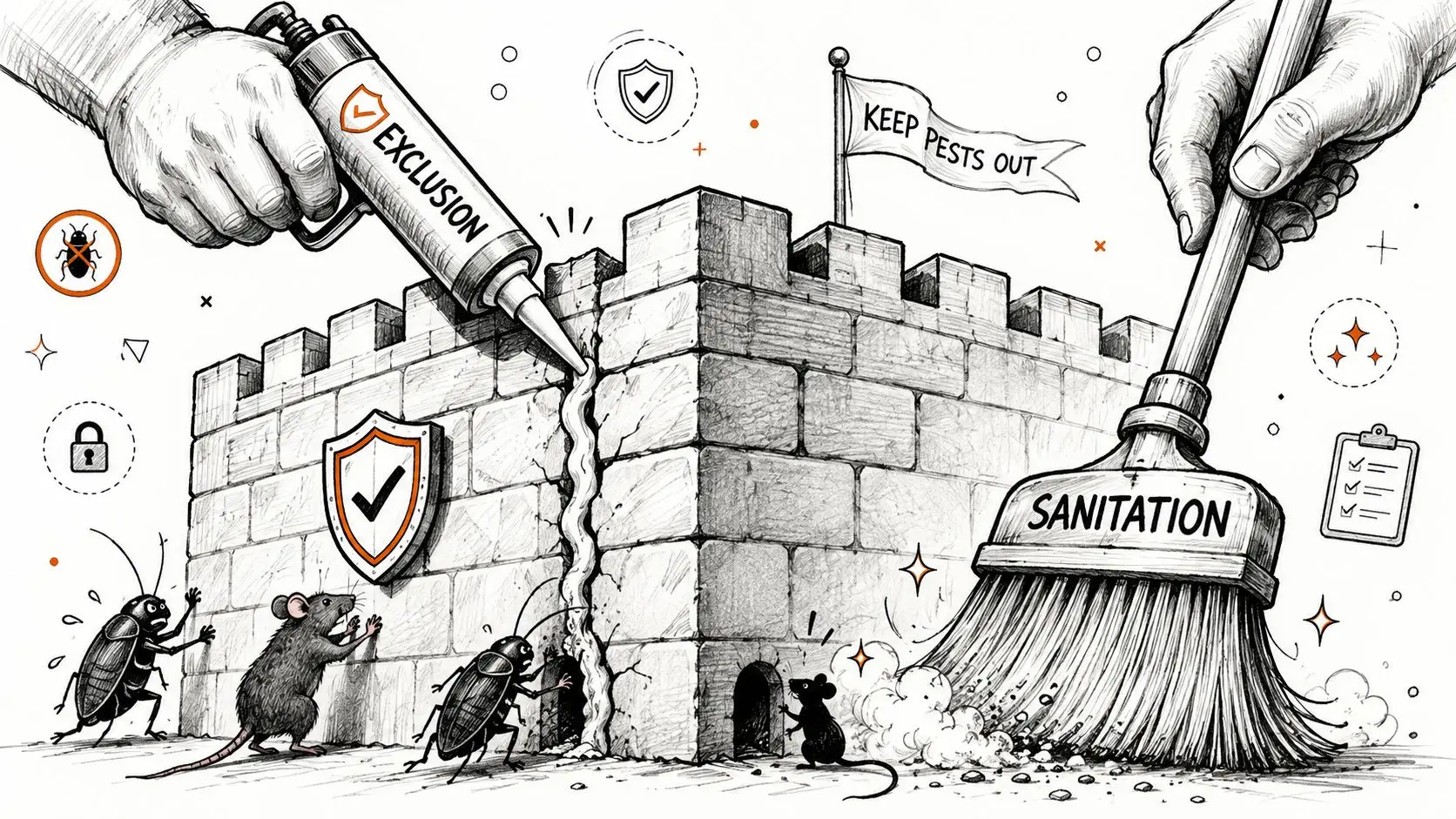
Most restaurant pest problems come down to two failures. The structure lets pests in, or the operation gives them what they need once they arrive. Fix those two points first.
Start with the openings pests actually use
Operators tend to search for dramatic holes in walls. Pests usually don't need dramatic. They need neglected.
The most important detail is the bottom of your doors. To prevent rodent entry, all exterior door sweeps must have a maximum gap of 1/4 inch, because a house mouse can pass through that size opening. The verified data also notes that this measure alone can contribute to a 90% reduction in rodent intrusion events. That should put door sweeps on your weekly walkthrough, not your someday maintenance list.
Check these points in order:
- Exterior doors: Look for light showing under the sweep. If you can see daylight, assume a mouse can use it.
- Utility penetrations: Pipes, conduit, and refrigeration lines often leave rough gaps in walls.
- Drive-thru and service windows: These get ignored because they aren't thought of as structural entry points.
- Damaged thresholds and weather stripping: A good sweep on a bad threshold still leaves a usable route.
- Screens and vents: Torn mesh and loose vent covers invite flying pests and small invaders.
Build a sanitation routine that targets hidden food sources
A clean dining room doesn't tell you much about pest risk. The action is in the unseen residue. Under the fryer. Behind the ice machine. Around the dish pit. Inside floor drains. Under shelving where dry goods dust accumulates.
Many operators need a more tactical checklist than a generic cleaning chart. If your team needs a plain-language primer, kitchen pest control basics is the kind of operational framework worth reviewing alongside your own cleaning SOPs.
Focus staff on these areas:
- Under and behind equipment: Pull movable units on schedule and remove grease and food debris
- Floor drains and surrounding grout lines: Clean out residue, not just standing water
- Trash zones: Wash bins, lids, wheels, and the floor beneath them
- Dry storage shelving: Remove torn packaging, food dust, and cardboard fragments
- Beverage stations and syrup areas: Sticky residue is enough to sustain ongoing insect pressure
The kitchen that "looks clean" at eye level can still be feeding pests at floor level.
Use devices carefully and for the right job
Insect light traps, monitors, and selected trapping tools can support a strong program, but only when they're placed correctly and maintained. They don't replace exclusion and sanitation. They confirm activity and help intercept it.
For front-of-house or covered outdoor hospitality spaces where flying insect pressure is part of the problem, operators sometimes compare fixture types before installing devices. Product-focused roundups like Simply Hospitality bug zapper recommendations can help you think through placement and use cases, but in food service the main rule is still operational fit. Devices should support control without creating contamination or visibility issues.
Before you choose hardware, watch how technicians explain exclusion and sanitation in real-world settings:
What works and what doesn't
A lot of wasted money in food service pest control comes from doing visible things instead of effective things.
| Approach | What happens in practice |
|---|---|
| Replacing damaged door sweeps quickly | Cuts off one of the simplest rodent entry routes |
| Breaking down and removing cardboard fast | Reduces harborage and removes a common transport medium |
| Deep-cleaning around fixed equipment | Removes long-term food buildup that routine mopping misses |
| Spraying without fixing gaps or residue | Delivers short-lived relief and repeated callbacks |
| Leaving clutter in storage areas | Creates protected harborage and hides early warning signs |
Operators who get control and keep it usually have boring routines. That's the point. Pest prevention should feel routine, not dramatic.
Securing Your Supply Chain from Hitchhiker Pests
A lot of restaurant owners still assume pests come from poor housekeeping inside the building. That's only half the picture. Some infestations arrive at your back door already in motion.
The verified data notes that 34% of unexpected rodent and cockroach outbreaks in food establishments originated from contaminated cardboard or pallets delivered from non-pest-controlled vendors, not internal sanitation breaches, with the reference provided in the NYC Health guidance on keeping pests out of food establishments. If you ignore receiving, you can run a clean kitchen and still import a problem.
Treat receiving like a checkpoint
You don't need a slow, complicated process. You need a fast one that staff can repeat every time.
Use a receiving checkpoint that covers:
- Outer packaging condition: Look for gnawing, staining, torn wrap, webbing, or moisture damage
- Pallet surfaces: Check corners, slats, and shrink wrap folds for droppings, egg cases, and insect movement
- Cardboard seams and bottoms: Pests often shelter where boxes sit against damp surfaces or travel in stacked voids
- Produce and dry goods crates: Inspect undersides and protected corners, not just top surfaces
- Truck-to-door path: If product waits outside or sits near dumpsters, risk goes up before it enters the building
Don't wheel problems into storage
The biggest receiving mistake is speed without control. Staff are busy, so they bring everything inside first and inspect later. That's backwards. Once suspect packaging reaches dry storage or prep zones, you've expanded the problem area.
A better sequence looks like this:
- Stage deliveries in a defined receiving spot
- Inspect packaging before it crosses into core storage
- Reject or isolate suspect items immediately
- Move product out of unnecessary cardboard when possible
- Document the vendor, item, and condition
- Notify management and your pest professional if signs are active
If a shipment looks questionable, don't "monitor it inside." Isolate it outside food areas and make a decision before it spreads risk.
Set vendor expectations clearly
Operators often spend a lot of time training line cooks and almost none training suppliers on facility expectations. That's a gap.
Tell vendors what your receiving team will check. Require clean pallets, intact packaging, and no visible pest evidence. If a supplier repeatedly sends damaged or suspect loads, treat that as a food safety issue, not a minor inconvenience. Good vendors will understand. The ones who don't are offloading their pest problem onto your operation.
Keep the process fast enough to survive a busy shift
The receiving protocol has to fit a real kitchen, or staff won't follow it. Keep it simple. One person checks the load, one person logs any issue, and only then does product move. You don't need a committee. You need a short checklist posted at the receiving point and managers who back the process when a shipment needs to be held or refused.
This is the most neglected piece of food service pest control, and it's one of the most preventable. Clean restaurants still get pests. The difference is often what came in on the truck.
Implementing Routine Monitoring and Documentation
A pest control program that isn't documented won't help much during an inspection, a vendor dispute, or an internal review after a sighting. In food service, records matter because they show whether your team is alert, whether corrective actions happened, and whether recurring issues are being managed or ignored.
Monitoring also changes how quickly you catch trouble. A single fly near a drain may be nothing. Repeated staff notes from the same location over several days usually mean it isn't nothing.
Keep a simple pest sighting log
Don't overbuild this. Most restaurants need one sheet or one shared digital form that every shift can use. Staff should record what they saw, where they saw it, when it happened, and who was notified. Add a field for the action taken, even if the action was "reported to manager and area cleaned."
A useful sighting log includes:
- Date and time
- Specific location
- Pest seen or evidence found
- Employee name
- Immediate response
- Manager review
- Follow-up status
That last line matters. If the same issue appears repeatedly with no closure note, your records are documenting neglect instead of diligence.
Review your service reports like an operator
Too many managers file pest control paperwork without reading it. That's a missed opportunity. The report should tell you where activity was found, what was treated, what non-chemical corrections were recommended, and what the kitchen needs to fix before the next visit.
When you review a report, ask:
- Did the technician identify a root cause or just note activity?
- Were sanitation or exclusion corrections assigned clearly?
- Did management sign off and complete those corrections?
- Is the same problem appearing visit after visit?
Good documentation doesn't just prove service happened. It proves your team responded.
Weekly Food Service Pest Inspection Checklist
Use a short, repeatable checklist every week. Managers can complete it during opening prep, before ordering, or during a slower block between shifts.
| Area/Zone | Check For | Status (OK / Action Needed) |
|---|---|---|
| Receiving area | Damaged cardboard, pallet debris, droppings, live activity | |
| Back door and exits | Light under doors, damaged sweeps, loose seals | |
| Dry storage | Torn packaging, spilled product, clutter, old cardboard | |
| Prep line | Food residue under equipment, standing water, missed wipe-downs | |
| Dish area | Moisture buildup, floor debris, drain condition | |
| Floor drains | Odor, residue, insect activity, poor cleaning | |
| Trash holding area | Overflow, residue on containers, unclean floor | |
| Beverage station | Syrup spills, sticky surfaces, drain issues | |
| Employee break area | Unsealed snacks, spills, trash accumulation | |
| Restrooms and utility rooms | Moisture leaks, gaps, signs of activity |
Make one person accountable each week
Shared responsibility often turns into no responsibility. Assign the weekly inspection to one manager, then require sign-off from the general manager or owner. If something needs action, put a date next to it and check it again.
Routine monitoring delivers dividends. You stop relying on memory, and you create a record that shows your operation takes pest prevention seriously every week, not just the day before an inspection.
Executing an Emergency Pest Infestation Plan
Even disciplined operators can face an active sighting. What matters then is the response. Panic causes mistakes. So does denial.
The verified data states that in 2023, over 100 food service locations across the U.S. received official citations for rodent-related health code violations. That's enough reason to treat a rodent sighting, fresh droppings, or active insect activity in a sensitive area as an operational event, not a minor nuisance.
First actions in the first few minutes
When a pest is discovered, the immediate goal is control, not improvisation.
Take these steps:
- Secure the area: Limit access to the affected zone, especially if customers could see it
- Protect food and contact surfaces: Remove or cover exposed product and stop prep nearby if needed
- Preserve evidence: Don't wash away droppings, smear trails, or discard suspect packaging before it can be assessed
- Document the incident: Record the location, time, pest or evidence observed, and staff present
- Notify management immediately: The manager on duty should own the response
- Call a licensed pest professional: Don't hand this to a staff member with store-bought products
What not to do
A bad emergency response can create bigger compliance problems than the original sighting.
Avoid these moves:
- Don't spray retail insecticide in food areas
- Don't let staff guess at the source
- Don't move contaminated materials through prep zones without control
- Don't reopen the area just because the pest is no longer visible
- Don't wait for the next scheduled service if activity is active
Communication matters inside the building
Your team needs clear instructions. Tell staff what area is restricted, what product is on hold, and who is handling cleanup, documentation, and vendor or technician contact. Keep the message factual. Confused staff often spread bad information or take unapproved action.
If the issue involves a delivery, hold related stock and identify what came in with it. If it involves a rodent sighting near a door or storage area, check neighboring zones immediately for entry points and fresh evidence.
A calm response protects your inspection record better than a fast, sloppy one.
The point of an emergency plan isn't to look polished. It's to prevent one sighting from turning into contamination, inspector findings, or a visible customer event.
Choosing a Compliant Pest Control Partner in Southeast Texas
In Southeast Texas, food service pest control has to account for real local pressure. Heat, humidity, frequent deliveries, storm-driven moisture, and heavy year-round insect activity all make prevention harder if the provider uses a generic program.
A restaurant needs a partner who understands compliance, but also understands how commercial kitchens run in places like Kingwood, Conroe, Porter, and nearby communities. The best-looking proposal on paper won't help if the technician doesn't know how to work around receiving schedules, food handling areas, and recurring moisture issues.
What to ask before you hire
Use a short decision filter.
- Licensing and insurance: Verify the company is properly credentialed for commercial pest work in Texas
- Food service experience: Ask whether they handle restaurants, kitchens, and regulated commercial environments regularly
- IPM capability: They should talk about exclusion, monitoring, sanitation corrections, and documentation, not just treatment
- Service documentation: You need clear reports that managers can act on
- Local pest knowledge: Southeast Texas pressure is different from drier markets. Your provider should know that.
- Response capacity: Restaurants don't always get to wait for the next route day
What a useful commercial relationship looks like
A good provider doesn't just show up, treat, and leave. They identify structural risks, point out sanitation failures, review recurring hotspots, and help management tighten procedures around the back door, drains, storage, and receiving.
For operators comparing commercial programs across business types, retail pest control services can also be useful context because they show how providers adapt service plans to customer-facing environments where visibility, documentation, and rapid response matter. In this market, FullScope Pest Control is one local option that offers commercial pest programs, licensed technicians, and IPM-based service in north Houston communities.
The final test
Ask one direct question before signing anything: "How will you help my staff prevent the next problem, not just treat the current one?"
If the answer is mostly chemistry, keep looking. If the answer includes inspection, door sweeps, receiving controls, sanitation corrections, monitoring, service records, and clear communication with management, you're in the right conversation.
Food service compliance doesn't come from a spray can. It comes from a system. The right partner helps you run one.
If your restaurant needs a tighter prevention program, start with a walk-through of your receiving area, back doors, drains, storage rooms, and documentation habits. That's where most expensive pest problems begin.