 1500+ reviews

Sugar Ants Bite: What Homeowners Need to Know
Have you ever watched a trail of tiny ants cross your kitchen counter and assumed the only question was how to kill the ones you can see? In Magnolia, Texas, the more useful question is what kind of ant found the route, why your home is attracting it, and whether the address is within the service area you intend to call. “Sugar ant” is a broad homeowner label, not one precise species. Small ants may enter around kitchens, sinks, pantries, patios, and foundation gaps, especially where sweet food and moisture are available. Their bites are usually a nuisance rather than a serious injury, but correct identification still matters because fire ants and certain indoor-nesting species require a different response. Magnolia service coverage also needs a geographic check. Magnolia is in southwest Montgomery County, and commonly used ZIP coverage includes 77353, 77354, and 77355, while city limits and the surrounding extraterritorial jurisdiction are not identical areas, as shown by the City of Magnolia maps and GIS resources. Before scheduling any pest visit, verify your street address rather than relying only on the city name printed on your mail. What Sugar Ants Are and Why They Show Up in Kitchens A line of tiny ants crossing the counter usually begins with one worker, not an army. That worker is scouting for food, water, and shelter. Once it finds syrup, juice, honey, fruit, crumbs, or pet food, it can mark the route with pheromones, chemical signals that guide other workers to the same location. Think of the trail as a highway built on invisible ink. The first scout creates the route, and later ants reinforce it as they travel. A few ants can therefore become a steady procession without a new nest appearing overnight. The name covers more than one species Homeowners use “sugar ant” for several small, sweet-feeding ants. In cooler regions, the label may refer to banded sugar ants, while southern homes can also have pharaoh ants, odorous house ants, pavement ants, Argentine ants, and other species that search for sugary foods. The name alone doesn't tell you which insect is present. A pest professional looks at size, color, body shape, antennae, and waist structure. That distinction matters because a visible kitchen trail may come from an outdoor nest, a hidden wall void, or several nearby colonies. The life cycle follows the familiar ant pattern. Eggs develop through immature stages before becoming adult workers, while the colony depends on workers to forage, feed developing ants, and maintain the nest. You don't need to identify every stage to understand the practical issue: killing visible workers may remove the symptom while leaving the colony active. Why Magnolia kitchens become attractive Warm, humid Southeast Texas conditions can make indoor food and moisture especially inviting. Rain can disturb outdoor nesting areas and push workers toward protected edges around doors, windows, plumbing penetrations, and foundations. Summer humidity can also keep damp areas attractive near sinks, bathrooms, laundry spaces, and dripping faucets. Treat the trail like a neighborhood watch. One scout reports a useful food source, and the rest of the colony follows the report. Wipe the counter, seal the food, and remove moisture, but also watch where the ants reappear. That route often points toward the entry gap or nesting area. The important safety point is simple. Sugar ants are generally low-risk biters, and a medical overview from Cleveland Clinic explains ant bites and defensive behavior, including sugar ant workers measuring 2 to 15 millimeters and defending themselves with head pinchers rather than a painful sting. Their bites aren't usually painful, although sensitive people can experience allergic reactions. Do Sugar Ants Actually Bite or Sting The words bite and sting describe different tools. An ant bites by closing its mandibles, the small jaws near its head, to grip skin. Some ants can also use defensive chemicals after biting. A sting requires a stinger that injects venom, a feature associated with groups such as fire ants rather than the small household ants people commonly call sugar ants. A useful analogy is the difference between a clothespin and a needle. A sugar-ant-type species may act like a tiny clothespin, producing a pinch if handled. A fire ant acts more like a clamp followed by a sharp injection, which is why its reaction feels much more intense. Species don't all behave alike Banded sugar ants can deliver a mild pinch, but they rarely pierce human skin. Pharaoh ants have underdeveloped mouthparts and are generally unable to bite people in a meaningful way. Odorous house ants and Argentine ants may nip, yet the contact typically doesn't draw blood. Pavement ants can also be mislabeled as sugar ants when they wander indoors for food. Their presence around a Magnolia kitchen doesn't automatically mean the household faces a dangerous pest. It does mean the insects have located a route worth repeating. Fire ants are the clear contrast. They can bite to hold on and sting with venom, producing a burning sensation and sometimes a white pustule. If the pain is sharp, the area develops pustules, or multiple spots appear after disturbing a mound, fire ants are a more plausible explanation than a small sugar-feeding indoor ant. Practical distinction: A barely noticeable pinch points toward a low-risk household ant. Burning pain followed by a pustule deserves fire-ant precautions and closer attention. Most sugar-ant contact causes brief irritation, if anything. Sensitive people can react more strongly, so don't dismiss hives, breathing difficulty, or rapidly worsening symptoms because the ant was small. The next step is to match the skin reaction to sensible first aid instead of guessing from size alone. How to Tell Sugar Ants Apart From Other Household Ants Identification starts with the whole insect, not just its color. At close range, note the approximate size, color pattern, body shape, antenna segments, and the number of nodes in the waist, called the pedicel. Those features help a technician separate a genuine identification from the loose household term “sugar ant.” A single-file trail
How Summer Rainfall Can Increase Pest Activity
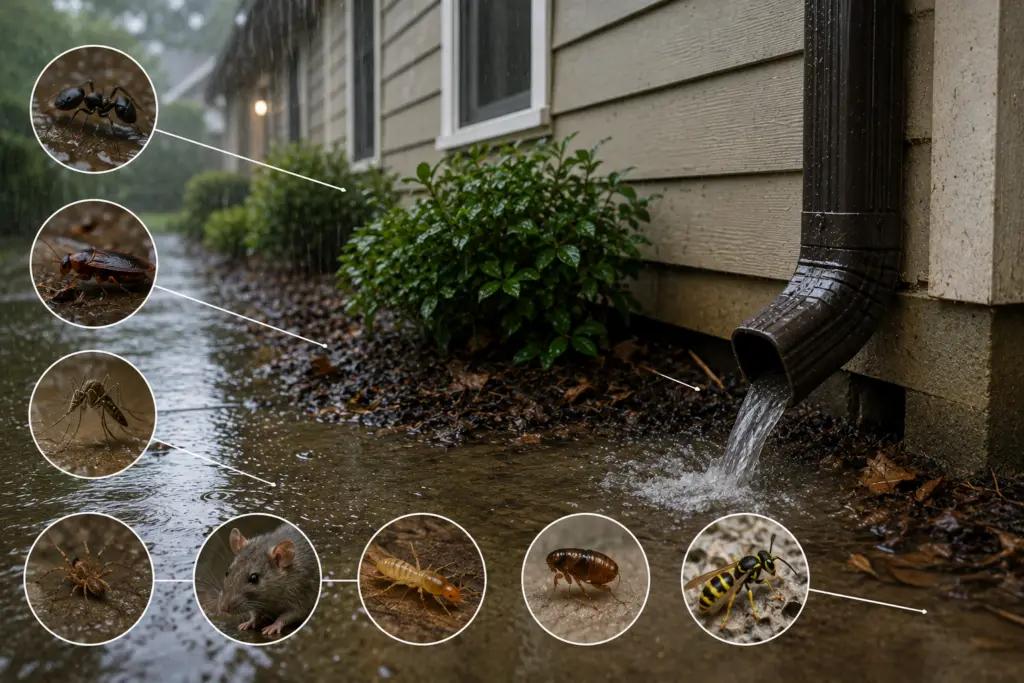
Summer rain can cool the air and revive dry landscapes, but it also changes pest behavior around Southeast Texas homes and businesses. Heavy downpours may flood nests, saturate soil, fill containers, increase humidity, and damage exterior barriers. Ants, cockroaches, mosquitoes, spiders, rodents, termites, fleas, ticks, flies, and wasps may respond by moving, reproducing, or seeking more stable shelter. Professional pest control considers rainfall as part of the larger property environment. Technicians inspect water-holding areas, foundation edges, vegetation, drains, storage spaces, and entry points before selecting treatment. This approach helps distinguish temporary post-storm movement from an infestation that is becoming established. Early assessment can also limit repeated indoor sightings by addressing storm-created access before pests settle into concealed spaces. Rain Can Flood Outdoor Nests And Drive Pests Inside Many pests live in soil, mulch, landscape beds, drains, or sheltered exterior areas. When rainfall saturates these locations, ants and cockroaches may move toward drier indoor spaces. Rodents can leave flooded burrows, while spiders may relocate when webs and prey populations shift. Post-rain warning signs may include: A sudden sighting does not always mean the pest originated indoors. Professionals trace movement back toward the exterior source and inspect the routes used to enter. Standing Water Supports Mosquito Development Rain can create breeding water in surprisingly small places. Buckets, plant saucers, toys, gutters, drains, tarps, low lawn areas, and discarded containers may hold water long after the storm passes. Warm summer temperatures can then speed mosquito development. The overview of Texas summer pests helps explain why rainfall, heat, humidity, and outdoor activity often overlap. Mosquitoes may increase near shaded vegetation and patios, while ants, cockroaches, fleas, ticks, and spiders respond to the same moisture-rich conditions in different ways. Source reduction is most effective when technicians identify why water keeps returning. Drainage, irrigation, debris, or container placement may need attention alongside targeted mosquito treatment. Moisture Can Strengthen Hidden Pest Conditions Summer rainfall does more than create puddles. It can raise humidity in crawl spaces, garages, wall-side areas, and storage rooms. Damp cardboard, wood, insulation, and organic debris may support cockroaches, termites, silverfish, ants, and other moisture-associated pests. Fleas and ticks may also remain active in shaded yards where hosts and vegetation provide protection. Professionals may inspect: Moisture correction supports long-term prevention, but it does not replace treatment when active pests are confirmed. A technician can separate ordinary storm dampness from evidence of nesting, feeding, or structural entry. Commercial Properties Face Added Post-Storm Pressure Warehouses, offices, restaurants, and other commercial buildings often have loading docks, floor drains, waste areas, stored goods, and frequently opened doors. Rain can push pests toward these protected spaces while deliveries and business activity create additional movement. The need for warehouse pest planning becomes especially clear after storms. Rodents may enter through damaged doors or utility gaps, cockroaches may gather near drains and moisture, and flies can increase around waste or organic buildup. Ants and spiders may also become more noticeable along walls, storage racks, and exterior lighting zones. A commercial response may include: Documentation helps property managers see whether activity is isolated or part of a repeated weather-related pattern. Follow-Up Keeps Treatment Effective After Weather Changes Rain can dilute or disturb some exterior treatments, move debris into drainage routes, and create new entry conditions. One visit before a storm may not account for the changes that appear afterward. Follow-up allows technicians to compare new findings with the original inspection and reinforce protection where evidence supports it. A long-term plan may include rechecking standing water, restoring exterior barriers, monitoring bait or trapping systems, removing accessible webs or nests, and recommending repairs around damaged seals or openings. Treatment should remain tied to the pest, weather, and property rather than repeated automatically across every area. Summer rainfall can increase pest activity by flooding shelter, creating breeding water, raising humidity, and pushing pests toward buildings. The strongest response combines inspection, source reduction, targeted treatment, exclusion, and monitoring. Professional oversight helps keep that process precise while weather and property conditions continue to change. Keep Storm-Driven Pest Pressure From Settling In Contact Fullscope Pest Control for professional inspection, targeted pest control, moisture-focused prevention, commercial service, and dependable post-storm follow-up.