1500+ reviews

By 1995, termite treatment had expanded beyond liquid soil barriers to include commercial bait systems. Today, treatment is a structured process that identifies termite activity, blocks access to a home's wood, and monitors the property after the initial work.
You notice a narrow mud tube running up the foundation of your Magnolia, Texas, home. It may be tucked behind a flower bed, garage trim, or a shaded corner of the slab, so the discovery feels small even though it can indicate a hidden route into the structure. A technician doesn't solve that problem with a quick spray. They inspect the building, determine what kind of termite is involved, and choose a method that interrupts the connection between the colony, the soil, and the wood.
For a Magnolia homeowner, that usually means evaluating a liquid soil barrier, in-ground bait stations, localized wood treatment, or a combination. The right choice depends on where termites are active, how the home was built, whether the foundation can be accessed, and what the surrounding soil and landscaping allow a crew to do safely.
What Termite Treatment Actually Means for Homeowners
A mud tube is a clue, not a complete diagnosis. The technician first confirms whether termites are using it, checks nearby wood for galleries and damage, and traces possible entry points around the foundation. That sequence matters because termites may be active in concealed areas even when only one tube is visible.

The treatment is a system, not a bottle
Inspection establishes where the risk is. Species identification helps determine how the insects are entering and where the colony is likely to be connected. Targeted application then addresses the route between termites and structural wood, followed by monitoring to confirm that the treatment is working and that new activity hasn't appeared elsewhere.
The most common approach for subterranean termites uses a liquid termiticide in the soil around the foundation. Crews may trench, rod, or drill through slabs and concrete features to create continuity around entry points. Bait systems solve the same access problem differently. They use monitored stations and slow-acting toxicants that termites carry through the colony instead of creating one continuous treated zone.
Local spot treatment has a narrower purpose. If an inspector finds a small, isolated area of affected wood, the crew may treat that section directly, inject suitable material into galleries, or remove conditions that are allowing termites to reach the wood. That work may be part of a larger plan rather than a substitute for checking the entire perimeter.
Practical rule: A quote should explain the entry route, the treatment method, the areas being treated, and how follow-up will confirm the result.
Magnolia homeowners often coordinate termite work with broader exterior improvements, especially when landscaping hides foundation lines or creates moisture against the structure. If you're planning a renovation or outdoor redesign, you can also find design ideas for luxury homes while keeping treatment access and inspection visibility in mind.
The historical record shows why the industry uses layered methods today. The review of termite control history and treatment strategies describes the field's development from early soil applications to modern combinations of termiticides, baits, treated materials, construction practices, and physical barriers. Treatment is therefore best understood as barrier management and colony control, not as a one-time pest spray.
How Inspection and Species Identification Work
The first visit usually starts outside. A technician walks the foundation with a flashlight, probe, and moisture meter, looking for mud tubes, soft or hollow-sounding wood, cracks, plumbing penetrations, slab edges, and areas where soil or mulch touches the structure.
Inside the home, the inspection may include baseboards, sill plates, door and window trim, garage door frames, utility penetrations, crawlspaces where present, and rooms that share walls with exterior landscaping. The technician is reading how the building was assembled and where moisture or concealed gaps could give termites access.
Why the species changes the plan
Subterranean termites commonly connect the structure to soil through mud tubes or concealed foundation routes. Their treatment plan often focuses on the perimeter, slab penetrations, and the soil beneath or beside entry points.
Drywood termites live within dry wood rather than depending on a soil connection. Their signs can include pellets, known as frass, and galleries inside structural or finished wood. A localized wood treatment may be more relevant than perimeter trenching, depending on the inspection.
Formosan termites can also create complex, concealed activity, so the technician must consider the extent of the colony and the structure's vulnerable connections. Species identification isn't always possible from one visible sign, which is why a professional combines several observations instead of relying only on the insect a homeowner found.
A useful inspection report should identify the evidence observed, distinguish active signs from old damage, describe accessible and inaccessible areas, document conducive conditions, and explain why the proposed treatment fits the findings. It should also note locations that need correction, such as leaking plumbing, excessive soil against siding, blocked foundation visibility, or dense vegetation.
For a detailed explanation of the process, homeowners can review this complete guide to termite inspection. The important principle is simple: the inspector isn't just looking for insects. They're mapping the routes a colony could use to reach the home.
Liquid Soil Barriers and Trenching Treatments
For many Magnolia homes with subterranean termite risk, the central treatment is a liquid soil barrier. The crew applies termiticide to soil at the foundation line, creating a treated zone between the structure's wood and termites moving through the ground.
That description can make the process sound like ordinary spraying. It isn't. EPA guidance describes the common approach as a soil-applied liquid treatment that creates a zone around the building, while post-construction work can require trenching, rodding, and drilling around foundations, slabs, cracks, joints, and utility penetrations. The goal is continuity. An untreated gap can become an entry route.
What the crew does on site
A technician may dig a trench beside accessible foundation sections, apply the labeled treatment to the soil, and replace the soil afterward. Where concrete, patios, garages, or interior slabs block access, the crew may drill small holes and use rods or injection equipment to reach the soil below. The holes are then sealed according to the treatment plan and surface involved.
Post-construction treatment is more complicated than preconstruction treatment because the home, driveway, landscaping, utilities, and finished surfaces are already in place. For new construction and higher-risk structures, guidance emphasizes combining preconstruction soil or borate treatment with postconstruction perimeter work after landscaping is complete.
The operational benchmarks below come from Mississippi State Extension guidance on termite control methods. Exact application must always follow the product label and local requirements, but these figures help a homeowner understand whether a proposal describes real trenching and barrier work rather than vague exterior spraying.
Liquid barrier application standards
| Element | Standard |
|---|---|
| Trenching depth | Minimum 6 inches in the cited guidance |
| Deeper foundation treatment | In some applications, from grade to footing depth of at least 30 inches |
| Labeled delivery example | 4 gallons per 10 linear feet per foot of depth |
| Slab treatment | Drilling at 12-inch intervals near cracks and joints where needed to restore barrier continuity |
A crew should explain which parts of the property require trenching, rodding, drilling, or another approved method. If landscaping, concrete, drainage features, or utility penetrations prevent a continuous treatment zone, the plan may need bait stations, localized treatment, or a combination.
For homeowners comparing approaches, this overview of soil treatments that protect foundation integrity can help clarify why access and application detail matter. The useful question is not just, “Did someone treat the outside?” It is, “Where is the treated zone, and how did the crew close the likely termite routes?”
Bait Systems and Local Spot Treatments Compared
A liquid barrier protects by treating the soil around vulnerable parts of the home. An in-ground bait system takes another path. Technicians place monitoring stations around the property, and termites that discover the stations can be exposed to a slow-acting toxicant that moves through the colony.
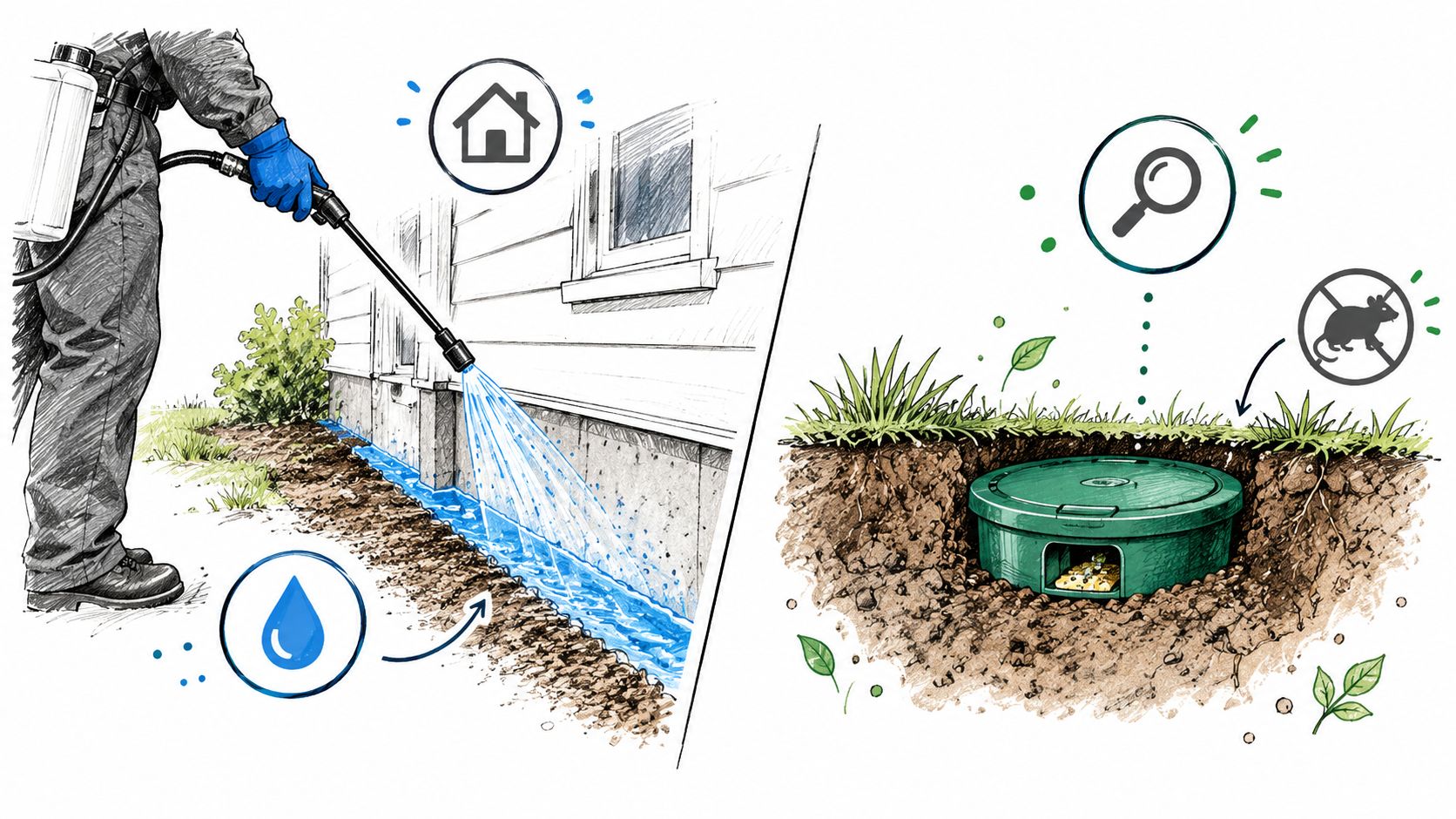
The bait category became a major alternative to liquid barriers when the first commercial bait product for subterranean termites launched in 1995, as documented in the termite control research review. Instead of relying on a continuous chemical zone, the system uses termite behavior. Workers feed, share material, and move through the colony, allowing the bait to affect termites away from the station.
Choosing between the main options
A liquid treatment may be practical when the foundation perimeter is accessible and the homeowner needs a defined treated zone around active or vulnerable areas. It can be harder to apply cleanly where dense landscaping, extensive concrete, wells, difficult access, or complicated slab construction limit soil treatment.
Baiting may make more sense when the property needs a monitored approach or when broad soil treatment is difficult to complete. It still requires professional placement, inspection, and maintenance. A station in the ground isn't protection by itself. The provider must check it, document activity, replace or manage bait as appropriate, and respond if termites appear elsewhere.
Local spot treatments are more precise. A technician may use them when the inspection finds a confined area of activity in wood or a specific entry point that doesn't justify treating the entire perimeter. Spot work can include direct wood treatment or injection, but it shouldn't be used to ignore hidden routes or uninspected portions of the building.
A liquid barrier creates a treated route around the structure. Baiting monitors termite behavior over time. Spot treatment addresses a defined location. The inspection determines which job the method must do.
Homeowners interested in a branded baiting approach can read about the Sentricon termite system and what homeowners should know. The name of the system matters less than whether the provider explains station placement, inspection frequency, activity findings, and the plan for new termite pressure.
This short video provides a visual look at how perimeter treatment and baiting can appear as part of a broader termite-control plan.
What to Expect on Treatment Day and Afterward
Treatment day starts with preparation, not chemicals. The technician reviews the work area, confirms which rooms or exterior sections need access, identifies pets and children that must stay away from treated zones, and discusses any drilling, trenching, or indoor wood treatment.
If the crew needs to drill through a slab, garage floor, patio, or other concrete surface, you may hear short bursts of drilling and equipment noise. The technician should explain where holes will be placed and how the openings will be sealed afterward. Move stored items away from walls and foundation edges before the appointment if the provider requests clear access.
What happens after the application
Re-entry instructions depend on the product, the location, ventilation needs, and the label. Don't rely on a generic internet rule. Ask the technician when people and pets can return to each treated area, whether indoor rooms need ventilation, and which surfaces should remain untouched until dry or otherwise cleared.
Termites may still be visible briefly after treatment. A remaining insect or an old tube doesn't automatically mean the work failed, because activity can persist while exposed termites die or while the provider confirms whether a route is active. The meaningful signs are the inspection findings, the condition of the treated route, new or worsening damage, and the results of follow-up checks.
Bait systems require their own monitoring schedule, while liquid treatments still benefit from inspections because new colonies can approach a property through routes that didn't exist or weren't accessible during the original work. Ask for written documentation of the treatment areas, products used, inaccessible sections, corrective recommendations, and follow-up dates.
Why renewals matter
Termite protection is commonly structured around continuing inspection, monitoring, and renewal rather than a single visit. USDA research estimated that homeowners in 11 southern U.S. states spent $143 million in 1970 dollars during 1970 to prevent and control subterranean termites and wood-destroying beetles. The same research recorded more than 2 million termite treatments from 1965 to 1969, with about 1.2 million renewals annually in those states. These figures appear in the USDA report on termite treatment economics and service activity.
The practical lesson for a Magnolia homeowner is that follow-up isn't an optional add-on. It's how a provider checks whether the original barrier remains intact, whether stations contain activity, and whether changing landscaping or moisture conditions has created a new route.
Magnolia's Place in the Greater North Houston Service Area
Magnolia isn't an isolated service stop. It sits within the broader north Houston and Southeast Texas pest-control corridor, where routes commonly connect Montgomery County communities with parts of north Harris County.
Local service-area listings place Magnolia alongside Conroe, Montgomery, Spring, Willis, Splendora, Porter, Pinehurst, and Dobbin in the Gulf Coast and Montgomery County market. A separate Magnolia-area listing includes Atascocita, Cleveland, Conroe, Huffman, Humble, Kingwood, Livingston, Montgomery, New Caney, Porter, Splendora, Spring, and Willis among covered communities. These locations are documented in the Montgomery County termite service-area directory and the Magnolia pest-control service listing.
Why the service corridor matters
Suppose you're buying a home in Magnolia and need a wood-destroying insect inspection for a transaction involving Conroe, Tomball, or The Woodlands. The provider's route planning can affect how quickly the technician reaches the property, when an inspection slot is available, and how efficiently the report is coordinated with agents, buyers, lenders, and sellers.
The same applies to active treatment. A company that regularly serves Magnolia, Montgomery, Spring, and nearby communities is more likely to understand the practical routing between properties, the access challenges created by established landscaping, and the need to coordinate repeat visits for monitoring or station checks.
One Magnolia-based provider listing identifies its address as 506 Honea Egypt Rd, Magnolia, TX 77354 and describes service extending to The Woodlands, Cypress, Katy, Conroe, Spring, Tomball, and select Houston neighborhoods. That listing appears in the provider's Magnolia contact information. You don't need to choose a provider solely because it has a Magnolia address, but local coverage is a useful question to ask.
Before booking, confirm that the company serves your exact neighborhood, handles both inspections and treatment, provides WDI reports when needed, and can return for follow-up without sending a crew from far outside the area.
Putting It All Together for Your Magnolia Home
The answer to what is termite treatment is not “a chemical applied around the house.” It's a coordinated protection plan that starts with evidence and ends with verification.
Use this checklist when you speak with a pest professional:
- Start with identification: Ask what signs indicate active termites and whether the findings suggest subterranean, drywood, Formosan, or another wood-destroying insect.
- Review the structure: Confirm that the inspection includes the foundation line, garage, plumbing penetrations, slab edges, accessible wood, and conditions that could conceal entry.
- Match the method to the property: Ask why the proposal calls for liquid treatment, bait stations, local wood treatment, or a combination.
- Understand the work: Get a clear explanation of trenching, rodding, drilling, station placement, sealing, indoor preparation, and re-entry instructions.
- Schedule verification: Make sure the plan includes follow-up inspections, station checks when applicable, documentation, and renewal options.
- Correct the conditions: Address leaks, blocked foundation visibility, soil or mulch against the structure, and landscaping that prevents inspection access.
Magnolia homes vary in age, construction, slab layout, landscaping, and access. That's why two neighboring properties can receive different treatment plans even when both owners find mud tubes. A local provider should explain the reasoning in plain language and identify what the treatment can and cannot address.

Ongoing protection beats one-time remediation because termites can use new routes, hidden gaps, and changing moisture conditions long after the first treatment.
If you're in Magnolia, Conroe, Spring, Tomball, The Woodlands, or a nearby north Houston community, arrange a professional termite inspection before choosing a treatment method. Ask for a written plan that identifies the evidence, explains the treatment route, documents follow-up, and gives you a clear way to protect the home after the crew leaves.