1500+ reviews

Houston ranked 7th in the U.S. for rat activity in 2026, and Texas saw a 23% increase in rodent-related calls in the prior year. In Magnolia and across Southeast Texas, that scale means roof rats aren't a one-off nuisance, they're a pressure problem, and trapping alone won't hold if the roofline stays open.
A homeowner hears scratching at dusk, finds a few droppings in the garage, and assumes one rat slipped in from the yard. What usually happens in this part of Texas is more complicated. Roof rats are already established in towns across the state, they move through trees and rooflines, and once they find food, water, and attic access, the problem can keep rebuilding itself.
The local pattern matches the biology. Urban growth, construction disturbance, and dry conditions push rodents toward structures, especially where homes sit under mature trees or have complex rooflines. If the entry points stay open, the attic becomes the preferred harbor, not the exception.

Why Southeast Texas Is Seeing More Roof Rats Right Now
The 2026 Houston report made the regional picture hard to ignore. Houston ranked 7th in the U.S. for rat activity, and Texas saw a 23% increase in rodent-related calls in the prior year, which tells you the problem is large enough to affect a major metro and statewide service volume, not just a few unlucky blocks. Fox 26 Houston's report also quoted a local branch manager describing a “huge influx” in rodents, especially roof rats.
What that looks like in Magnolia
A Magnolia homeowner notices scratching at dusk in the attic, then finds a few black droppings in the garage the next morning. That's the moment to assume a single rat came and went. In reality, the attic, the roof edge, and nearby trees often form a connected route that lets rats keep returning until the structure is closed off.
That's why the broader market matters. Texas A&M's Mammals of Texas notes that Rattus rattus is common over most of Texas, especially in towns, so recurring attic activity in suburban and urban counties isn't unusual at all. The species already fits the built environment here, which means a clean house can still be vulnerable if the roofline and surroundings give rats a bridge in.
Why the pressure keeps shifting into homes
Local Texas reporting has tied rodent complaints to construction and drought, and that lines up with what I see on Southeast Texas properties. When land is disturbed, cover changes, or food and water get scarce, rats don't vanish, they relocate. For many homes, that relocation ends in the attic, soffit, or upper wall cavity.
Practical rule: if the complaint keeps returning, the structure is still inviting the animal back in. Traps may reduce the count, but exclusion is what breaks the cycle.
For homeowners who want to understand the neighborhood-level driver behind that shift, this explanation of urban development and pest pressure is worth reading alongside a roof inspection. In Magnolia, Conroe, and Kingwood, the question usually isn't whether rats are present somewhere nearby. It's whether your roofline has become the easiest next stop.
Roof Rat Biology That Explains the Speed of an Infestation
Roof rat control gets easier when you stop thinking in terms of single animals and start thinking in terms of breeding potential. The Frisco, Texas municipal guidance says roof rats reach productive maturity at about 3 months, live about 1 to 2 years, and produce at least 3 litters per year with an average of about 6 young per litter. Texas Tech's roof rat account backs up the broader point that this species is established and common in Texas towns.
Why one pair turns into a problem fast
Start with one breeding pair. If the female is mature and conditions stay favorable, she can add multiple litters before a homeowner even notices the first attic noises have become routine. The warm season in Southeast Texas gives roof rats exactly what they need, food from human activity, water from condensation or landscaping, and raised harborage in attics and roof voids.
That timing matters more than many realize. A “wait and see” approach isn't neutral, it gives the colony time to expand. By the time a homeowner finally hears the problem clearly, some of the offspring may already be old enough to reproduce too.
Why towns and suburbs get hit repeatedly
The Texas A&M note that Rattus rattus is common over most of Texas, especially in towns, explains why this species keeps showing up in developed areas rather than staying out in the woods. Roof rats don't need a barn or a field edge to settle in. They need a path up, a quiet cavity, and a reason to stay.
That's why roof-rat control in Magnolia isn't just about the number of traps you set in the attic. It's about whether the property still offers the same breeding conditions a week later.
A single trap catch can feel like progress, but if the roofline is still open, the population can rebuild behind the scenes.
How Roof Rats Behave on a Texas Property
Roof rats live differently from ground rats, and that difference changes where you look first. They're nocturnal, strongly arboreal, and opportunistic omnivores that feed on fruit, pet food, birdseed, grease, and stored goods, which is why activity clusters around kitchens, garages, attics, sheds, and fruit trees. Texas Bug Out's roof rat guidance lays out those practical food sources and the health concerns tied to them.
Where they travel and where they hide
On a Magnolia property, roof rats often move across tree canopies, along utility lines, up vine-covered walls, and into roof-level openings. That's why the most useful inspection points are roof edges, vents, attic spaces, and upper-wall penetrations, not just foundation cracks. A source focused on Texas roof rats describes them as living in attics, eaves, rooflines, rafters, crossbeams, and other high areas, which matches what shows up in real service calls. Holder's Pest Solutions on roof rats in Texas
Why the health and damage side matters
Roof rats can carry or vector Salmonella, leptospirosis, and rat-bite fever. Their gnawing can also expose wiring in walls or attics, which creates a secondary fire risk when insulation and cable jackets are damaged. Once wiring is exposed, the issue stops being only a nuisance and becomes a structural concern.
For homeowners trying to separate roof-rat clues from other roof problems, spotting roof damage early can help identify whether an opening is tied to shingle failure, flashing damage, or a rodent access point. That matters because roof rats don't need a big opening. They only need a small one near the roofline.
If there's one practical habit to build, it's this, inspect the roof edge before you ever assume the attic sound came from a squirrel or a stray animal passing through. Roof rats spend their day above ground level, then come down to feed after dark.
Signs of an Active Roof Rat Infestation
The first clue is usually sound. Homeowners hear scratching, scurrying, or light thumping in ceilings and walls after dark, often around the same attic slope or wall line night after night. That repeat pattern matters more than a one-time noise, because roof rats use familiar travel routes.
Audibility, visual evidence, and odor
Audibility points to the active route. When the noise comes from a ceiling bay or upper wall cavity, the problem is usually close to the roofline, a vent, or a utility penetration.
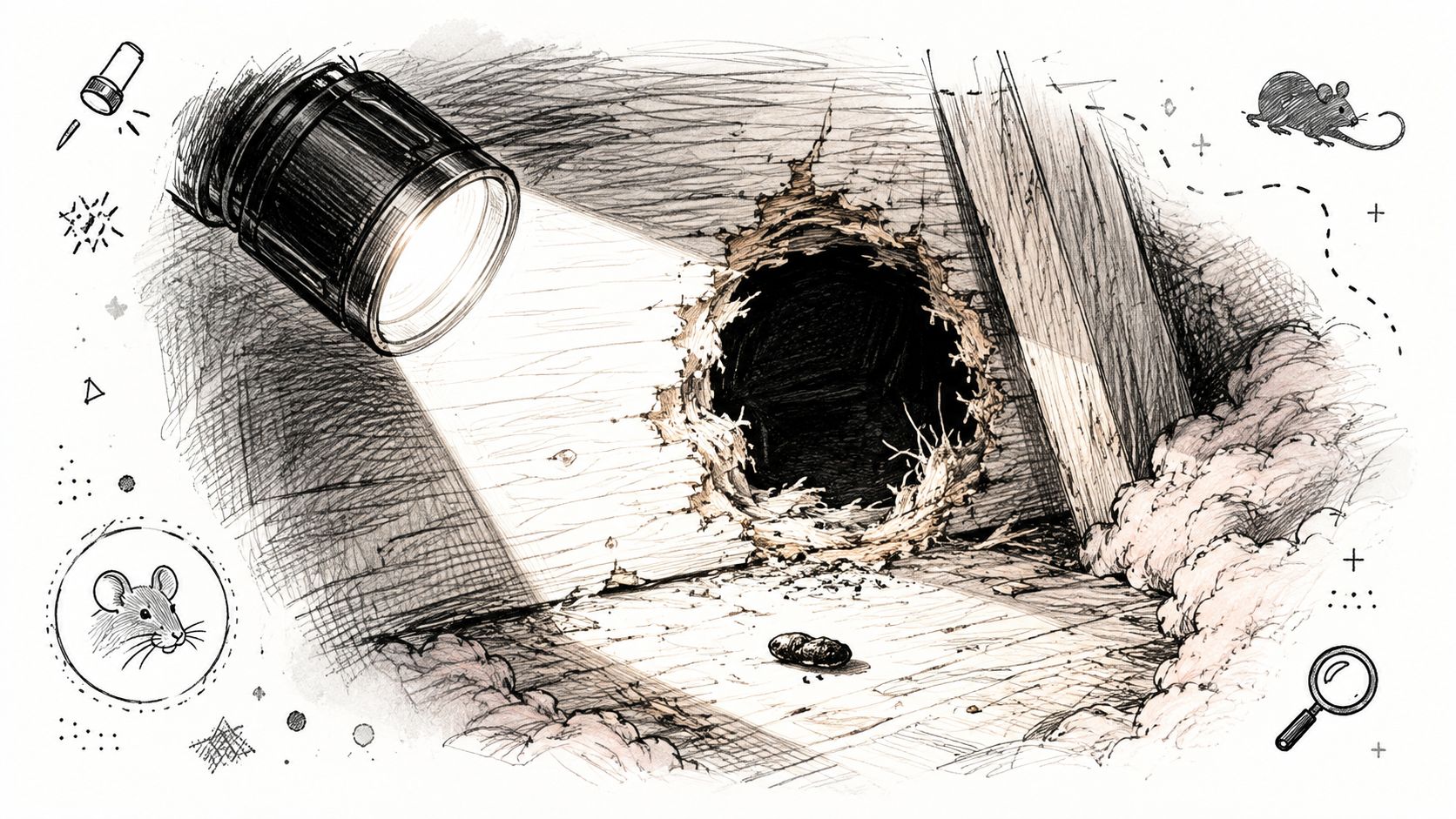
Visual evidence shows up next. Droppings along beams, gnaw marks on wiring, smudge marks where fur has rubbed along travel lanes, and damaged fruit in the yard all point to ongoing use of the property. Roof rat droppings are smaller and more tapered than squirrel droppings, and squirrels are more active at dawn and dusk, while roof rats are strictly nocturnal.
Odor usually means the space has been occupied for a while. A musky, ammonia-like smell in an attic or enclosed crawl area often shows up when droppings, urine, or nesting material have been left undisturbed.
Where each sign tends to show up
- Ceiling scratching, often over a garage, hallway, or bedroom under the attic.
- Droppings on beams, usually near rafters, stored boxes, or insulation paths.
- Gnaw damage, most often around wiring, wooden framing, or stored goods.
- Smudge marks, commonly on attic joists, conduit lines, and roof-side runways.
- Fruit damage outdoors, especially under trees that connect to the roof.
If the activity is strictly at night and keeps returning in the same place, treat it as roof-rat behavior until the inspection proves otherwise.
The hardest part for homeowners is that most Texas guides stop at signs and general prevention. That's where people get stuck, because trapping may remove a few animals, but it doesn't stop the entry points. Roof rats keep coming through roofline gaps, vents, utility penetrations, and trees that still touch the structure.
That's why I treat this as an environmental displacement issue too. Landscaping, rebuilding, and dry conditions can push rodents into attics and upper floors even in a clean home. For a deeper look at identifying the evidence correctly, this guide to rodent droppings and prevention is a useful cross-check before you call anyone out.
A Step-by-Step Exclusion and Prevention Protocol
The cleanest roof-rat jobs I've seen in Magnolia and Conroe start with hardening the structure, not with more traps. The practical threshold is simple, seal gaps larger than 1/4 inch, because roof rats can use openings about the size of a quarter, and they don't need much more than that to keep moving in and out. Comanche Roofing's Texas identification guidance also notes keeping tree limbs at least 6 feet away from the roof.
Exterior hardening first
Roof edges, vent screens, and utility penetrations are the priority. I look for missing flashing, soft wood, lifted fascia, torn gable vent screening, and any line or pipe penetration that isn't tightly sealed. Hardware cloth, metal flashing, and sealed penetrations are the materials that hold up, while loose foam or sloppy patch jobs don't last in Texas heat.
Sanitation has to happen at the same time. Garbage needs to stay secured, pet food shouldn't sit out overnight, fallen fruit needs to be picked up, and bird feeders should be managed so seed doesn't spill along the roofline. If the food stays available, the rats keep testing the structure.
Clean up contamination the safe way
Frisco's municipal cleanup guidance gives a simple method for droppings or urine contamination. Wear gloves, soak the area with disinfectant or a 1:10 bleach solution, do not sweep or vacuum, remove waste with paper towels, and wash exposed clothing or bedding. Those steps matter because dry cleanup can spread contaminated dust through the attic or living space.
Seal first, clean second, trap third. If the order is wrong, the rat pressure stays active.
For a more detailed look at the actual sealing work, these rodent entry-point sealing tips line up well with what holds up on real homes. I also use this standard to judge whether a contractor has done the job fully, or just made it look better for a week.
Interior hardening that gets overlooked
Inside the attic, access points around plumbing, wiring, and the attic hatch need the same attention. Protected wiring runs, sealed attic access points, and screened roof vents stop the easy reinvasion routes. If a tree still reaches the roof, though, the work is incomplete.
DIY Control Options and Honest Limits
Snap traps are the most useful DIY tool when they're placed correctly, but they work best after exclusion has started. Set them along beams, rafters, and known run routes in the attic, not in open floor space where roof rats won't naturally cross. Electronic traps and bait stations can help in some situations, but they're not a substitute for closing the entry points.
What works, and where DIY stops
- Snap traps, best for active runways in attics and along upper-wall travel paths.
- Single-visit exclusion, useful for very small, simple jobs if the homeowner can safely reach the roofline.
- Off-the-shelf bait stations, limited value when access routes stay open.
- Over-the-counter rodenticide, risky around children, pets, and wildlife, and it can create dead-odor problems inside walls.
A lot of homeowners also underestimate how fast an exclusion job gets technical. A one-story roof with simple soffits can be manageable for a hands-on owner, but multi-story homes, complex rooflines, and heavy tree cover usually push the work past a sensible DIY ceiling.
If drains or utility paths are part of the access story, contact MG Drain Services as a reminder that some entry and moisture issues need specialized trade attention before rodent work can really hold. Wet, hidden spaces make exclusion harder, not easier.
| Entry Point or Risk | Action | Threshold |
|---|---|---|
| Roofline gaps | Seal with rodent-resistant materials | Larger than 1/4 inch |
| Attic vents | Install hardware cloth | Fine mesh, tightly fastened |
| Roof access from trees | Trim limbs back | At least 6 feet from the roof |
| Droppings or urine | Clean with disinfectant or 1:10 bleach solution | Gloves, no sweeping, no vacuuming |
What Professional Rodent Services Actually Deliver
A real rodent service should read like a building repair plan, not a trap sale. The process starts with inspection, then moves to exclusion, then trapping and sanitation, then follow-up to confirm activity has stopped and no new entry points have opened up. That sequence is what makes the difference between a short-lived reduction and a stable fix.
What a full inspection covers
On a Magnolia-area home, the inspection should include roof edges, attic spaces, vents, utility penetrations, and harborage sites around trees and attached structures. That's where roof rats travel, hide, and re-enter. A provider should be able to explain which openings are active and which are just old damage.
What the service should include
FullScope Pest Control offers rodent services that cover inspection, exclusion, sanitation guidance, and trapping, with QualityPro certification and an integrated pest management approach. It also offers pet- and child-friendly options, which matters in homes where the attic or garage sits above bedrooms and living areas. Attic rodent prevention tips are a helpful supplement if insulation damage is already part of the conversation.
What follow-up should look like
Good follow-up is not an upsell. It's a second look at the areas rats were using, plus any new signs that appeared after the first visit. If a contractor never returns to verify the exclusion work, they're asking you to trust that the problem resolved itself.
FullScope's Southeast Texas coverage includes Magnolia, Atascocita, Cleveland, Coldspring, Conroe, Huffman, Humble, Kingwood, Livingston, Montgomery, New Caney, Porter, Splendora, Spring, and Willis. In practical terms, that matters because the same roof-rat behavior shows up differently in tree-heavy lots, older attics, and newer construction, so local experience saves time.
The cleanest answer for recurring attic activity is usually the same one I give on site, inspect, seal, trap, then verify. Anything less leaves the structure open for the next round.
Seasonal Pressure and Long-Term Outlook in Southeast Texas
Roof-rat pressure in Southeast Texas doesn't stay flat through the year. Cooler months, major construction projects, and drought-driven food and water stress all increase the odds that rats shift toward attics, rooflines, and upper walls, especially in neighborhoods with mature trees and dense development. That's why Magnolia, Conroe, Kingwood, Cleveland, and Porter see repeat complaints instead of neat one-time events.
Why the same home keeps getting hit
A rat issue that appears after a remodel, a new build nearby, or a dry stretch usually points to displacement. The rodents didn't get smarter overnight, the property around them changed. Once that happens, the home becomes part of a larger movement pattern, not just a standalone infestation.
Recurring attic activity is usually a sign of open access and changing surroundings, not homeowner neglect.
That's also why seasonal roofline inspections make sense. If you wait for a smell, a nest, or obvious noise, the activity has already been going on long enough to contaminate insulation and create re-entry routes. Maintenance is cheaper in effort than rebuilding the same exclusion points after every return visit.
The practical long-term rules stay the same. Keep vegetation at least 6 feet back from the roof, keep food sources secured, and treat the attic as a monitored space, not a storage area that can be ignored for years. Roof rats exploit convenience, and Southeast Texas gives them plenty of it when roof edges, trees, and utility lines connect cleanly.
For Magnolia homeowners, the question is not whether roof rats can reach the house. They can. The better question is whether the house is still giving them a route, a food cue, and a place to stay once they arrive.
If you're hearing nighttime scratching, finding droppings in the garage, or seeing tree-connected roof access around a home in Magnolia, Conroe, Kingwood, Cleveland, or Porter, schedule a professional roofline inspection and ask for an exclusion-first plan. A good rodent service should show you the openings, seal them, clean the contamination correctly, and come back to verify the work held.