 1500+ reviews

In June 2026, the New World screwworm reappeared in the United States for the first time in nearly four decades. Confirmed cases have now climbed to a dozen across South and Central Texas, and the news has North Houston pet owners asking the same question: are we at risk?
Here is what the outbreak actually looks like right now, what it means for our area, and why awareness and reporting, not panic, are the real keys to keeping it contained.
What Is the New World Screwworm?
The New World screwworm (Cochliomyia hominivorax) is not your typical nuisance fly. The adult fly seeks out warm-blooded animals with an open wound, a scratch, a tick bite, even an umbilical site on a newborn calf, and lays her eggs there. Once the eggs hatch, the larvae do something most flies do not: they burrow into living tissue and feed on it. Left untreated, the damage can be severe enough to kill livestock, and in rare cases, it affects pets and people too.
This is the same pest the United States eliminated in the 1960s and 70s using the sterile insect technique, releasing massive numbers of sterile male flies to collapse wild populations. That program worked so well that most Texans alive today have never had to think about screwworm, until now.
Where Cases Have Actually Been Confirmed
This is the most important part of the story, and the part that tends to get lost in the headlines: every confirmed U.S. case so far is in South and Central Texas, not North Houston.
The current quarantine zone covers parts of Zavala, La Salle, Gillespie, Edwards, Sutton, Tom Green, Coke, Crockett, Kerr, Kimble, Schleicher, Uvalde, Val Verde, and Webb counties, along with a single case across the state line in Lea County, New Mexico. That detection zone sits well over 200 miles southwest of Houston, in Texas’s brush country cattle and ranching region. There have been no confirmed cases, in livestock, pets, or people, anywhere near Harris County or the greater Houston area.
That distance matters. It does not mean North Houston should ignore the outbreak, but it does mean the conversation should be about awareness, not alarm.
Why Awareness and Reporting Matter More Than Anything Else
Here is the part that actually determines whether this stays a South Texas story or becomes a statewide one: early detection and reporting.
The original eradication effort succeeded because the country built a system for catching cases fast and responding before populations could rebuild. The same principle is driving today’s response. USDA and the Texas Animal Health Commission are running daily surveillance, sterile fly releases, and movement restrictions in the infested zone, but all of that depends on people noticing something is wrong and saying so quickly. A wound that will not heal, a foul smell, visible larvae, these are the signals that get cases identified before flies have a chance to spread further.
In other words, the single best thing a North Houston homeowner can do right now is not to fear screwworm specifically. It is to build the habit of noticing wounds on pets early and acting on anything unusual without delay, and to know who to call if something does not look right.
Prevention Tips for North Houston Pet Owners and Homeowners
A few simple habits go a long way, whether or not screwworm ever reaches our area:
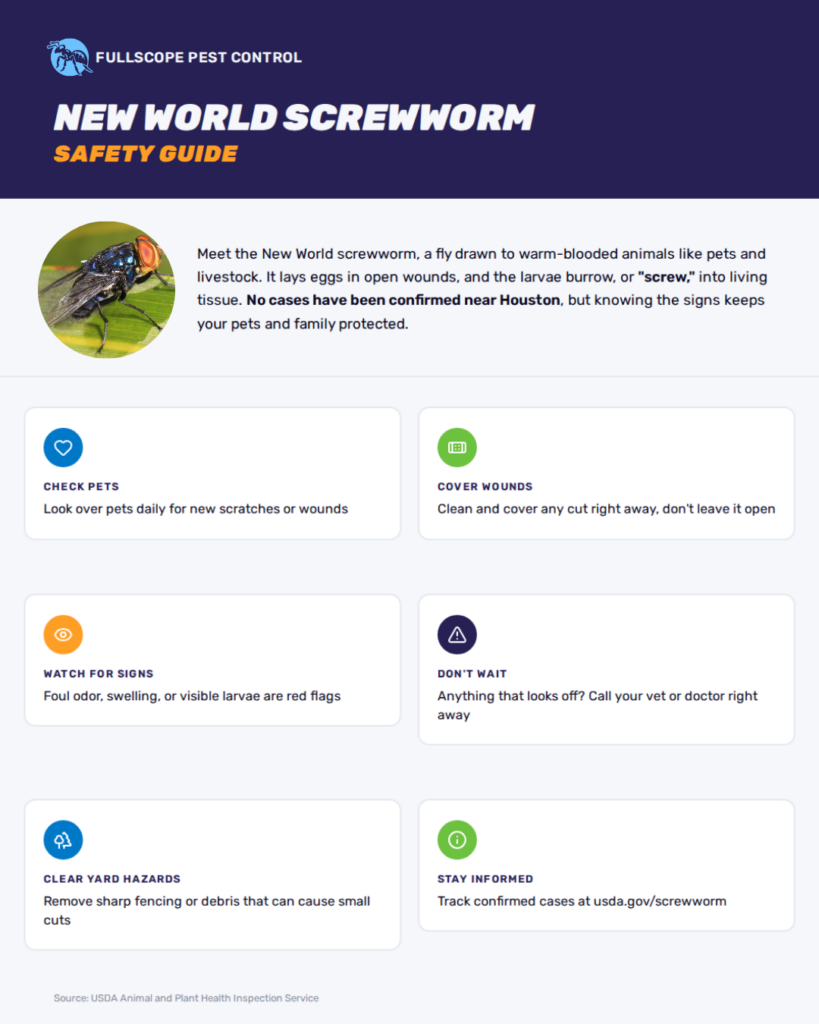
- Check pets daily for new scratches, cuts, or wounds, especially after time outdoors
- Clean and cover any wound right away instead of leaving it exposed
- Watch for warning signs: foul odor, swelling, or visible larvae around a wound
- Don’t wait if something looks off. Call your veterinarian or doctor right away rather than monitoring it at home
- Clear yard hazards like sharp fencing, exposed wire, or debris that can cause the small cuts flies are drawn to
The Bigger Picture for North Houston
Houston is not cattle country, but the region is not insulated from this story either. Montgomery, Liberty, and Waller counties have working ranches and acreage properties where livestock and pets are part of daily life, and local veterinary clinics across the greater Houston area have already fielded a noticeable increase in screwworm-related questions since the outbreak began. Even where the direct risk is low, the indirect effects, owner anxiety, vet visit volume, and demand for reliable information, are already being felt.
There is also a broader pest-pressure angle worth understanding. Screwworm flies are drawn to the same conditions that draw most flies: standing water, exposed trash, and unmanaged yard debris. Reducing overall fly pressure around a property will not prevent screwworm specifically, but it is a meaningful part of a layered approach to protecting pets and family from fly-borne issues in general, and it is something every homeowner can act on today regardless of where the outbreak ultimately spreads.
Staying Informed
The situation is evolving, and the most reliable source of updates is USDA APHIS at screwworm.gov and the Texas Animal Health Commission at tahc.texas.gov. If you suspect a screwworm infestation in an animal, contact the Texas Animal Health Commission NWS line at (800) 550-8242 or your veterinarian immediately. Suspected human cases should be evaluated by a doctor right away.
For North Houston homeowners, the takeaway is simple: stay informed, build the habit of checking pets and wounds early, and know that awareness and fast reporting, not panic, are what keep outbreaks like this one contained to where they started.
Want help keeping fly pressure down around your property as part of a broader pest management plan? Reach out to FullScope Pest Control to talk through what’s right for your yard.
The Bigger Picture for North Houston
While no cases have been confirmed near Houston, homeowners can benefit from reducing pest pressure through proactive prevention.
Learn more about our North Houston mosquito control services and how we help homeowners protect their outdoor spaces year-round.
Homeowners may also benefit from implementing a comprehensive pest management plan to address multiple pest threats throughout the year.
For additional education, read our blog