1500+ reviews

A lot of homeowners start looking into a mosquito misting system installation after the same kind of evening. The grill is hot, the patio lights are on, people are outside for maybe ten minutes, and then everyone starts swatting, scratching, and drifting back indoors. In Southeast Texas, that pattern gets old fast.
An automated misting system can change that. It gives you a built-in perimeter treatment instead of relying on citronella candles, hand sprayers, or remembering to fog the yard before guests arrive. But this isn't a simple weekend project for every property. Some yards are straightforward. Others have tight lot lines, dense landscaping, exposed seating areas, and neighbors close enough that bad nozzle placement turns into drift complaints.
The key question is: Can you handle the job yourself, or are you better off having a technician design and install it correctly from the start? If you're still deciding whether this type of system makes sense for your yard, this guide on why you need a mosquito misting system in Texas gives useful background before you get into layout and hardware.
Reclaiming Your Yard from Mosquitoes
The appeal of a misting system is simple. You want your yard back.
For many families in Magnolia, Kingwood, Conroe, and the rest of the north Houston area, the problem isn't one bad weekend. It's a whole season of evening plans getting cut short. Back patios, pool decks, dog runs, and garden paths become places you avoid after sunset. That's usually when homeowners stop asking about temporary fixes and start asking about a permanent setup.
What homeowners usually expect
It's easy to assume a mosquito misting system installation works like irrigation. Mount a tank, run some tubing, add a few nozzles, set a timer, and you're done. The hardware side can look that simple from a distance.
It usually isn't.
The difference between a system that helps and a system that causes headaches comes down to layout, calibration, and upkeep. If the nozzles are pointed poorly, the mist misses the resting zones where mosquitoes hang out. If the spacing is wrong, you get gaps. If the unit is placed in a bad location, service becomes annoying and winterization gets neglected.
A misting system isn't just equipment on the fence line. It's a pesticide delivery system, and the layout decides whether it works.
The real trade-off
DIY makes sense for some properties. A basic rectangular yard with clear fence runs, limited vegetation, and plenty of buffer from neighbors is easier to map and install. Homeowners who are comfortable with outdoor electrical connections, tubing runs, chemical handling, and regular maintenance can sometimes pull it off.
Dense neighborhoods are a different story.
In places like Magnolia and Kingwood, a lot of yards have narrow setbacks, mature shrubs, tree cover, and outdoor living spaces packed close to the property line. In those settings, the technical mistakes matter more. A sloppy install doesn't just underperform. It can create drift, wasted product, and constant adjustment work.
That's why the planning phase matters more than is often realized.
Strategic Site Assessment and Layout Planning
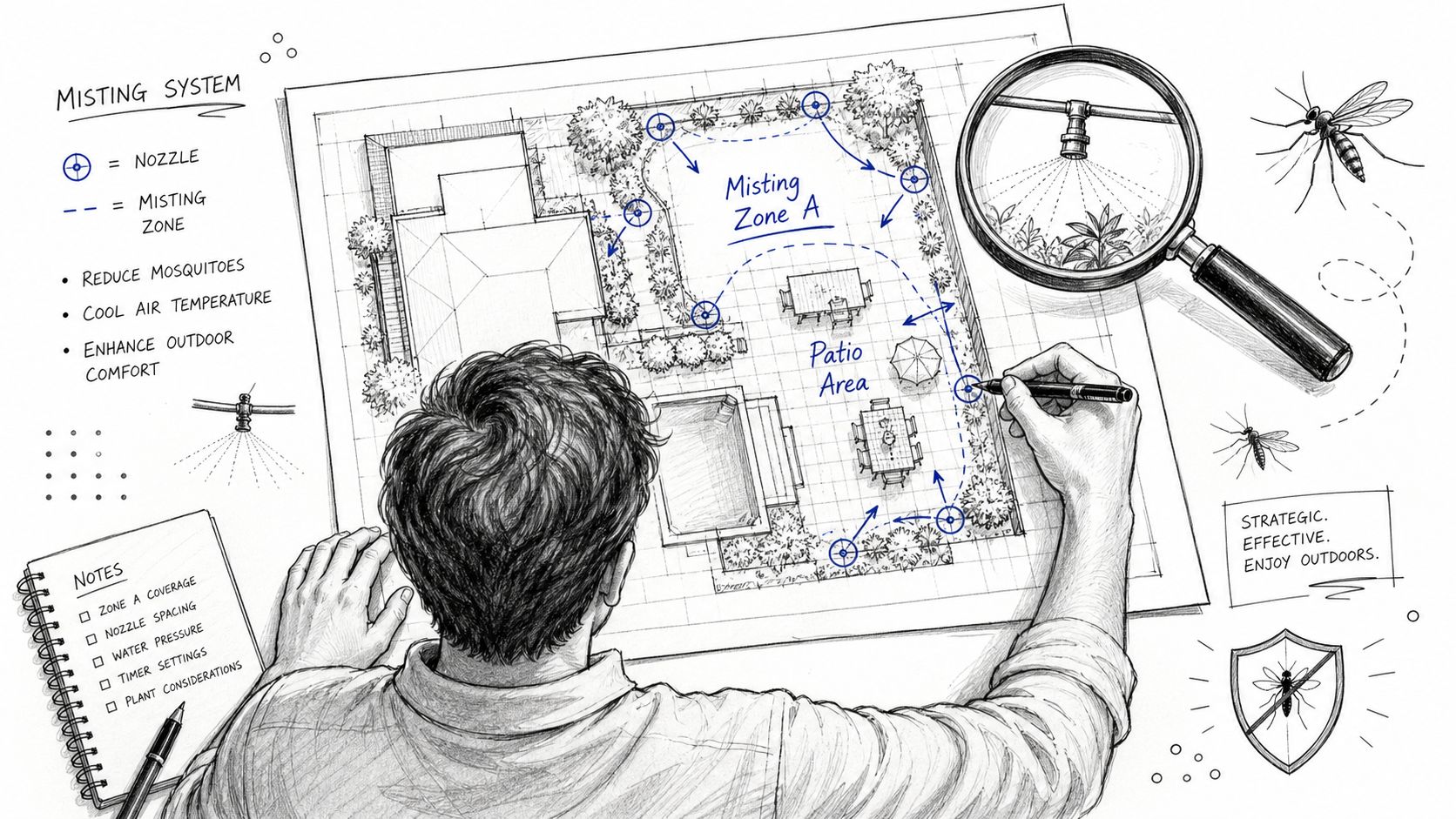
A good plan starts with a walk of the property at the time mosquitoes are likely to be active. Late afternoon or early evening shows more than a quick noon inspection. You can feel where air stalls, see which corners stay damp, and spot the shaded pockets that hold mosquitoes between feedings.
Start with the mosquito resting zones
Open turf usually is not the target. Mosquitoes hold in cool, protected cover. Look at shrub lines, fence intersections, damp side yards, groundcover near condensers, and beds around patios or pool decks. If a spot stays shaded, humid, and still, it belongs on the map.
Mark those resting areas first. Then mark the spaces people use. The two overlap sometimes, but not always. A workable layout protects seating and doorways while still putting mist where mosquitoes spend most of the day.
If you need help sketching the yard before you touch any hardware, some homeowners use landscape software for homeowners to map fences, beds, patios, and structures. It helps you see tubing paths, mounting surfaces, gate crossings, and blind corners before you start drilling holes.
Set nozzle locations for control, not appearance
Nozzle height and spacing decide whether the system reaches the target zone or sends product into open air. In the field, tighter spacing makes sense in heavy shrub cover because foliage blocks mist. Wider spacing can work on straight, open fence runs, but pushing that too far usually creates dead spots.
Height matters just as much. Install nozzles too high under the eaves and the pattern often floats past the harborage instead of settling into it. In tighter subdivisions around Magnolia or Kingwood, that also raises the chance of drift toward a neighbor's patio, play area, or open window.
A clean-looking layout is not always a good-performing layout.
My rule on residential jobs is simple. If the nozzle cannot be aimed into shaded cover without crossing a walkway, grill area, or property line, it is the wrong location. Rework the route before you install anything.
Build around real site conditions
Fence line planning only gets you halfway there. The lot itself decides how the system should be arranged.
Check these conditions before finalizing the layout:
- Air movement: Breezy sides of the yard behave differently than enclosed corners.
- Plant density: Thick hedges, vines, and layered beds need closer attention than sparse foundation plantings.
- Neighbor distance: Tight lot lines leave less room for error and make drift control more important.
- Mounting surfaces: Wood fencing, masonry, soffits, and metal gates all affect how cleanly tubing and nozzles can be installed.
- Service path: The tank, pump, and controller need clear access for refills, flushing, and repairs.
Dense neighborhoods expose weak planning fast. A DIY layout that might work on an open acre can become a nuisance on a small fenced lot with mature growth and close neighbors.
Know what belongs on the plan
Before installation starts, the drawing should show more than a rough perimeter line. It should identify every major component and how you will reach it later.
| Component | What it does | What to watch for |
|---|---|---|
| Reservoir or drum | Holds the mixed solution | Leave room to refill, inspect, and clean it |
| Pump unit | Pressurizes the system | Needs a stable, dry mounting location with power |
| Tubing | Carries solution through the system | Protect it from trimmers, gates, pets, and foot traffic |
| Nozzles | Disperse the mist | Angle and placement decide coverage and drift |
| Controller and sensors | Automate timing and pauses | Poor placement or skipped safety features causes avoidable service issues |
This is the point where homeowners can make an honest DIY call. If you can map the target zones, account for drift, choose serviceable equipment locations, and route tubing without creating vulnerable runs, the project may be manageable. If the lot is tight, heavily planted, or bordered closely by neighbors, professional planning usually pays for itself in fewer adjustments, less wasted product, and fewer problems later.
The Hands-On Installation Process
A clean install looks simple when it's finished. The work to get there usually isn't.
Mount the tank and pump where service is easy
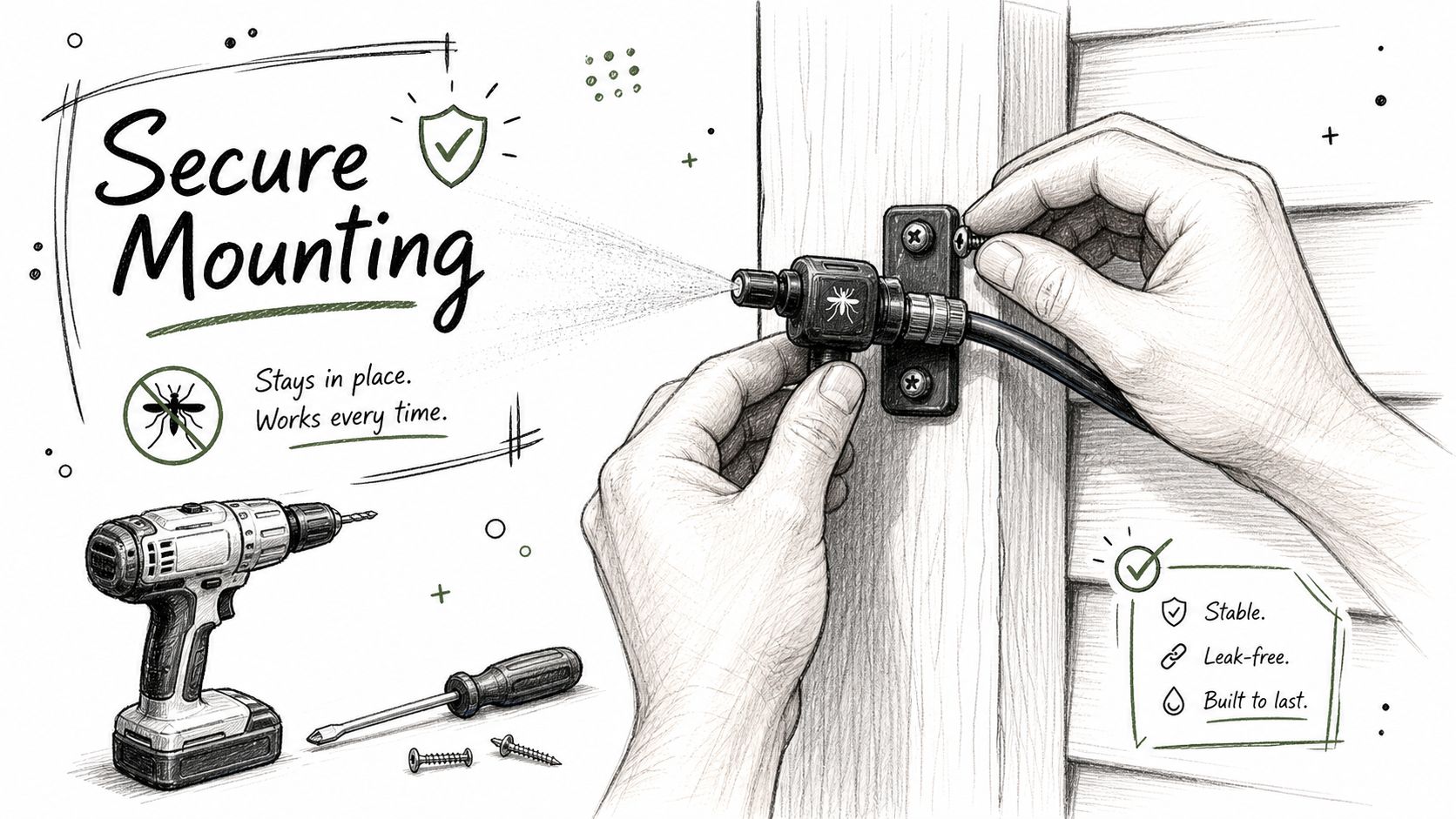
Start with the main unit. It needs a flat, stable location with access to power and water. It also needs protection from roof runoff and irrigation spray. If you tuck it into a spot that's hard to reach, every refill, flush, and repair becomes more annoying than it needs to be.
Many DIY installs begin with a poor decision: homeowners often hide the unit behind dense landscaping so they don't have to see it. That can work visually, but it often creates poor access and extra moisture around the equipment.
Choose a location that balances appearance with serviceability. If a technician has to wrestle through shrubs just to open the tank, the setup was wrong from day one.
Run tubing with the shortest sensible path
Once the main unit is set, run tubing along the planned route. Fence lines, patio edges, soffits, and bed borders are common paths. Keep runs neat and protected. Avoid spots where trimmers, mowers, pets, or gate movement can damage the line.
Three habits help here:
- Leave gentle bends, not sharp turns: Tubing that gets forced around corners is more likely to kink.
- Secure the line consistently: Loose tubing sags, catches, and pulls stress into fittings.
- Think ahead about repairs: If you bury connectors behind décor or hardscape, service gets messy.
A good install is discreet, but it also stays accessible.
Add nozzles where the layout says they belong
Now you're installing the business end of the system. This is the point where precision matters most. Put nozzles where the plan calls for them, not where it feels easiest with a drill in your hand.
That usually means aiming into vegetation, along shaded perimeter zones, and near mosquito harborages. It does not mean spraying open lawn or blasting across a patio where people sit. Watch for gates, children's play areas, pet traffic, and equipment paths.
If a nozzle can get hit by a mower, knocked by a gate, or sprayed directly into open air, relocate it before you ever pressurize the system.
For homeowners doing this themselves, this is often the first moment they realize the install is slower than expected. Every corner creates a decision. Every planting bed changes sightlines. Every exterior material mounts differently.
A visual walkthrough helps if you want to see the hardware sequence before trying it yourself.
Handle hookups carefully
Water connection, pump power, and controller setup need the same level of care as the tubing and nozzle work. Sloppy connections are one of the fastest ways to create leaks, failed cycles, or intermittent performance.
Focus on these points:
- Protect electrical connections: Outdoor power needs weather-appropriate protection.
- Check every fitting by hand: Cross-threading and loose compression fittings cause avoidable leaks.
- Keep tubing clear of heat and abrasion: Sun exposure is one issue. Repeated rubbing against masonry or metal is another.
- Install sensors if practical: Wind, rain, and motion sensors reduce unnecessary spraying and help avoid misting during the wrong conditions.
What DIY installers often underestimate
The physical work isn't usually impossible. The hard part is maintaining consistency through the whole perimeter. One bad corner can throw off the result. One poor nozzle location can start a neighbor complaint. One section of line mounted too loosely can sag, kink, or fail later.
DIY is most realistic when the yard is simple, the owner is comfortable working carefully, and there's patience for testing and later maintenance. If the lot is dense, oddly shaped, or packed with mature landscaping, the install gets technical fast.
System Commissioning and Performance Testing
The first real test usually happens at the worst time. Dusk hits, the system fires, and one nozzle sends mist across the patio while another barely drips. That is commissioning. It decides whether the install controls mosquitoes or just sprays chemical in the general direction of your yard.
Start with a controlled first run. Fill the reservoir with the labeled mix, prime the pump, clear the air from the lines, and run a full cycle while you walk the perimeter. Move slowly. Watch every nozzle pattern, every fitting, and every section of tubing under pressure. Small mistakes that stayed hidden during installation show up here.
Look for the problems that matter in the field:
- Sputtering nozzles: trapped air, partial blockage, or a loose fitting
- Dead spots in the line: a kink, clog, pinched tube, or pressure loss
- Heavy droplets instead of fine mist: the wrong nozzle, contamination, or poor pressure
- Mist crossing property lines or walkways: bad nozzle angle, bad placement, or poor timing for site conditions
Dense neighborhoods make this part harder. In Magnolia, Kingwood, and similar wooded subdivisions, lots are tighter, fences are closer, and landscaping creates odd air movement. A setup that looks fine at noon can drift badly at dusk when air settles. That is one of the biggest DIY blind spots. Homeowners often judge the install by whether the pump runs, not by where the chemical lands.
Scheduling needs the same level of attention. Set cycles around mosquito activity, usually around dawn and dusk, then test and adjust based on the property. Midday spraying often wastes product and increases the chance that people or pets walk through fresh mist. If the yard backs up to another home, a greenbelt, or a pool area, timing matters as much as nozzle placement.
Do a final walk during a live cycle under normal evening conditions. Stand near seating areas, doors, side yards, pet runs, and fence lines. If droplets hang in a place people pass through, fix it. If a fence line sends mist toward a neighbor, re-aim or relocate the nozzle. If the system needs repeated correction to control drift, that is often the point where a professional installer is the better call.
Commissioning also includes the first maintenance check. Clean or replace weak nozzles, confirm the controller keeps correct time, and make sure the tank, filter, and pump are easy to service. Seasonal care matters too. Homeowners who keep these systems longer term should plan for shutdown and freeze protection. FullScope covers the basics in this guide on winterizing your MistAway mosquito misting system.
A DIY installer can handle commissioning on a simple lot with open spacing, clear spray zones, and patience for repeat testing. The margin for error gets much smaller on wooded lots, narrow side yards, and properties with close neighbors. That is where pro installation usually pays for itself. The hardware can look identical. The difference is in the calibration, drift control, and the willingness to keep adjusting until the system performs cleanly.
Calculating Long-Term Maintenance and Costs
A mosquito misting system keeps costing money after install day. Homeowners who plan for that usually stay happier with the system and get more consistent control.
Industry pricing data shows why. The global market for residential mosquito misting systems was valued at $575.57 million in 2026 and is projected to reach $749.49 million by 2035, with a 9.2% CAGR. For U.S. homeowners, professional installation averages $2,747, with typical spending between $1,957 and $3,584. Installation labor often runs $200 to $1,000, and a standard 30-nozzle system commonly costs $400 to $700 to install, according to Global Market Statistics.
The bigger budgeting mistake is treating that as the full cost.
Over five years, once you add annual operating expenses of $600 to $1,500, total ownership can run $6,000 to $13,500. That range changes with lot size, spray frequency, chemistry use, service intervals, and how often parts get replaced. On a simple property, a careful DIY owner can keep costs closer to the low end. On tighter lots in Magnolia or Kingwood, maintenance usually takes more time because nozzle adjustment, drift control, and routine service all need closer attention.
Here's the routine work that drives ownership cost:
- Reservoir refills: Solution has to be monitored and topped off before the system runs low.
- Nozzle cleaning and replacement: Fine mist nozzles clog. Once spray quality changes, coverage changes with it.
- Filter and line checks: Tubing, fittings, and filters wear out from heat, sun, pressure, and accidental damage during yard work.
- Seasonal shutdown: Cold snaps can crack components if the system is left full. Homeowners who need a checklist can use this guide on winterizing your MistAway mosquito misting system.
- Scheduled service: Flushing lines, checking pump output, and confirming nozzle direction keeps the system spraying the way it was designed to spray.
Neglect usually shows up as weaker performance first, not a dramatic breakdown. Analysts at Global Market Statistics found that without proper quarterly maintenance, systems can lose up to 40% efficacy within 18 months due to clogging and algae buildup.
That pattern is common in humid Texas conditions. One or two weak nozzles reduce coverage. Uneven output can increase drift. Then the owner buys more concentrate or changes the timer, trying to solve what is really a maintenance problem.
DIY ownership makes sense for homeowners who will service the system, keep spare parts on hand, and pay attention to spray quality every few weeks. If that sounds like another house system you do not want to babysit, paying for professional upkeep often saves money in wasted chemical, premature part replacement, and poor results. The same logic applies to other outdoor projects. People hire Georgia shed moving services because specialized equipment and experience reduce the chance of expensive mistakes. Misting systems are similar. The install is only part of the bill. Keeping the system working correctly is what determines whether the investment holds up.
When to Hire a Professional Installer in Magnolia TX
If your property is simple and you're comfortable with layout work, tubing, calibration, and ongoing service, DIY can be reasonable. If your yard is tight, with extensive outdoor features, or close to neighbors, professional installation is usually the safer call.
Magnolia matters here. FullScope Pest Control's Magnolia service page explicitly lists Magnolia, TX as a designated service location, confirming that mosquito misting system installation and maintenance are available there. That matters for homeowners who don't want a company that only loosely serves the area. Magnolia residents often deal with a mix of wooded lots, subdivision layouts, and neighbor proximity that can make drift control more technical than it looks.
The properties that usually justify pro installation
Professional help makes more sense when the yard has:
- Dense vegetation near property lines: These lots require more careful nozzle planning.
- Multiple outdoor living zones: Patios, pool areas, kitchens, and play spaces all need different consideration.
- Complex perimeter runs: Gates, detached structures, and irregular lot lines complicate tubing paths.
- Limited room for error: In close neighborhoods, bad calibration doesn't stay on your side of the fence.
Homeowners often understand this instinctively in other projects. If a large obstacle has to be moved before layout or access work begins, people don't usually improvise with the wrong equipment. They look for a specialist, much like someone might use Georgia shed moving services when a structure has to be relocated safely instead of dragged across the yard. Misting system work has a similar threshold. Once the job affects safety, property layout, and long-term reliability, experience matters.
DIY vs Professional Installation Comparison
| Factor | DIY Installation | Professional Installation (FullScope) |
|---|---|---|
| Property assessment | Homeowner maps the yard and identifies coverage zones | Technician evaluates layout, harborage, and service access |
| Nozzle calibration | Easy to misjudge height, spacing, and angle | Installed to fit the property and reduce drift risk |
| Dense neighborhood concerns | Higher chance of neighbor issues if layout is off | Better suited for close lots in Magnolia, Kingwood, and Conroe |
| Startup testing | Homeowner troubleshoots leaks and spray quality | Commissioning handled as part of installation |
| Maintenance burden | Owner handles cleaning, winterization, and inspection | Ongoing maintenance can be managed as a service |
| Local availability | Depends on your own time and skill | Available in Magnolia and nearby communities |
QualityPro-certified providers with local experience in north Houston conditions have an advantage here because they've seen the same yard types and the same failure points repeatedly. If you want local service options for installation or maintenance, mosquito control near Magnolia and the surrounding area is the practical next step.
For a lot of Magnolia homeowners, the decision comes down to this. If you want a project, DIY may fit. If you want a working system that's laid out carefully, tested properly, and maintained on schedule, hiring a pro is usually the better investment.
A mosquito misting system installation can absolutely reclaim an outdoor space, but only when the layout, calibration, and maintenance are handled with care. The hard part isn't mounting tubing. It's making the whole system work safely and consistently in a real yard with wind, vegetation, neighbors, pets, and seasonal upkeep. In Magnolia, Texas, that's often the difference between a smart long-term solution and a system that becomes another piece of equipment you're always adjusting.