1500+ reviews


You notice a dark patch along the base of a wall after rain, or find a few pale wings on a windowsill while cleaning. Maybe the slab edge looks damp long after the patio dries, or a door suddenly sticks without an obvious reason. In a Magnolia, Texas home, those clues deserve attention even when you can't find a single termite.
The practical answer to how to tell if you have termites starts with more than visible insects. Look for a pattern involving unexplained moisture, shelter tubes, damaged wood, pellets, wings, and changes in the structure. A clean-looking room only tells you that the room looks clean. It doesn't prove that the wall cavity, sill area, crawl space, or slab edge is clear.
Why Termite Problems Stay Hidden Until They Get Expensive
A Magnolia homeowner may first notice termites while sweeping beneath a window, moving storage boxes in a garage, or checking a wall that has developed a strange blister. The obvious sign often appears well after termites have found a concealed route into the structure. Subterranean termites can remain hidden in soil, wall voids, insulation, or mud shelter tubes, while drywood termites stay inside the wood they consume.
Termites are effective at hiding for three related reasons. They avoid open, dry exposure, they travel through protected routes, and they can feed inside wood while leaving much of the outer surface intact. The USDA Forest Products Laboratory guidance on subterranean termites explains that these insects may consume the interior of wood while the exterior shell remains in place.
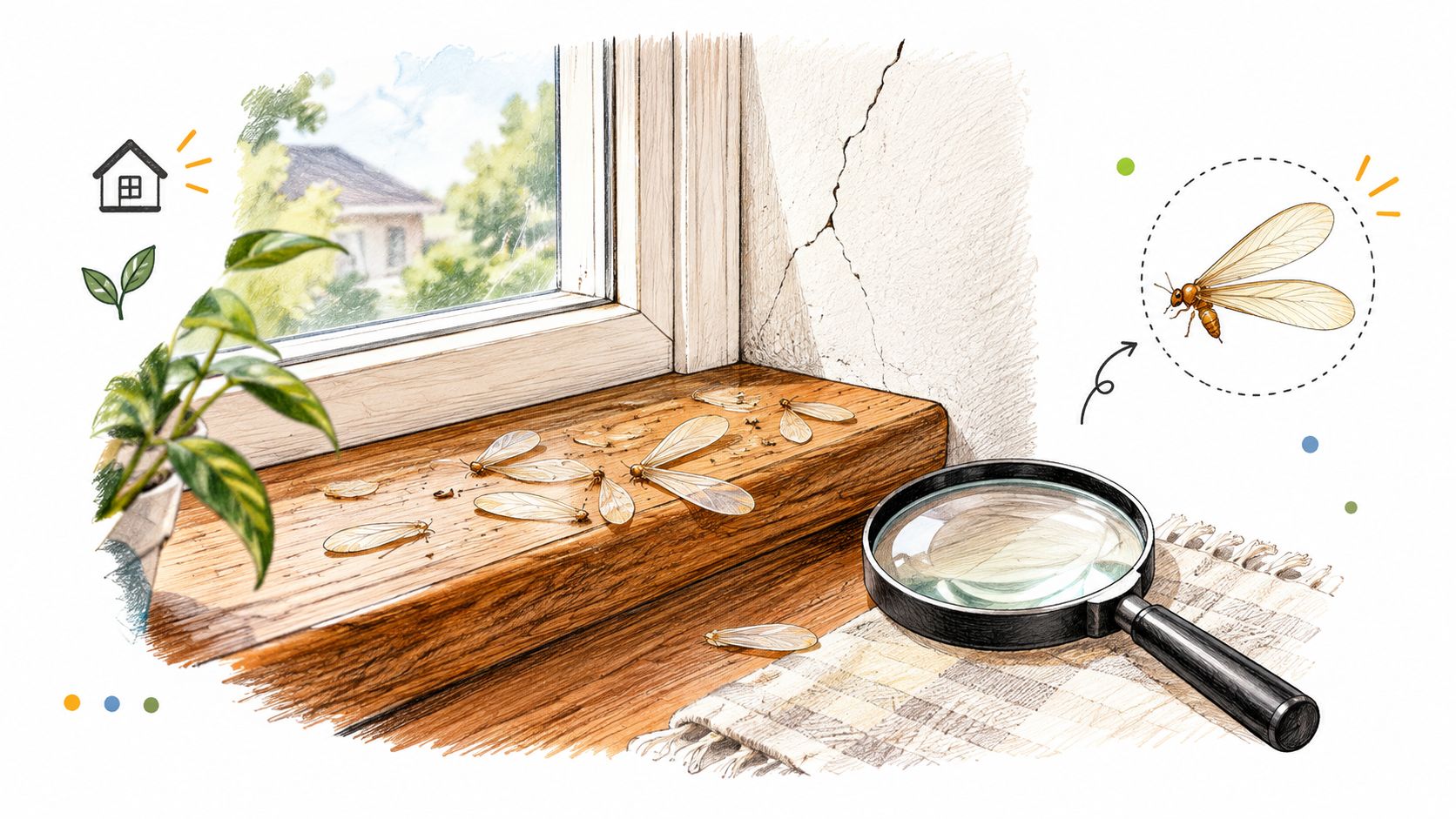
Why a clean room proves very little
A visual inspection that covers only finished rooms misses the locations where evidence commonly develops. Termites may enter near a plumbing penetration, remain behind a baseboard, or travel beneath a slab edge before reaching a wooden component. In a crawl space, insulation and ductwork can hide the route entirely.
Swarmers and discarded wings are valuable evidence, but they offer only a short observation window. Mississippi State University Extension notes that colonies may swarm for only about one day per year, so the absence of swarmers doesn't rule out activity. Wings indoors, especially near windows, lights, or wall openings, should prompt an inspection rather than reassurance.
Practical rule: Treat a clean-looking surface as unexamined until you have checked the moisture sources, entry points, accessible wood, and protected edges around it.
The first inspection question should be, “Where could termites stay protected here?” On a slab home, that means foundation edges, plumbing penetrations, porches, expansion joints, utility entries, and areas where soil, mulch, siding, or stored wood come close to the structure. In a crawl space, add sill plates, joists, support piers, and any place where ventilation or drainage leaves wood damp.
The purpose of screening isn't to prove a suspicion from one dramatic clue. It is to collect enough evidence to distinguish current activity, old damage, water damage, decay, and another wood-destroying insect.
Walking the Perimeter, Crawl Space, and Slab Edge
Start outside and work inward. Subterranean termites usually need a protected connection between soil and wood, so the foundation perimeter often gives you the most useful first evidence. Walk slowly with a flashlight, screwdriver, phone camera, and a way to record locations.
Begin where soil meets the structure
Inspect foundation walls, slab edges, porch supports, garage edges, and places where plumbing or utilities enter. Look for earthen shelter tubes, which are commonly about 1/4 to 1/2 inch wide according to the county inspection guidance compiled by San Diego County. They may look like narrow dirt trails climbing concrete, crossing a pier, or disappearing beneath siding.
Don't scrape every tube away before documenting it. Photograph the entire route, then take a close image that shows texture and location. If it's safe and accessible, break a small section rather than destroying the whole tube. Check it over the following several days. Repair activity or live workers indicates that termites are using the route, while an untouched break only tells you that the route wasn't repaired during that observation period.
Check the following locations carefully:
- Foundation transitions: Look where brick, siding, trim, and slab edges meet.
- Moisture entries: Inspect around hose bibs, plumbing penetrations, condensate discharge, and leaking outdoor fixtures.
- Porches and supports: Examine posts, steps, lattice, and wood close to soil.
- Crawl spaces: Check sill plates, joists, support piers, insulation edges, and plumbing openings.
- Stored materials: Move firewood, cardboard, lumber, and dense mulch away from the wall before inspecting the surface behind them.
A property with older construction features or concealed framing can benefit from broader building-context guidance, including this surveyor's guide to 1930s houses from Corinthian Surveyors London LTD. It helps explain why age, alterations, ventilation, and hidden voids affect what a surface inspection can reveal.
Use a short field checklist
Screenshot this before walking the house:
- Photograph every tube before disturbing it.
- Check slab edges, piers, sill plates, joists, and penetrations.
- Look for wood-to-soil contact and persistent dampness.
- Probe only exposed, safe wood.
- Note wings, pellets, soft spots, stains, and blistered finishes.
- Mark each finding by room or exterior wall.
- Leave concealed or unsafe areas for a professional.
A clean foundation is useful information, but it isn't a clearance certificate. Termites can travel behind finished surfaces or enter where the route isn't visible from the exterior.
Reading Wood Damage Patterns by Sight and Sound
Wood damage tells you where termites may have been feeding, but it doesn't identify the cause by itself. Water intrusion, fungal decay, carpenter ants, construction damage, and termites can all produce soft or discolored material. Compare suspicious wood with a nearby sound piece made from the same material whenever possible.
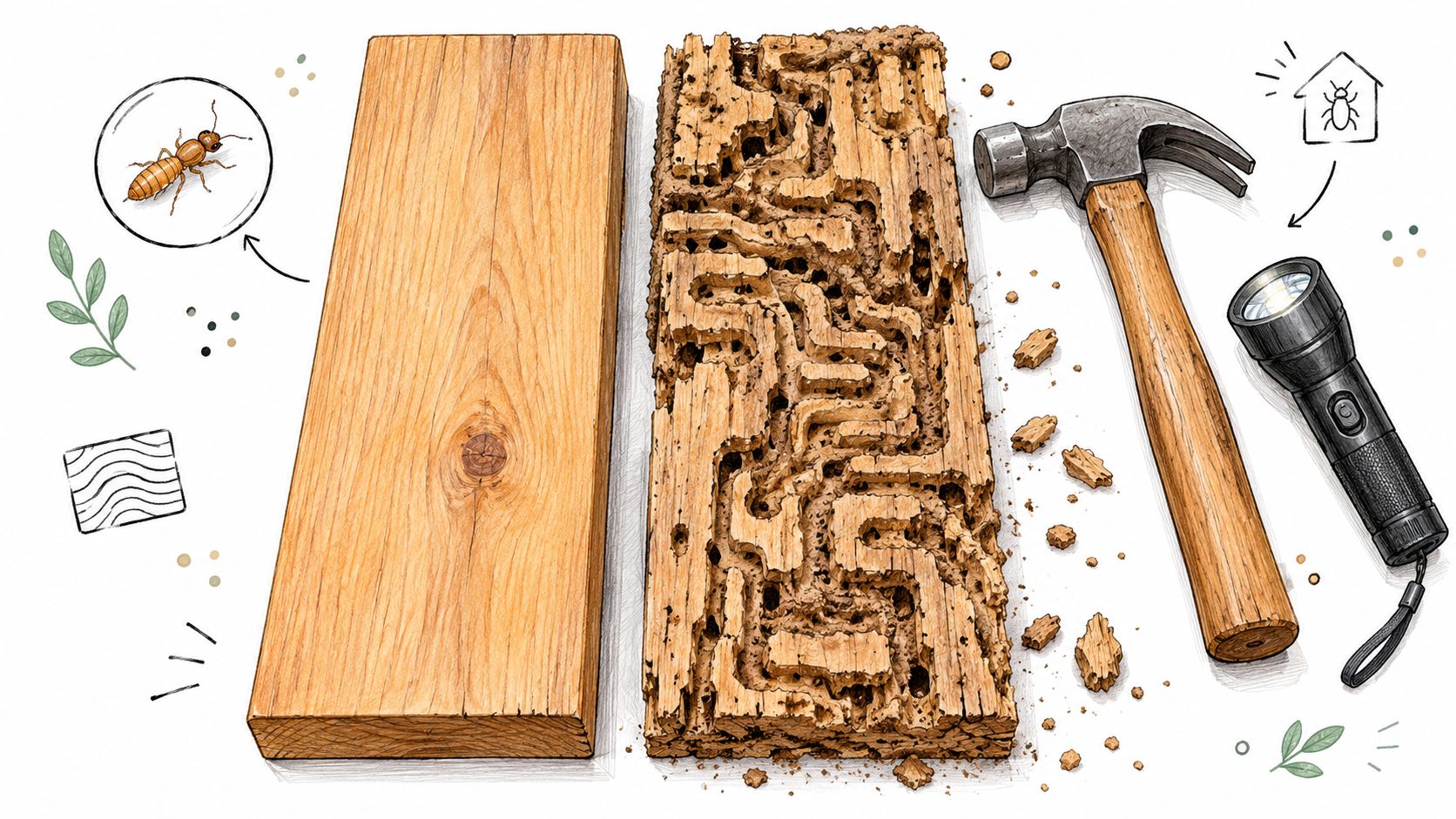
Run your eyes across trim, sill plates, exposed joists, door frames, and flooring transitions. Blistered, swollen, or sunken wood can indicate concealed galleries or moisture damage. Maze-like lines beneath a thin surface, pinholes, and wood that resembles water damage deserve closer attention, particularly when the nearby moisture source hasn't been explained.
Tap the suspect area with the handle of a screwdriver, then compare the sound with sound wood. A hollow tone doesn't prove termites, but it tells you the material may have lost density. Probe only accessible wood with light pressure. Termite-damaged members may feel thin, crumble easily, or give way along grain lines.
For a visual reference, compare your observations with this guide to what termite tunnels look like. The important distinction is not whether every groove looks identical. It's whether the pattern, softness, entry point, and surrounding conditions form a coherent explanation.
Drywood pellets are a different clue
Drywood termites commonly push out small, hard, angular fecal pellets through openings in the wood. These particles are often less than 1 millimeter long, while field guidance may describe individual drywood pellets as approximately 1 to 2 millimeters depending on how they're measured and observed. Their shape and hardness matter more than a casual resemblance to dust.
Pellets often collect beneath trim, furniture, attic framing, or another wooden component. Sawdust alone is not proof. It may come from ordinary cutting, carpenter ants, wood-boring insects, decay, or renovation debris. Preserve a sample if you can do so safely, photograph the pile in place, and note whether it returns after cleaning.
The video below offers another way to visualize the difference between surface appearance and concealed damage.
A small pellet pile or hollow board isn't a treatment decision. It is a reason to identify the organism and determine whether the damage is active, old, or unrelated.
The Moisture Clue Most Homeowners Overlook
The most useful termite clue may be the damp condition that nobody has investigated yet. Subterranean termites dehydrate easily and generally need soil or another moisture source. A clean slab edge doesn't eliminate risk if a plumbing leak, roof leak, air-conditioning condensate line, failed gutter, irrigation spray, or drainage problem keeps a hidden area damp.
That changes the inspection sequence. Instead of waiting for a mud tube, first ask where water is entering, collecting, or drying slowly. Texas A&M identifies moisture meters as useful for detecting excessive moisture behind interior wall coverings, where damp conditions may signal an environment conducive to subterranean termite activity. The Texas A&M guidance on subterranean termites supports treating moisture investigation as part of termite prevention, not as an unrelated repair task.
Follow the water around a slab home
A Magnolia slab foundation can look dry from the yard while a narrow zone near the wall stays damp. Check whether the slab edge remains dark after surrounding concrete dries, whether downspouts discharge beside the foundation, and whether irrigation sprays siding or a garage wall.
Inside, inspect the base of bathroom walls, kitchen plumbing walls, window corners, laundry areas, and locations below air-conditioning equipment. Recurring stains, peeling finishes, soft trim, high humidity, or a musty odor don't confirm termites. They do tell you to inspect the adjacent wood and entry points before assuming the problem is cosmetic.
Use this practical sequence:
- Check gutters, downspouts, grading, and irrigation overspray.
- Trace plumbing and HVAC condensate routes.
- Inspect crawl-space ventilation and standing moisture where applicable.
- Check wood-to-soil contact and dense landscaping near walls.
- Document soft, swollen, hollow, or repeatedly stained materials.
- Arrange confirmation if moisture and wood changes occur together.
A clear explanation of how gutters protect your foundation can help homeowners connect roof drainage with the conditions around the slab. Correcting the water source won't prove termites are absent, but leaving it in place can preserve the conditions that allow concealed activity to continue.
For local context, review this guide to what attracts termites to homes in Southeast Texas. The key point is simple: don't wait for visible insects when unexplained moisture is already telling you where to look.
Using a Moisture Meter and Other Confirmation Tools
A moisture meter extends a visual inspection. It doesn't diagnose termites. Use a pin or pinless meter to compare a suspicious baseboard, sill, beam, or exposed framing member with nearby wood that appears sound and has similar exposure.
The useful question isn't “What number means termites?” No single reading establishes an infestation. Ask instead whether one area is consistently wetter than its surroundings, whether the result aligns with a stain or soft spot, and whether a leak or drainage route explains the reading.
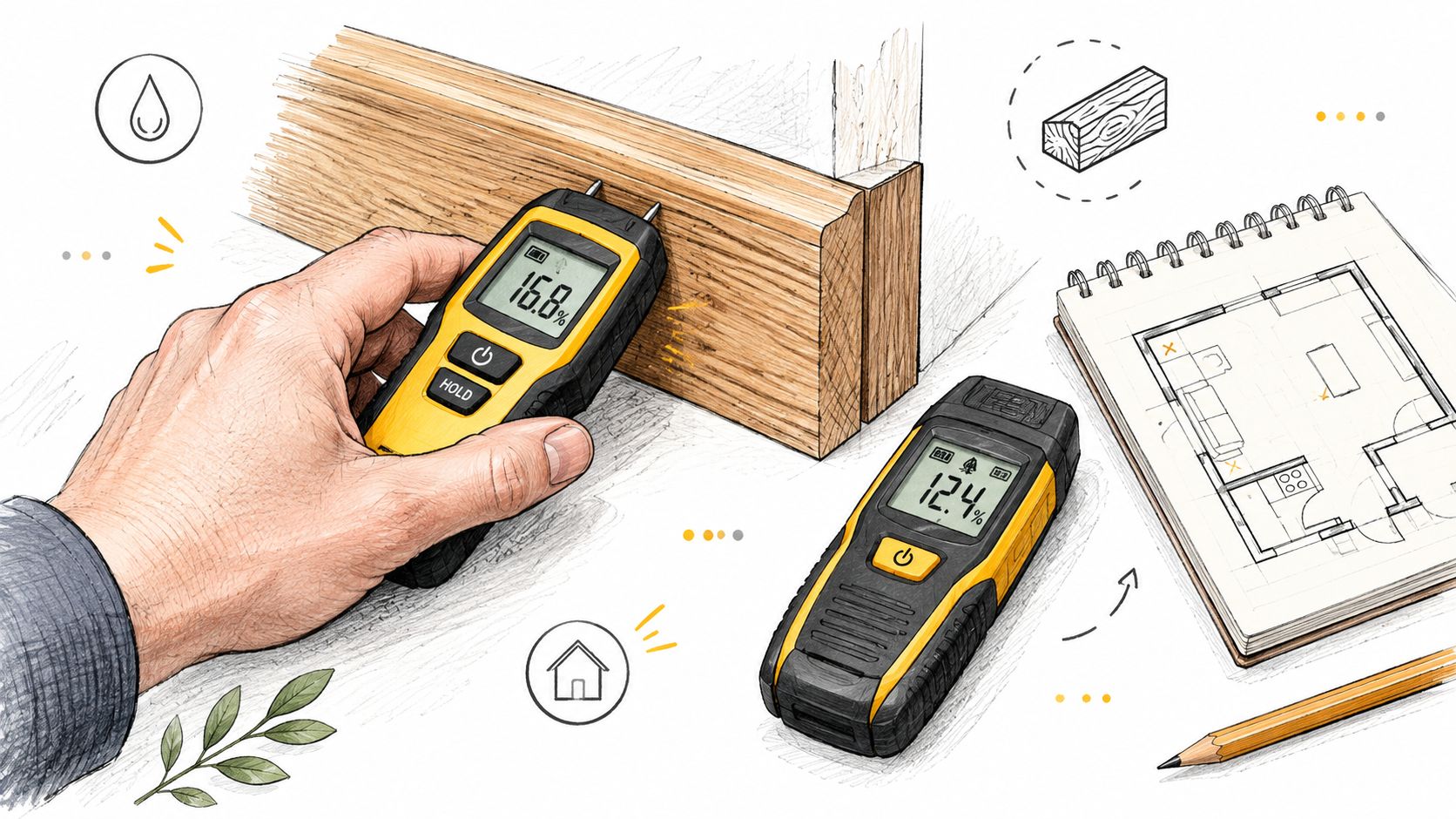
Use the tool to target inspection
A pin meter can test a small area directly, while a pinless meter can scan without leaving holes. Both can be affected by material, surface coatings, fasteners, wiring, salts, and calibration. Drywood termites are especially easy to miss with moisture readings because they don't introduce the same moisture conditions as subterranean termites.
Infrared cameras show temperature or moisture anomalies, not termites. Plumbing leaks, insulation gaps, sunlight, and air movement can create similar patterns. Acoustic tools may detect termite activity in some test settings, with published reviews reporting approximately 80% detection accuracy in certain contexts, but performance changes with wall construction, distance, background noise, colony size, and instrument placement. That figure is not a homeowner guarantee or a stand-alone diagnosis, as the Maryland guidance on termites and ants makes clear.
A meter tells you where to investigate harder. It doesn't tell you what to treat.
Record each anomaly, inspect nearby wood and entry points, verify the insect when possible, and assess damage before selecting a control method. Don't scan only the visibly damaged room. A moisture anomaly in one area may point to a leak, while the termite route is elsewhere.
Documenting What You Find So a Pro Can Act on It
A useful homeowner inspection produces evidence with location and context. Photograph the wide view first, then the close detail. Put a ruler beside a tube or pellet pile when safe, and include a room label or identifying feature so the image still makes sense later.
Log the date, weather or recent rain, room, wall orientation, material, visible sign, moisture source, and whether anything changed after observation. A recurring stain is more informative when you can show that it returned after drying or reappeared after a repair.
What to Capture for Each Type of Finding
| Finding type | What to photograph | What to log | Why it matters |
|---|---|---|---|
| Shelter tube | Full route, close texture, and a ruler beside an undisturbed portion | Exact location, whether it was moist or brittle, and whether a broken area was repaired | Shows a possible soil-to-structure pathway and helps assess apparent activity |
| Shed wings or swarmer | Wings in place beside a scale object, plus the nearby window, light, or wall | Date found, indoor or outdoor location, and whether live insects were present | Helps separate indoor evidence from a nearby outdoor colony |
| Wood damage | Suspect board beside comparable sound wood, with close views of galleries or blistering | Material, room, softness, hollow sound, and nearby moisture | Helps distinguish structural concern from superficial staining |
| Pellets or frass | Pile beneath the suspected wood, with a close detail and surrounding area | Color, location, whether the pile returned, and what wood is above it | Supports investigation of a possible drywood source |
| Moisture anomaly | Meter display beside the tested surface and a wider wall or beam view | Meter type, exact spot, comparison area, and suspected water source | Turns an isolated reading into a traceable diagnostic lead |
Bring the photographs, log, samples if safely collected, repair history, leak history, and any previous inspection documents to the call. Don't spray, scrape, seal, or replace the evidence first unless safety requires it. A clear handoff lets the inspector spend time confirming the pattern instead of reconstructing what happened.
When DIY Stops and a Professional Inspection Begins
Call for a professional inspection when you find live swarmers indoors, repeated shelter tubes, hollow or blistered wood, unexplained moisture beside structural wood, recurring pellets, or several signs in the same area. A real-estate transaction is another clear handoff point because buyers, sellers, and lenders may need a formal wood-destroying insect inspection and report.
A professional should identify the organism, inspect accessible and concealed-risk areas, assess the extent of damage, and explain which evidence appears active or old. Treatment depends on those findings. Possible approaches include liquid soil barriers, bait and monitoring stations, or targeted drywood treatments. None should be selected from a photograph alone.
Magnolia is an incorporated city in southwestern Montgomery County, Texas, within the Houston metropolitan area. The 2020 U.S. Census recorded 2,359 residents in the city, according to the city information summarized for Magnolia, Texas. The city identifies its location at FM 1774 and FM 1488, approximately 45 miles northwest of Houston and 25 miles southwest of Conroe, while describing the greater Magnolia area as extending approximately 12 miles in all directions with an estimated population exceeding 138,000. Those distinctions matter when arranging service, because a Magnolia mailing address may refer to the municipality or to nearby unincorporated communities.
Montgomery County covers 1,047 square miles and connects Magnolia operationally with communities including Conroe, Montgomery, Porter, and other nearby Southeast Texas locations, as described by Montgomery County visitor information. A local provider such as FullScope Pest Control offers termite inspections for homes and businesses, identification of termite type, damage assessment, and treatment recommendations. It also provides wood-destroying-insect inspections and reports for real-estate needs.
Before an inspection, correct leaking plumbing, redirect downspouts, improve drainage, remove wood-to-soil contact, and keep crawl spaces or slab edges observable. Use this complete guide to termite inspection to understand what an inspection should cover, then ask the professional how monitoring, repairs, and follow-up fit the conditions found at your property.
The prevention standard: Remove the moisture source, preserve access to structural edges, and monitor for changes. Treatment works better when the conditions supporting termites aren't left behind.
If you've found wings, pellets, tubes, soft wood, or a persistent damp area in or around your Magnolia home, photograph the evidence and schedule a licensed termite inspection before repairing or disturbing it. Give the inspector your location log and moisture history so the visit starts with usable facts, not a guess.