1500+ reviews

You open the garage door in Magnolia, Texas, and see the same scene many homeowners know well: webs stretched around the door track, a spider tucked behind holiday decorations, and small insects gathering near the light. Sweeping the visible webs away may make the space look better for a day, but it won't solve the conditions bringing spiders back.
The reliable answer to how to get rid of spiders in a garage is to redesign the garage so it stops working as a shelter. That means finding entry points, removing harborage, reducing insect activity, sealing gaps, and using treatment only where it supports those steps. Texas A&M's spider IPM guidance places physical exclusion, sanitation, clutter reduction, and monitoring at the center of that process, with chemical control used as a supplement rather than the whole plan (Texas A&M spider IPM guidance).
Why Garages in Magnolia Attract So Many Spiders
In Magnolia, a garage can support spider activity while still looking reasonably clean. A mower or ladder stays tight against the wall, holiday decorations sit in cardboard boxes, and the space behind a workbench goes weeks without being disturbed. Those conditions create shelter. Exterior lights and moisture also draw insects, giving spiders a dependable food source.
The garage therefore functions as habitat, not just an entry point. Clutter forms protected gaps, wall-adjacent storage blocks airflow and cleaning access, and quiet corners let webs and egg sacs remain undisturbed. Kentucky extension guidance identifies sheltered storage areas, thresholds, cracks, and clutter as practical targets for cleanup, monitoring, and control (garage spider control guidance from the University of Kentucky).
A useful way to diagnose the problem is to connect the clutter to the spider activity. Webs behind stacked bags point to a harborage zone. Insects gathering near a light point to an exterior attractant. Repeated webbing around the door suggests an opening or poorly sealed edge. Mapping those relationships tells you which storage areas to move, which gaps to seal, and where treatment may be justified.
Common mistake: sweeping visible webs and stopping there. The web disappears, but the sheltered object, insect activity, and entry route remain. The garage continues to provide the same conditions, so new webbing returns.
The local conditions matter
Magnolia is an incorporated city in southwest Montgomery County and part of the Houston metropolitan area (Magnolia location information). In this part of the region, a closed garage can hold moisture and stay quiet for long periods. Seasonal storage makes that effect worse when boxes and equipment remain in place through warm, humid weather. A practical timing choice is to clear and reorganize before the season when garage doors stay open more often, then check again after periods of rain or heavy insect activity.
The control sequence is simple:
- Remove shelter: Clear floor edges and separate stored items from walls.
- Reduce prey: Limit insects around lights, moisture, and exposed materials.
- Seal routes: Address thresholds, cracks, penetrations, and other gaps.
- Monitor results: Use recurring webs and trap catches to find remaining activity.
For a broader explanation of household conditions that draw spiders indoors, see this guide to what attracts spiders to your home. Spraying without changing shelter and prey conditions usually leaves the garage operating as a refuge.
How to Spot Spider Harborage and Entry Points in Your Garage
Start the inspection when the garage is quiet and use a bright flashlight. Don't just look at open floors. Move slowly around the perimeter, because spiders and their egg sacs often remain behind stored objects, above eye level, and in narrow spaces where a broom won't reach.
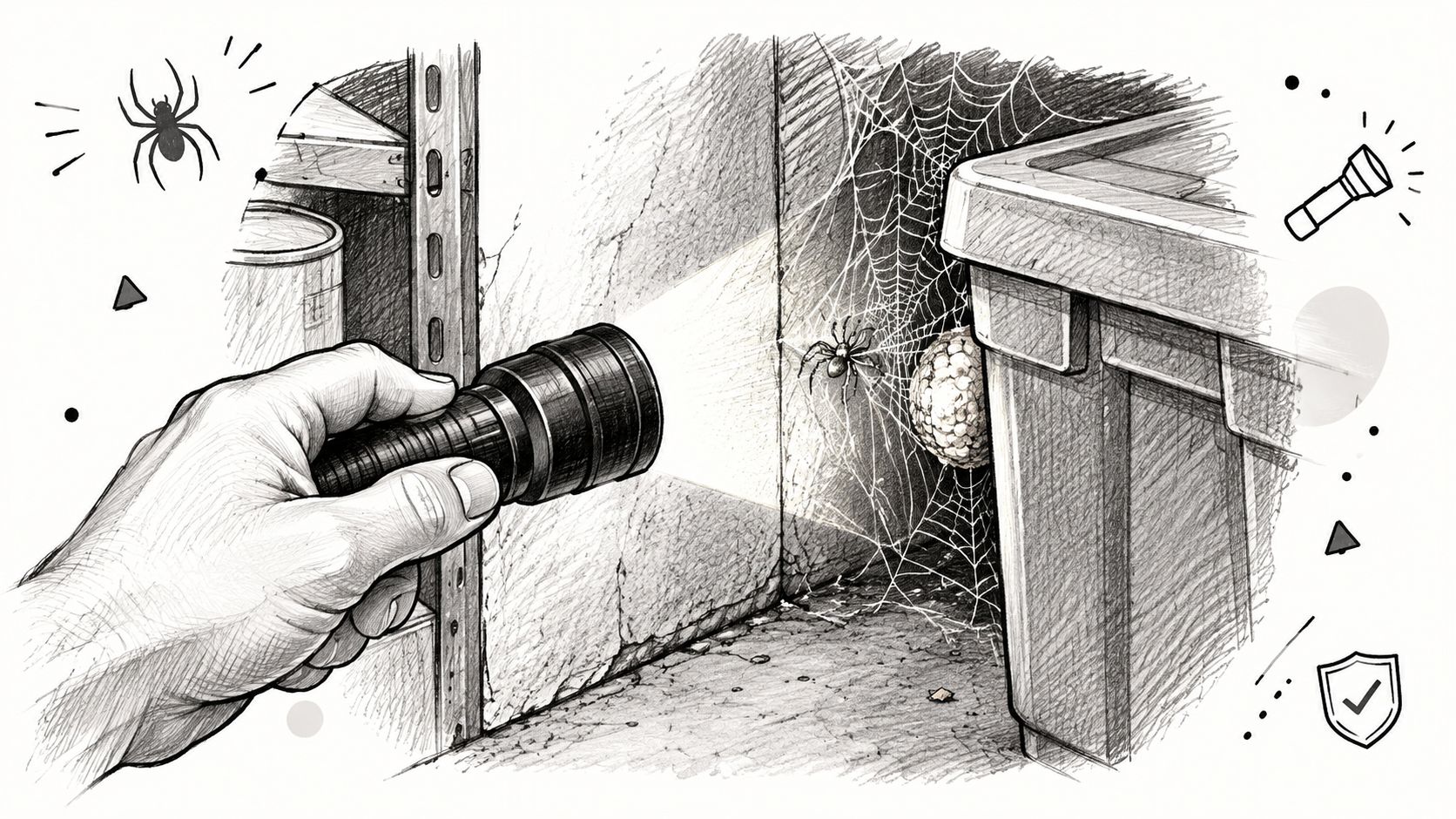
Read the garage as a map
Inspect in a consistent path, beginning at the garage door and continuing around the walls. Mark each finding with painter's tape or note it on your phone.
- Door thresholds: Look along the bottom seal, side tracks, and corners where the door meets the frame. Dust lines, web strands, and small gaps point to both entry and harborage.
- Pipe and wire penetrations: Check where plumbing, electrical conduit, cables, or other services pass through walls. Even narrow openings can provide a route inside.
- Wall-adjacent storage: Pull bins, shelving, bags, and lawn equipment away from the wall. Webbing behind an object tells you that the item has been shielding the area from disturbance.
- Overhead structure: Examine ceiling joints, beams, opener components, and the upper corners of the garage door frame.
- Rarely used equipment: Inspect folded ladders, garden tools, tarps, spare parts, and seasonal decorations before moving them deeper into storage.
Web shape can help you prioritize work, but don't rely on identification by appearance alone. Dense webbing in a sheltered corner usually indicates a stable harborage, while fresh strands near a light may point to active insect traffic. Egg sacs deserve attention because removing only adult spiders may leave the next generation in the same protected area.
Inspection rule: Follow the web to the protected space behind it. The visible web is often the symptom, not the main harborage.
Place sticky traps along baseboards, beside the garage door, and near suspected storage zones. These traps help monitor spider movement, but they also reveal whether insects are supporting the activity. If traps catch many small insects, cleaning and lighting changes may matter as much as removing spiders.
Use a simple sketch or phone photo to record each hotspot. Note whether it sits near a light, damp area, vegetation touching the exterior, a crack, or stored cardboard. That map tells you where to vacuum, what to move, and which seals deserve attention first.
A short visual walkthrough can help you recognize the inspection process before you begin:
Exclusion and Sanitation That Makes Your Garage Less Inviting
A garage in Magnolia can look tidy and still function as a spider shelter. Shelves packed against walls, damp cardboard, door gaps, and insects gathering around lights give spiders protection and a steady food supply. The fix is to redesign the space so it stays visible, dry, and accessible after the initial cleanup.
Start with a shop vacuum, not a feather duster. Remove webs, spiders, egg sacs, and insect debris from corners, beams, shelving, door tracks, and the spaces behind stored items. Empty the vacuum according to its instructions, then wipe nearby surfaces so loose web material does not remain in the same harborage.
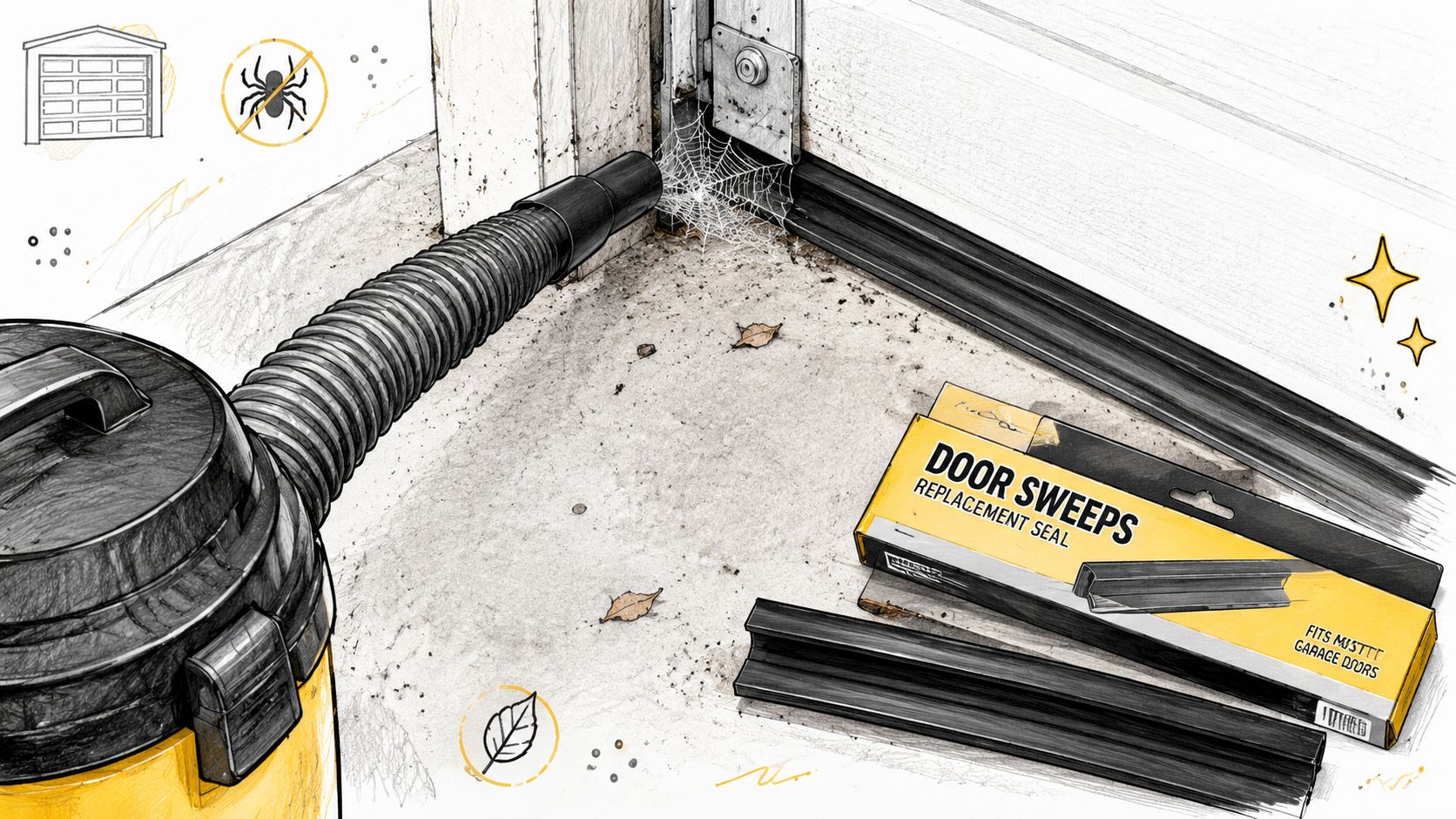
Storage determines whether that cleanup lasts. Replace cardboard boxes, paper goods, spare clothing, and loose household items with plastic storage bins with sealing lids, a storage approach included in Texas A&M's spider management guidance (Texas A&M storage and exclusion recommendations). Keep containers far enough from walls to inspect behind them, and leave space beneath workbenches and equipment for the vacuum nozzle. A sealed bin pressed tightly into a dark corner still creates a blocked harborage.
Map clutter to the places spiders use. The door zone needs a clean threshold, clear tracks, and intact bottom and side seals. The workbench zone needs loose cardboard removed and wall penetrations around cords or tools exposed. Lawn equipment, hoses, bags, and rarely used decorations should be inspected before they return to storage. Open seldom-used containers outdoors or in a bright, open area, then vacuum upper corners, beams, and fixtures where webs accumulate.
Complete cleaning before sealing. Apply an appropriate sealant around pipe and wire penetrations, wall joints, windows, frames, and other openings. Texas A&M's exclusion guidance also discusses blocking suitable weepholes with copper mesh, but drainage and ventilation openings require the correct method before they are closed (Texas A&M exclusion guidance for garages and structures). Repair or replace damaged door sweeps and weather seals when daylight or debris shows a clear route beneath the door.
Outdoor conditions can keep repopulating the garage. Trim vegetation touching the building, since branches and dense growth provide shaded cover and a path toward the structure. Reduce insect attraction at garage lights by using sodium vapor bulbs or directing light away from the building, recommendations included in the same Texas A&M guidance. In Magnolia, this work pays off before the humid spring buildup and again before late-summer activity, when moisture and insect traffic can make a recently cleaned garage attractive again.
Check for leaks, condensation, wet cardboard, and poor drainage even when there is no standing water. Persistent dampness supports insects and can damage stored materials. If mold is part of the problem, guidance on stopping garage mold from returning addresses the moisture condition instead of repeated surface cleaning.
The practical order is simple: remove webs and clutter, replace cardboard with sealed bins, create access around stored items, seal confirmed openings, then reduce outdoor lighting and vegetation that feed insect activity. This is the working principle behind garage exclusion pest control. A garage redesigned for inspection and airflow gives spiders fewer protected places to settle and makes future sightings easier to handle.
Targeted Treatment Options From Non Toxic to Residual Sprays
Treatment should match the garage's condition, not the homeowner's frustration. Occasional sightings in a clean, accessible space usually call for removal and monitoring. Recurring webs, egg sacs, and heavy insect traffic in a storage-packed garage may justify targeted professional treatment after the shelter conditions are addressed.
Choose the treatment path
Start with the lowest-intensity option when you find a single spider or fresh web. Vacuum the spider, web, and egg sac together. Sticky traps placed along baseboards, thresholds, and storage edges can show whether activity is isolated or continuing. Natural deterrents may help in a low-pressure area, but scent and short-term repellency do not remove the food or protected spaces supporting the population.
If traps keep showing activity, map the locations before applying anything. Repeated catches near a door track, shelf, or stored equipment point to a specific harborage. Treating that protected site is more useful than spraying the entire garage.
Residual sprays require careful selection and placement. Laboratory research on brown recluse spiders found measurable control from some residual and contact insecticides, with results depending on the active ingredient, formulation, and application conditions (brown recluse residual insecticide research). A quick knockdown or brief repellent effect still does not prove lasting suppression.
Sheltered crack-and-crevice and perimeter applications can remain effective longer than exposed residues. Sunlight, rain, and humidity break down outdoor applications faster. Broadly spraying floors, walls, or open storage areas uses more product while leaving the garage's harborage pattern unchanged.
Choose residual treatment when cleanup and exclusion have reduced shelter but monitoring still shows recurring activity. Apply only to labeled protected sites, such as confirmed cracks, entry points, baseboards, and concealed harborages. Broad interior coverage is generally a poor garage strategy because it increases exposure without reliably eliminating the conditions attracting spiders.
Families with children or pets must keep them away from treated areas and follow the product label, including reentry and ventilation instructions. For household cleaning products where reducing unnecessary chemical exposure matters, safe spray alternatives for families provide useful context. Cleaning products are not substitutes for pesticide directions.
Use this decision sequence:
- One sighting or fresh web: Vacuum it and inspect the nearby storage or structure.
- Repeated sightings: Place sticky traps, record exact locations, and identify the connected harborage.
- Persistent activity after correction: Consider a targeted residual application by a qualified technician.
- Widespread spraying request: Stop and reassess. Product on open surfaces will not correct shelter, insect access, or poor placement.
For a fuller comparison of natural and chemical spider control methods, use the same rule: choose the least intensive method that fits the activity, then escalate only when monitoring shows the garage continues to support spiders.
Seasonal Monitoring and Prevention for North Houston Garages
A one-time cleanup can fail when the garage returns to its old pattern. In Magnolia and nearby north Houston communities, seasonal maintenance makes more sense than waiting until webs cover the door frame again. Warmer conditions can increase indoor sightings and alter where some spider species survive and spread, while changes in insect food supply can also affect pressure (recent reporting on warming conditions and indoor spider activity).
That doesn't mean every garage needs the same treatment calendar. It means homeowners should watch conditions rather than assume one application will carry the space indefinitely.
Use a simple maintenance rhythm
During periods when you notice more insects or fresh webs, inspect the garage more often. Vacuum visible webbing, check the door seal, and examine the corners behind equipment. Replace sticky traps when they become dusty, full, or difficult to read.
A useful log can be as simple as a note on your phone:
- Date: Record when you inspected or cleaned.
- Location: Identify the exact wall, threshold, shelf, or corner.
- Finding: Note webs, egg sacs, spiders, or insects.
- Action: Record whether you vacuumed, moved storage, or sealed a gap.
- Follow-up: Recheck the same location after maintenance.
Trap catches help you interpret the problem. An increase in small insects suggests the garage still has a food-supply issue. Repeated spider catches along one baseboard point toward a nearby harborage or entry route. In either case, re-clean and re-seal before reaching for another broad spray.
Time prevention around local conditions
Inspect after major garage reorganizations, before returning seasonal equipment to storage, and whenever vegetation grows against the structure. Pay special attention to exterior lights, door thresholds, cracks, and rarely disturbed storage. These are the areas most likely to shift as the garage and yard change.
Monitoring turns a surprise infestation into a maintenance task. The first new web is easier to manage than a garage full of protected harborages.
A quarterly or biannual professional schedule can make sense for garages with persistent pressure, heavy storage, or limited homeowner access. The right frequency depends on what the inspection finds, not on a promise that a single treatment will permanently prevent spiders.
When to Call a Professional in Magnolia and What to Expect
DIY cleanup is reasonable when sightings are limited, storage is accessible, and you can complete the inspection, vacuuming, decluttering, and sealing thoroughly. Professional help becomes more practical when webs return despite that work, sticky traps continue to catch activity, or the garage is too crowded to inspect and reorganize safely.
Treat suspected brown widow or brown recluse activity cautiously. Don't handle unfamiliar spiders, reach blindly behind stored items, or rely on a visual guess for species identification. A professional can document the locations, assess the surrounding habitat, and recommend a treatment plan that addresses both spiders and the insects supporting them.
Storage-heavy workshops create another decision point. If machinery, parts, lumber, tools, and seasonal equipment make full access difficult, a technician may identify overlooked harborages and entry points faster than repeated DIY spraying. The useful service is not just applying product. It is connecting inspection findings with exclusion, sanitation, targeted treatment, and follow-up monitoring.
FullScope Pest Control is one Magnolia-area option for an inspection and spider-control plan. Its service model includes inspection, treatment planning, ongoing protection options, and schedules that can be quarterly or biannual when the property needs continued attention. The company serves north Houston and nearby Southeast Texas communities, including Montgomery County locations.
Magnolia is in southwest Montgomery County, about 45 miles northwest of downtown Houston and about 25 miles southwest of Conroe, making it a practical north-Houston service reference point rather than a generic Southeast Texas label (Magnolia distance and location reference). The City of Magnolia lists its official address as 18111 Buddy Riley Blvd., Magnolia, TX 77354 (City of Magnolia maps and location information).
Ask for an inspection that identifies where spiders are living, how they enter, what prey is present, and which areas need exclusion. To schedule service in Magnolia or discuss a garage with recurring spider activity, contact FullScope Pest Control and request a property-specific evaluation.
Don't wait for the next wave of webs to decide what to do. Clear the garage, map the harborage, seal the entry points, and schedule an inspection with FullScope Pest Control if activity continues after cleanup.