1500+ reviews

You step outside in Magnolia around sunset, the air finally feels bearable, and within minutes somebody's slapping their ankle, somebody else is waving a paper plate around their head, and the kids are asking to go back inside. That's a normal Southeast Texas scene. Warm evenings, thick humidity, shaded yards, drainage swales, pine straw beds, bird baths, plant trays, and summer rain make this region ideal for mosquitoes.
A lot of homeowners react the same way. They buy a candle, plant a few “mosquito-repelling” herbs, maybe hang a bat house, and hope for relief. Usually that buys disappointment. Effective eco-friendly mosquito control works, but it doesn't come from one gimmick or one fogging event. It comes from a layered plan that cuts mosquitoes off at the places and life stages where they're easiest to control.
That's the approach that makes the most sense for families in Magnolia, Conroe, Montgomery, and the rest of this part of Texas. If you already try to how to reduce your environmental impact in other parts of home life, mosquito control should follow the same logic. Use targeted methods, reduce waste, and solve the cause before reaching for broad treatments.
Reclaiming Your Texas Yard from Mosquitoes
A chemistry lesson isn't what's desired. The aim is to sit on the patio without getting eaten alive. In Southeast Texas, that starts by accepting one hard truth. Mosquito pressure here is rarely caused by one obvious puddle. It's usually a network of small, overlooked breeding spots spread across the property and sometimes just beyond the fence line.

A smarter plan is Integrated Mosquito Management, often shortened to IMM. That means you don't rely on one spray and hope for the best. You reduce breeding habitat, treat water that can't be removed, and add targeted tools for adult mosquitoes where they make sense. That's more sustainable, and in practice it's usually more effective than throwing random products at the problem.
What this looks like in a Texas yard
In Magnolia and nearby communities, I'd expect to see a mix of mosquito-friendly conditions:
- Heavy shade under trees and along fence lines
- Frequent rain followed by days of standing water in hidden spots
- Decorative items like pots, saucers, and water features
- Outdoor living areas where people gather at dawn and dusk, exactly when mosquitoes are active
Those conditions don't mean you have to give up your yard. They mean you need a plan that matches the property.
Practical rule: If your mosquito plan starts and ends with “spray something,” it's incomplete.
Even “natural” ideas need context. Some plants may have a place in a broader garden design, but they won't carry the job by themselves. If you're curious about the popular advice, it helps to compare it with a more realistic look at plants that keep mosquitoes away and where those ideas fall short in a humid Texas yard.
Start with a Property Inspection to Eliminate Habitats
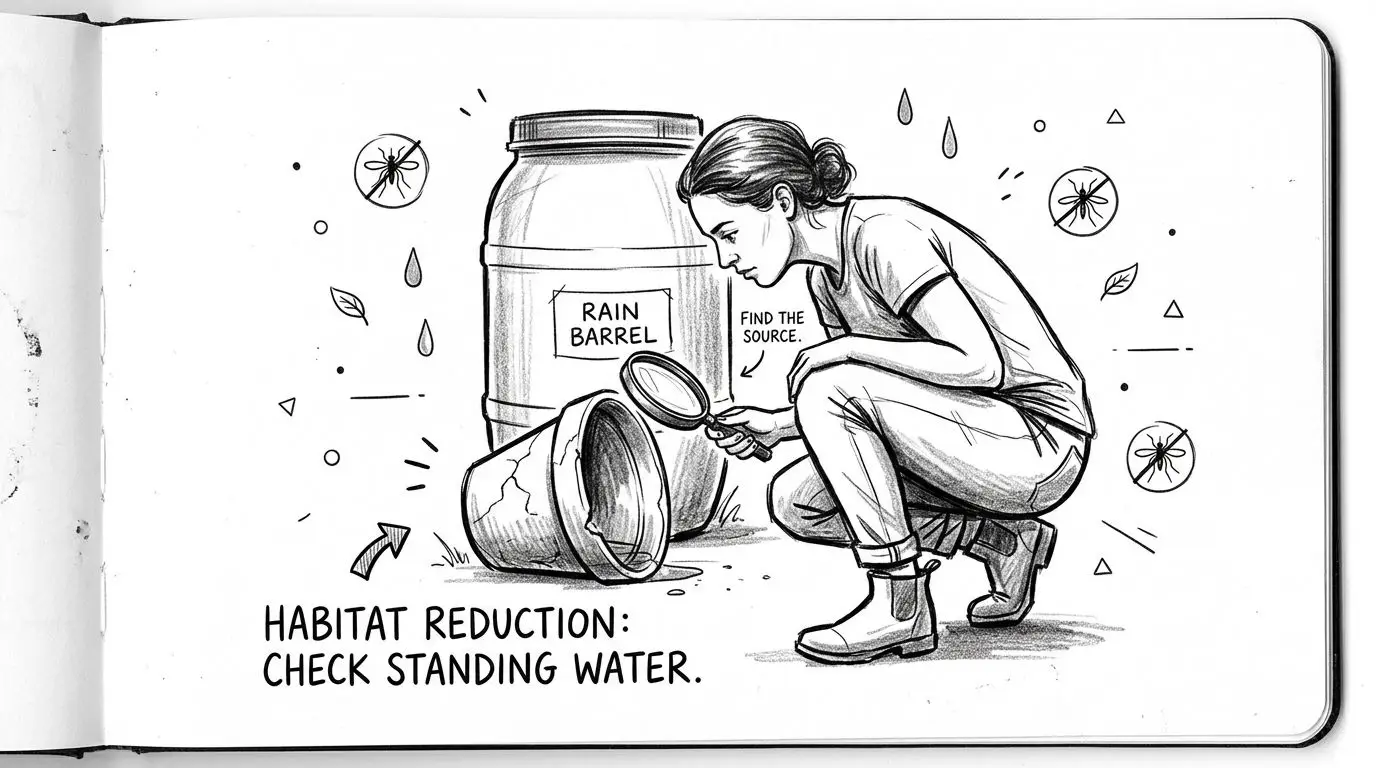
The most important part of eco-friendly mosquito control is also the least glamorous. Walk the property and look for water. Then look again in the commonly overlooked places.
The EPA says targeting the egg and larva stages is the “most effective, least costly” way to control mosquitoes, and the same EPA guidance says bird baths, fountains, and potted plant trays must be emptied and changed at least once weekly under the 7-day water turnover rule for mosquito prevention in an integrated approach to control (EPA mosquito control guidance).
The Magnolia yard inspection checklist
Don't just scan for obvious buckets. Check the places that stay wet after rain or irrigation.
- Roof drainage points: Gutters clogged with pine needles, downspout elbows, splash blocks, and low spots below roof lines.
- Containers near the house: Plant saucers, watering cans, pet bowls left outside, toys, wheelbarrows, and tarps with a sag in the middle.
- Outdoor problem areas: French drains that aren't draining well, corrugated drain pipe ends, hollow stumps, tree holes, and decorative rock areas that trap runoff.
- Backyard extras: Fire pit covers, grill covers, kiddie pools, outdoor furniture frames, and unused pots stacked upside down but holding water around the rim.
- Perimeter trouble spots: Fence lines, ditches, drainage swales, and shaded corners where leaves build up and hold moisture.
A lot of Southeast Texas mosquito problems start with things homeowners don't think of as “standing water.” Wet leaf sludge in a gutter counts. Water caught in a folded tarp counts. A forgotten bottle cap can count.
The seven-day rule matters
Mosquito control gets easier when you think on a weekly schedule instead of waiting until the bites get bad. Water that sticks around too long becomes productive habitat. That's why the once-a-week dump-and-drain routine matters so much around homes.
Miss one week during warm weather and your yard can start producing the next wave.
If your property has drainage or overgrowth issues, broader cleanup can help prevent those hidden water pockets from forming in the first place. Land management ideas outside the mosquito industry can still be useful. This overview of Treecorp Solutions' eco clearing is a good example of how selective clearing and debris removal can improve drainage without turning a yard into bare dirt.
A practical weekly routine
Keep this simple enough that you'll do it.
- Walk the front and back yard after rain. Check where water sits the next morning, not just during the storm.
- Dump and scrub containers. Bird baths and plant trays need fresh water on a weekly cycle, not just a top-off.
- Clear gutters and drains. If water can't move, mosquitoes win.
- Thin dense clutter. Stored materials, stacked pots, and junk along fence lines create cool resting spots for adults and hidden water pockets for larvae.
Here's a quick visual if you want a homeowner-friendly demonstration of where mosquitoes hide and breed:
The point isn't perfection. The point is reducing the number of places where mosquitoes can complete their cycle on your property. Every habitat you remove makes the next control step work better.
Use Biological Larvicides for Unremovable Water
Some water has to stay. That's normal. Rain barrels, ornamental ponds, certain drainage features, and low areas that hold water part of the season can't always be dumped out. That's where Bti comes in.
Bti, short for Bacillus thuringiensis israelensis, is one of the best tools available for eco-friendly mosquito control because it targets larvae in water instead of chasing flying adults after they've already spread through the yard. If you want a refresher on how those stages fit together, this breakdown of the mosquito life cycle is useful for matching the treatment to the problem.
Where Bti fits and where it doesn't
Peer-reviewed data summarized in the verified material shows that natural predators like dragonflies and bats consume negligible numbers of mosquitoes, while habitat modification and larval control with Bti remain the only proven eco-friendly methods for meaningful reduction, and Bti can reduce larvae by 90 to 95% in targeted breeding sites according to that summary (sustainable mosquito control discussion).
That matters because a lot of homeowners get pulled toward feel-good answers that don't match the biology. Bats are fine to have around. Dragonflies are good insects. Neither is a dependable residential mosquito control program.
The common dunk mistake
The biggest Bti mistake is using it in places where mosquitoes aren't really breeding, or where the treatment can't stay where it needs to work. A dunk dropped into moving water won't solve much. A treatment tossed into a decorative area that dries out before larvae develop won't do much either.
Use biological larvicides where water is:
- Consistently present long enough to support breeding
- Relatively still rather than actively flushing away
- Producing mosquitoes, not just occasionally wet
Don't treat every wet spot the same. Treat the water that stays, breeds, and repeats.
What not to rely on
Many “natural” mosquito articles often go off the rails. They'll tell you to attract birds, install a bat box, burn citronella, and call it sustainable. In a Southeast Texas yard with repeat rainfall and dense vegetation, that's not a plan. That's wishful thinking.
A better way to think about it is simple:
| Method | Role in an eco-friendly plan |
|---|---|
| Dumping and draining | First line of defense |
| Bti in standing water | Best option for water you can't remove |
| Predators like bats or dragonflies | Fine as part of nature, not a standalone control method |
| Random “natural” sprays | Often short-lived and inconsistent outdoors |
Homeowners usually get the best results when they pair habitat reduction with correctly placed larvicides and stop expecting wildlife to fix a breeding problem created by yard conditions.
Deploy Modern Traps and Low-Toxicity Adulticides
Even a well-managed property still gets pressure from surrounding lots, greenbelts, drainage areas, and neighbors who don't stay on top of water. That's why adult mosquito reduction still has a place in an eco-friendly program. The key is choosing targeted tools, not defaulting to broad, repeated fogging.
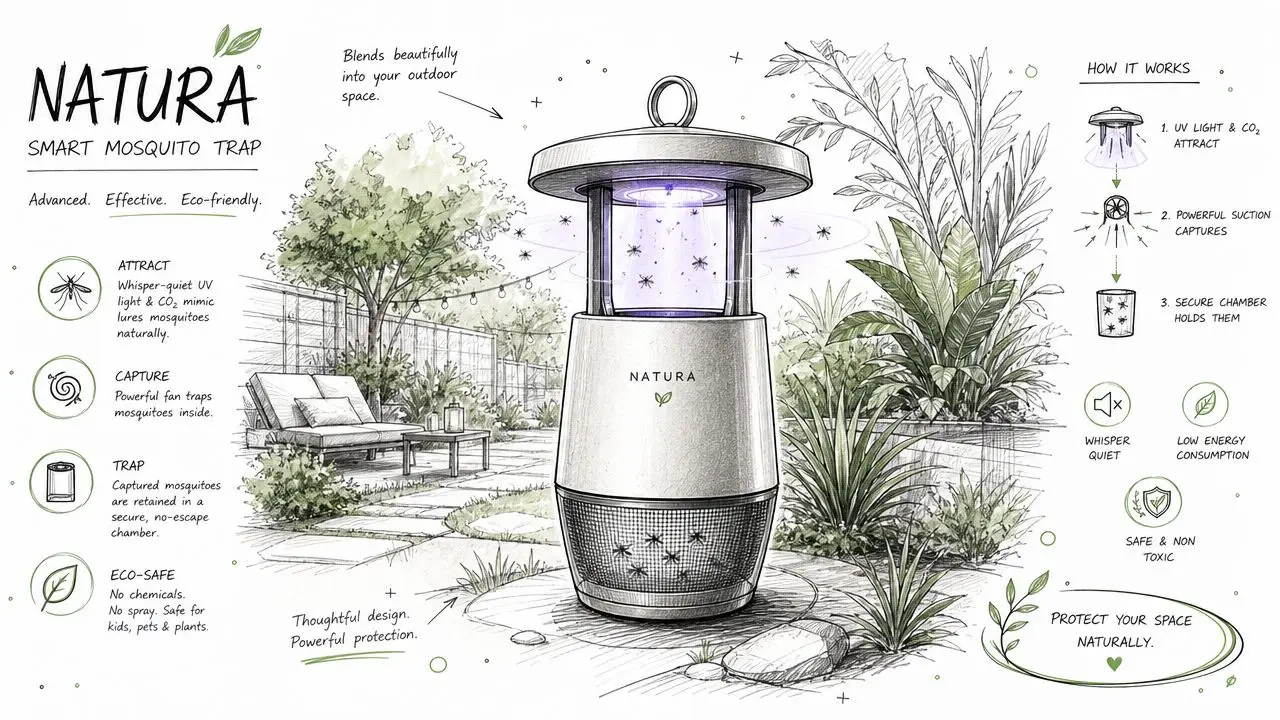
One proven option is the modern mosquito trap. A peer-reviewed study found that mosquito traps achieved an estimated overall performance of 70%, measured by reduction in mosquitoes landing on human bait in trap-treated areas compared with untreated areas, showing that trap deployment can be an environmentally friendly control technique and a cost-effective alternative to traditional Bti spraying in sensitive natural areas (peer-reviewed mosquito trap study).
Why traps help in Southeast Texas
Traps make sense in yards where people spend time in one or two main zones, like a back patio, pool deck, or outdoor kitchen. They don't replace source reduction, but they can lower pressure where adults are actively host-seeking.
In practical terms, traps work best when you:
- Place them away from seating areas so they draw mosquitoes off people, not toward them
- Use them as part of a system rather than as a solo gadget
- Maintain them on schedule so attractants, fans, and collection components keep working as intended
A trap can't overcome a yard full of breeding water. It can make a cleaner yard noticeably more usable.
Bait stations are the newer development to watch
The more interesting shift is the rise of attract-and-kill bait stations, also called felder stations in the verified material. Recent developments show 60 to 80% reduction in mosquito populations by using a mechanism where female mosquitoes pick up a slow-acting larvicide and contaminate breeding sites, creating a self-replicating control loop (bait station overview).
That approach matters in places like Magnolia because not every breeding site is visible. Some are in shaded drainage edges, hidden containers, neighboring clutter, or cryptic pockets under vegetation. Bait stations are valuable because they can help reach the breeding sites you can't find by eye.
The best adult-stage tools aren't trying to blanket the whole yard. They're trying to intercept the mosquito and turn her behavior against the population.
Where low-toxicity adulticides fit
There's still a role for targeted adult control in some situations, especially during heavy seasonal pressure or before outdoor events. The trade-off is that adult treatments should support a larger program, not stand in for one.
A sensible modern plan looks like this:
| Situation | Best fit |
|---|---|
| Hidden breeding pressure nearby | Bait stations |
| Patio or entertaining area with active biting | Traps near, but not in, the living zone |
| Short-term knockdown need | Targeted low-toxicity adult treatment |
| Whole property ignored at the water stage | Start over with habitat control |
That's the difference between eco-friendly mosquito control and “greenwashed” mosquito control. One uses biology and placement. The other just swaps the label and hopes no one notices the method hasn't improved.
Consider an Automated Misting System for Ultimate Control
Some homeowners want a higher-coverage option because the property is large, the shade is dense, or outdoor use is a priority every week of the season. In those cases, an automated misting system can make sense. It's not the first tool I'd reach for on every home, but it can be the right one for the right property.

What you're paying for
An automated system isn't just a tank and a timer. You're paying for consistent placement, measured application, and convenience. Proper nozzle layout matters because mosquitoes rest in shaded harborage zones, not in the middle of open lawn. A professional layout targets those edges while avoiding sloppy coverage.
For homeowners comparing options, this guide on everything you need to know about mosquito misting systems gives a useful look at how these systems are installed and maintained.
The real trade-offs
Plain talk is essential. A misting system can reduce day-to-day hassle, but it doesn't remove the need for property sanitation. If gutters stay clogged and containers keep collecting water, you'll still be feeding the problem.
Professionally administered eco-friendly mosquito treatments typically occur every three to four weeks and cost $40 to $70 per application, with a typical three-month mosquito season totaling $500 to $900 according to the verified Virginia Master Naturalists summary of eco-friendly mosquito control practices (eco-friendly mosquito control costs and schedule). Those figures help frame the broader economics. Ongoing mosquito protection is a maintenance service, not a one-time event.
Who usually benefits most
A misting system tends to fit best when several of these are true:
- You use the yard constantly. Outdoor kitchens, covered patios, pool areas, and play spaces justify the convenience.
- The lot has heavy mosquito harborage. Dense shrubs, tree lines, and shaded setbacks create steady resting zones.
- You want routine control without remembering every step. Some homeowners are great at weekly drain-and-treat routines. Some aren't. Automated systems help close that gap.
Convenience has value, but it only pays off when the system is installed well and supported by basic habitat control.
When it's not the best option
A small yard with one obvious breeding source usually doesn't need a misting system first. Neither does a homeowner who hasn't yet done the simple work of cleaning up water sources, correcting drainage issues, and adding larval control where needed.
Think of an automated system as the upper tier of a layered program. It's for comfort, consistency, and reduced day-to-day effort. It's not a substitute for understanding why mosquitoes are there in the first place.
When to Hire a Professional in Magnolia and Beyond
DIY eco-friendly mosquito control works up to a point. Then there's the Southeast Texas reality check. You've dumped the containers, cleaned the gutters, treated the water that won't go away, and maybe even added traps, but the mosquitoes are still thick at dusk. That usually means one of two things. There's hidden breeding habitat you haven't found, or the pressure is coming from a broader area that takes a more technical response.
That's where a professional earns their keep. A trained technician looks at the entire property differently. Drainage pattern, shade density, harborage zones, structural runoff, irrigation habits, and neighboring conditions all matter. Homeowners often see “the bites.” A pro looks for where the population is being produced and where adults are resting before they move in on people.
Good reasons to bring in help
A homeowner usually benefits from professional help when the property has complexity, not just mosquitoes.
- The lot is large or wooded. Magnolia properties often have tree cover, outbuildings, and edge habitat that make mosquito control more involved than a simple suburban lawn.
- The problem keeps returning. If pressure bounces back fast after DIY effort, there's probably a source you're not catching.
- You need predictable results. Families with kids outside every evening, frequent backyard gatherings, or low tolerance for bites usually want a scheduled plan, not trial and error.
Why Magnolia matters
Local service coverage matters because mosquito control isn't generic across Texas. Magnolia has its own mix of wooded lots, drainage features, and neighborhood patterns. Verified location information confirms that FullScope Pest Control operates a dedicated Magnolia, TX location at 30225 Tudor Way Suite A, Magnolia, TX 77355, specifically serving the Magnolia area and confirming direct local coverage for residents (Magnolia service location).
That matters for practical reasons. A company with direct Magnolia service presence is better positioned to understand local lot layouts, seasonal pressure, and the kinds of breeding conditions common in this pocket of Southeast Texas. The same logic applies in nearby communities like Conroe, Kingwood, Montgomery, and other north Houston areas where yard conditions can vary a lot from one neighborhood to the next.
What professional service changes
Professional mosquito work usually improves three things at once:
| Problem | What a pro adds |
|---|---|
| Missed breeding sites | Better inspection and identification |
| Persistent adult pressure | Access to stronger placement strategies and specialized tools |
| Inconsistent homeowner upkeep | Scheduled treatment and follow-through |
The biggest advantage isn't just product access. It's consistency. Mosquitoes exploit gaps in routine. A professional plan closes those gaps with inspections, repeat service, and adjustments when weather or yard conditions shift.
If you're in Magnolia, Conroe, Kingwood, or the surrounding Southeast Texas service area and want help building a practical, lower-impact mosquito plan, FullScope Pest Control can evaluate the property, identify breeding and resting zones, and recommend the right mix of habitat correction, targeted mosquito treatment, or MistAway system support for your yard.