1500+ reviews

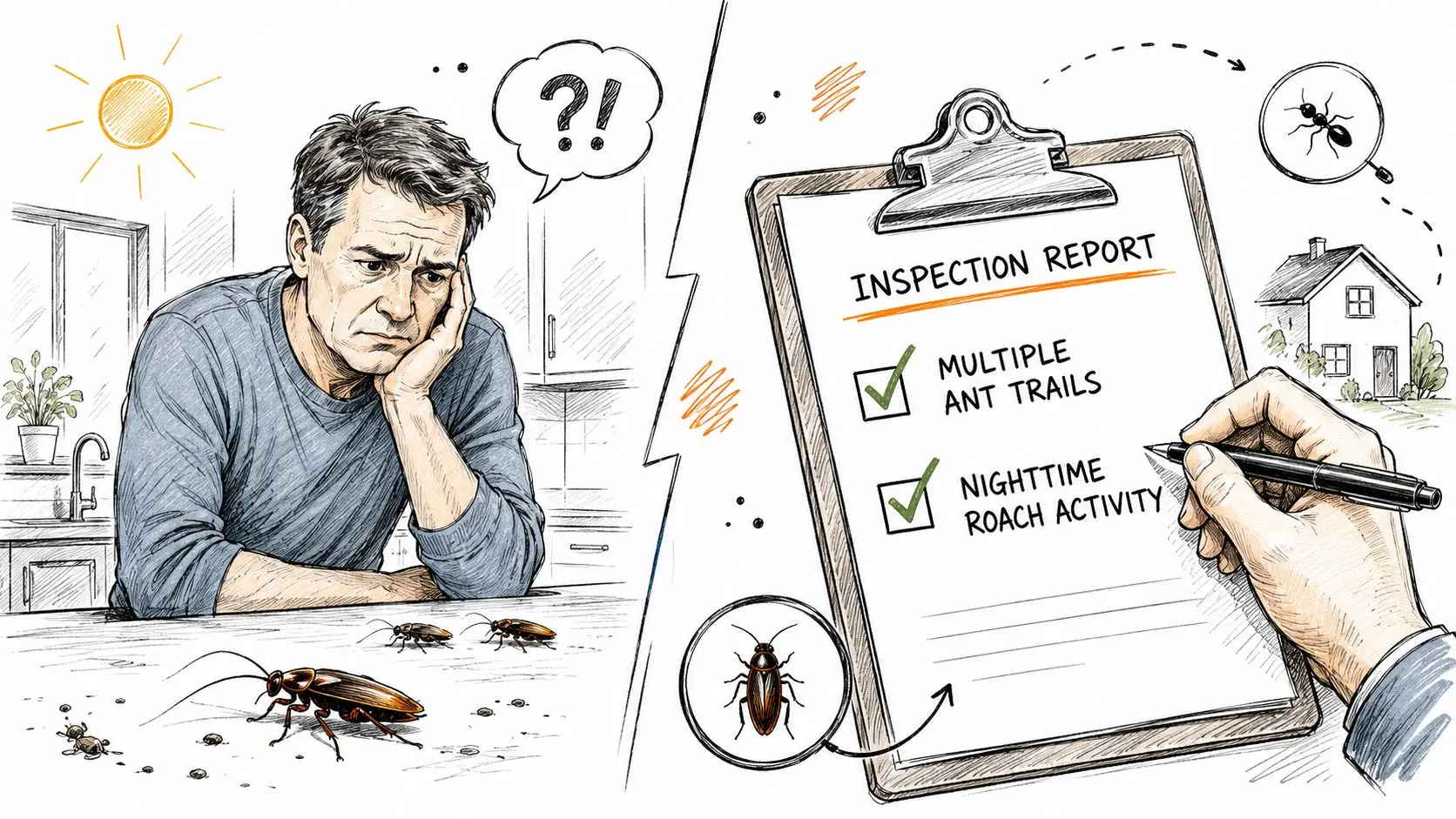
At dusk in a Magnolia kitchen, movement along the baseboard can look like one problem until the flashlight catches the details. A few tiny insects may be odorous house ants, while a larger, fast-moving insect disappearing beneath the refrigerator may be a German cockroach. Both pests follow edges, seek moisture, and become more noticeable when outdoor food and water conditions change.
That confusion matters because the treatment logic isn't the same. Ant colonies can respond to delayed-action bait that workers carry back and share, while cockroach control depends heavily on removing food, water, grease, and protected harborages. In Magnolia, post-rain humidity, shaded landscaping, homes near creeks, and pier-and-beam additions can give either pest the advantage.
The practical question isn't just which insect is worse. It's which pest is present, what conditions are supporting it, and whether the activity is limited to one entry point or spread through the structure.
Why Homeowners in Magnolia Are Asking This Question
A homeowner may find a line of tiny brown insects along a counter one evening, then notice a dark oval insect near the dishwasher the next. From across the room, both sightings become “bugs in the kitchen.” Up close, they represent different biology, different harborages, and different control priorities.
Magnolia homes experience the conditions that make this overlap common. Rain can push ants away from saturated soil and toward wall penetrations, windows, and plumbing routes. Shaded mulch beds can stay damp against the foundation, while crawlspaces, under-sink cabinets, and condensate lines provide reliable moisture indoors. Homes with pier-and-beam sections or additions may also have more connected voids than a homeowner can inspect from the living area.
Both pests tend to use edges because edges provide cover. Baseboards, cabinet corners, pipe penetrations, appliance gaps, and window tracks let insects move while staying protected. Activity can increase at night, when homeowners are more likely to see a cockroach crossing open flooring or an ant trail extending toward a forgotten food source.
What the first sighting can and can't tell you
One insect doesn't reveal the size of the problem. A single outdoor ant may have entered through a gap, while one cockroach can indicate a nearby harborage that deserves inspection. Daytime cockroach activity is especially concerning because it can mean the usual nighttime hiding areas are crowded or disturbed.
Look for patterns rather than relying on a single encounter:
- One defined trail: Ants are more likely, particularly if the line follows a counter edge, window sill, or plumbing penetration.
- Pepper-like debris or dark smears: Those clues point more strongly toward cockroaches.
- Repeated sightings after rain: Outdoor moisture changes may be driving ants indoors, but the same weather can also increase cockroach movement around foundations and utility openings.
- Activity in several rooms: Multiple routes suggest the need for a structural inspection rather than a trap placed beside the first sighting.
Practical rule: Product choice comes after identification. Moisture, sanitation, exclusion, and harborage usually determine whether treatment holds.
Magnolia is a small but expanding suburban service area in Montgomery County. The U.S. Census Bureau QuickFacts data lists a population of 5,320 in July 2023, compared with 2,359 in the 2020 Census and 1,393 in 2010. The Census Reporter profile for Magnolia provides that local population context. For homeowners, the useful takeaway is simple: homes, renovations, landscaping, and pest pressure can vary sharply from one part of the community to another.
Cockroach vs Ants at a Glance
The fastest visual distinction is scale. A German cockroach is much larger than an odorous house ant worker, while carpenter ants occupy an intermediate range. You can usually identify the broad category with a flashlight, but species-level confirmation may require a close photograph, magnification, or an inspection of the insect's body features.
| Trait | Cockroach, German and American | Ant, Odorous House and Carpenter |
|---|---|---|
| Typical appearance | German cockroaches are light brown to tan, while American cockroaches are larger and commonly reddish-brown to mahogany | Odorous house ants range from brown to dark brown or black; carpenter ants may be black, reddish, or combinations of those colors |
| Body size | German adults are commonly discussed as small household roaches; American roaches are substantially larger | Odorous house ant workers are tiny, while carpenter ant workers are visibly larger |
| Antennae | Long and whip-like, extending prominently from the head | Elbowed, with a distinct bend that becomes easier to see in a close-up |
| Movement | Fast, generally solitary when seen foraging | Often organized into visible trails with multiple workers |
| Diet | Broad omnivorous scavengers that exploit crumbs, grease, starches, and organic debris | Depending on species, workers seek sweets, proteins, insects, honeydew, or moisture and may excavate damp wood |
| Nesting | Hidden in cracks, appliance spaces, wall voids, cabinets, and other protected harborages | Colonies may occupy soil, wall voids, landscape materials, or moisture-compromised wood |
| Reproduction | Females produce protected egg cases called oothecae | Queens maintain colonies and workers support brood, so killing foragers alone may not eliminate the source |
| Best visible clue | Droppings, smear marks, cast skins, odor, or a roach disappearing into a narrow gap | A persistent trail, nest entrance, winged swarmers, or sawdust-like material beneath damp wood |
The traits you can inspect tonight
Use a flashlight low to the floor and watch the insect's behavior. A cockroach usually bolts toward cover, while ants commonly move along a repeatable route. Look for an elbow in the ant's antennae and the narrow waist between its thorax and abdomen.
Don't rely on color alone. Lighting, age, and dirt can make brown ants look black or make a cockroach appear lighter than expected. A close photograph beside a coin can help, and the ant identification guide can help Magnolia homeowners compare common ant groups before they decide whether the trail is an indoor colony or an outdoor foraging route.
Reading the Evidence Each Pest Leaves Behind
The insect itself may vanish before you get a good look. The evidence left behind is often more reliable, especially after the house has been quiet overnight.
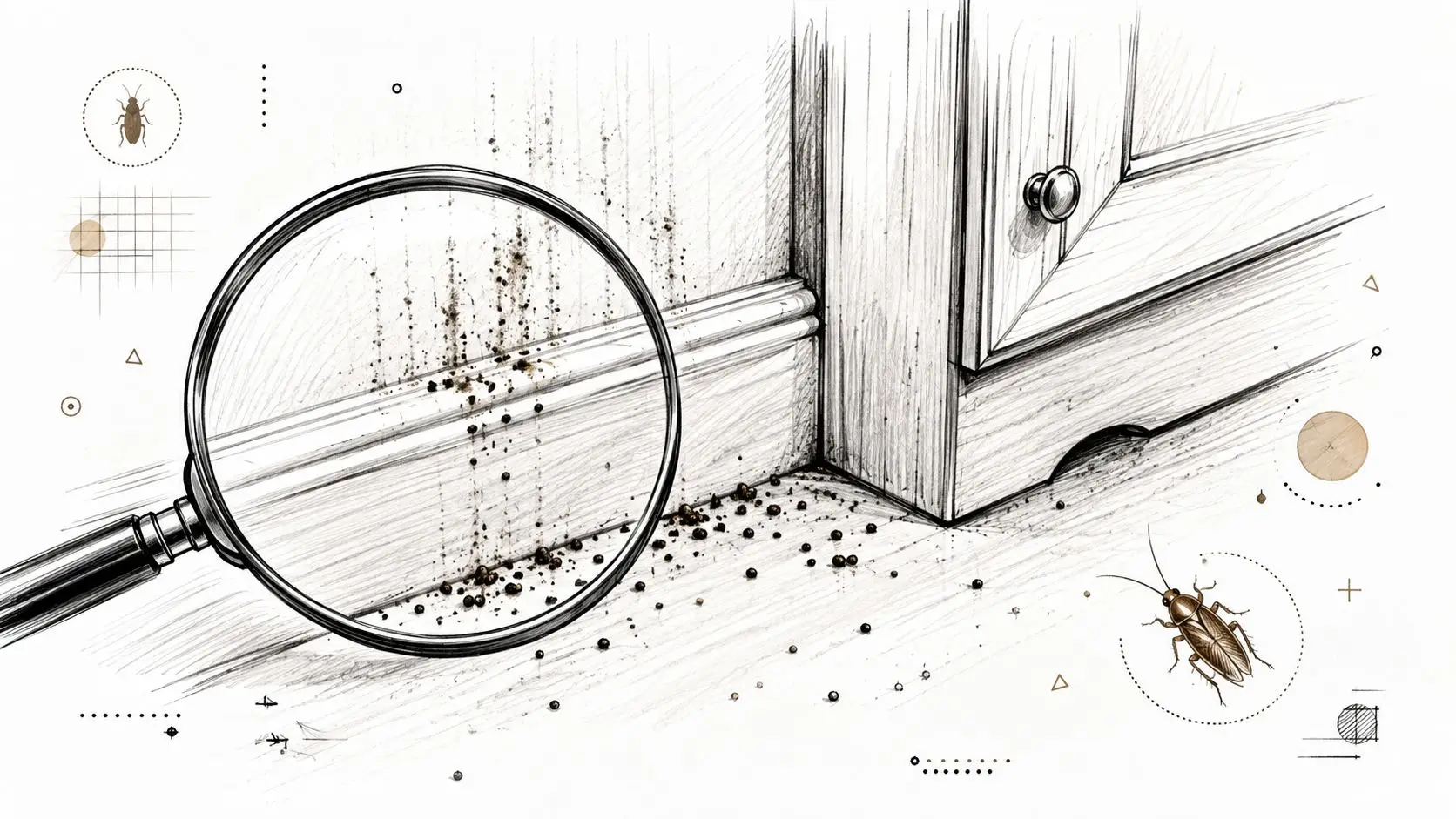
Start in the kitchen. Check beneath the sink, inside the cabinet corners, behind the refrigerator, beside the dishwasher, and along the baseboard behind trash or recycling containers. Pepper-like frass, dark vertical smears, cast skins, and a musty or oily odor all raise suspicion of cockroach activity. Rectangular ootheca cases can appear in protected cracks, cabinet joints, or behind appliances.
A homeowner should also inspect the top and sides of the refrigerator, particularly around the motor compartment. Warm equipment, grease residue, and narrow gaps create conditions cockroaches can use as harborage. Under the kitchen sink, look for both cockroach debris and leaks, because a damp cabinet can support the pest while also masking the source of the problem.
Ant evidence follows a route
Ants leave a different record. A defined line along the counter, window sill, pipe opening, or cabinet seam usually means workers are repeatedly traveling between a food or water source and a colony. Clean the visible trail only after you've observed its direction, because wiping too soon can remove the route you need to follow.
Around damp window frames, porch headers, and fascia, look for fine material resembling sawdust beneath possible carpenter ant galleries. Winged ants near doors or windows after rain may indicate a nearby mature colony or an outdoor swarm event, but they don't prove that the nest is inside the wall.
Odorous house ants can produce a rotten-coconut smell when crushed. That clue is useful, but don't crush insects near food preparation surfaces. Use a sealed sample container or a clear photograph instead.
Check the slab edge, water heater, attic eave, and plumbing penetrations. A trail converging at one crack points toward an entry route, while scattered cockroach debris across several protected areas suggests a broader harborage pattern.
For a more focused inspection, use this guide to recognizing a cockroach infestation and compare the physical clues rather than guessing from one sighting.
This short video can help you visualize the kind of movement and evidence that matters during an inspection.
Health and Property Risks Compared
Cockroaches and ants don't create the same risk profile. A homeowner should judge severity by the pest's behavior, the location of activity, and the condition of the building, not by the number of insects visible at one moment.
Cockroaches move between harborages, waste, grease, drains, and food-contact areas. Their bodies, fecal material, and shed skins can contribute to allergen exposure, including allergens commonly identified as Bla g 1 and Bla g 2. In a home with children who have asthma or sensitivity to indoor allergens, recurring cockroach activity deserves prompt attention even when sightings are limited.
Ants usually create a different concern. Most household ants are nuisance invaders that contaminate food by entering containers, counters, and stored products. Pharaoh ants deserve special caution in healthcare and assisted-living settings because poorly targeted treatment can disperse colonies through occupied areas. Fire ants create a separate outdoor hazard around nest mounds, play areas, walkways, and landscaped parts of a property.
| Risk Category | Cockroaches | Ants |
|---|---|---|
| Food contamination | Broad scavenging behavior can move contamination onto counters, utensils, stored food, and appliance surfaces | Foraging trails can enter food containers and preparation areas, especially where sweet or protein residues remain |
| Allergens | Feces, body fragments, and cast skins can add to indoor allergen exposure | Ant debris can irritate sensitive individuals, but the household allergen pattern differs from cockroaches |
| Disease concern | Movement between waste and food-contact areas creates a meaningful sanitation concern | Risk depends on species, location, and setting; pharaoh ants are especially problematic in sensitive facilities |
| Structural damage | Harborages can occupy appliances, cabinets, wall voids, and insulation without necessarily damaging sound framing | Carpenter ants tunnel through moisture-compromised wood, including fascia, porch beams, and window structures |
| Outdoor hazard | Some species enter from mulch, utility routes, and shaded exterior harborage | Fire ant mounds can create biting or stinging hazards in yards and common areas |
Food-handling businesses in Texas should treat any pest sighting as a documentation issue as well as a treatment issue. Record the date, exact location, observed species if known, affected food or equipment, corrective cleaning, structural repairs, product application, and follow-up inspection. That record helps demonstrate that management addressed the source rather than merely removing a visible insect.
The biology explains the difference. Cockroaches are mobile scavengers that can contaminate several surfaces, while ants are colony-based foragers whose property risk may center on moisture-damaged wood, sensitive facilities, or outdoor nests.
Entry Points and Harborage in Gulf Coast Homes
A Gulf Coast home often gives insects several routes indoors. The route may be obvious, such as a gap around a pipe, or hidden behind siding, beneath a slab penetration, or inside a soffit void.
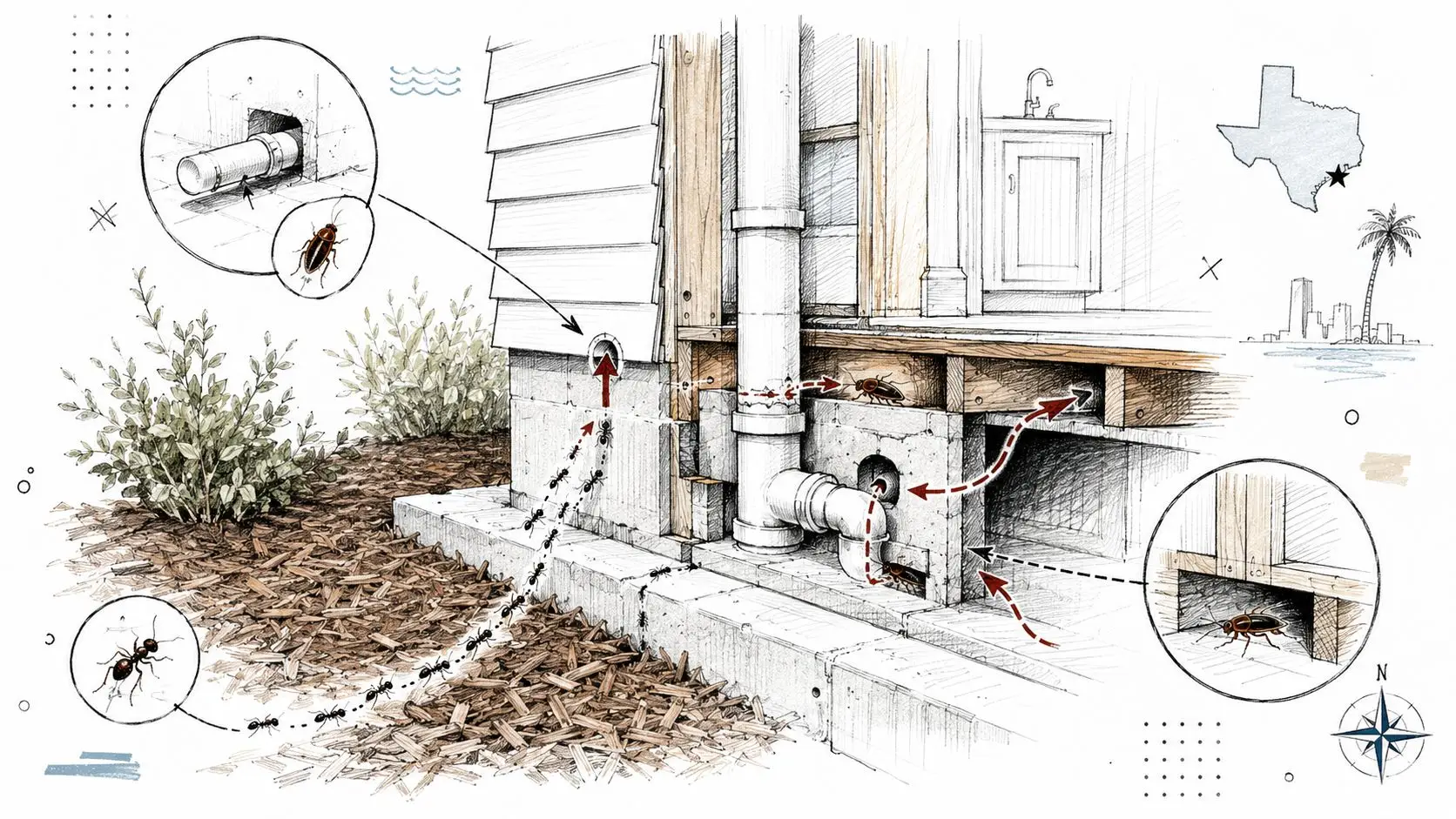
Cockroaches commonly use plumbing penetrations under slab bathrooms, gaps around dishwashers and refrigerator compressor compartments, and openings beneath cabinets. Outdoor species such as sewer roaches and smokybrown roaches can approach through attic soffits, utility lines, mulch beds, and poorly sealed exterior penetrations. A pier-and-beam addition may add crawlspace access and humidity that a sealed slab section doesn't have.
Ants exploit narrower bridges. Inspect foundation weep holes, window-frame cracks, AC condensate lines, gaps around exterior faucets, and branches touching the roof. Irrigation-saturated soil along flower beds can keep the foundation edge attractive long after the rest of the yard has dried.
Moisture usually beats product choice
Look under the sink for a slow leak or swollen cabinet base. Check crawlspaces for stale, humid air, standing water, or plumbing condensation. French drains can redirect water effectively, but a clogged or poorly graded drainage route may leave a damp strip next to the foundation.
Southeast Texas construction details matter. Post-tension slabs still have service penetrations that need sealing, pier-and-beam additions may connect to older unsealed sections, and Hardy plank siding can leave small gaps at corners, trim, and utility openings. Those details create bridges that a surface spray won't permanently remove.
Walk the exterior tonight with a flashlight:
- Foundation edge: Look for mulch, leaf litter, cracks, and ant traffic near weep holes.
- Roofline: Cut back branches touching the roof and inspect soffit openings.
- Utility penetrations: Examine hose bibs, AC lines, cable routes, and plumbing exits.
- Kitchen and baths: Check pipe collars, cabinet backs, appliance gaps, and water-heater connections.
- Drainage zones: Note saturated flower beds, French drain outlets, crawlspace vents, and areas where water collects.
- Wood components: Probe visually for damp fascia, porch headers, or window trim with frass beneath it.
Seal openings only after you know whether insects are still using them. Closing an active route without addressing the colony or harborage can push activity deeper into the wall.
DIY Control vs Professional Treatment
DIY treatment can work when the infestation is light, the species is correctly identified, and the homeowner removes the conditions supporting it. A few glue traps can reveal cockroach travel routes, while properly placed gel bait may reduce activity in a localized kitchen. Ant stations can help when workers are taking the bait and the colony isn't widely distributed through wall voids or landscaping.
The limits show up quickly. Spraying over a cockroach trail may kill exposed insects without reaching the harborage. Repellent sprays can also interfere with bait placement. Ant colonies may continue producing workers when a homeowner kills only the foragers, and cockroach bait aversion can make a familiar formulation less useful over time.
| Factor | DIY Approach | Professional Treatment |
|---|---|---|
| Identification | Relies on photographs, size, behavior, and visible clues | Uses inspection of harborages, trails, moisture, and entry points |
| Baiting | One gel, station, or placement pattern may reduce exposed activity | Species-specific bait selection, placement, monitoring, and rotation when appropriate |
| Crack and void treatment | Accessible gaps may receive limited treatment | Technicians can use targeted void dusts and focused applications where permitted |
| Reproduction control | Usually limited unless the source is found | May combine baiting with insect growth regulators and follow-up inspections |
| Exclusion | Homeowner seals obvious gaps and trims vegetation | A plan can connect exclusion work to observed routes and moisture sources |
| Monitoring | Glue traps and visual checks | Documented monitoring with treatment adjustments over follow-up visits |
What a professional program adds
An integrated pest management program connects the product to the building. It may include species confirmation, grease and food-source review, moisture correction, exclusion recommendations, targeted residual treatment, void dusts, insect growth regulators for cockroaches, and scheduled monitoring. That approach costs more than a single can of spray, but it addresses the reasons activity returns.
FullScope Pest Control is one local option serving Magnolia and nearby communities with residential and commercial pest services that include ant and cockroach treatments. An initial visit should establish what is present, where it is entering, and which conditions need correction. Ongoing service should include inspection and follow-up rather than automatic product application.
Homeowners comparing pest options may also find it useful to separate household pest control from personal outdoor-repellent decisions. A practical discussion of lemon eucalyptus vs DEET covers a different use case, namely personal protection, rather than eliminating an indoor colony. For long-term building control, this comparison of professional pest control and DIY strategies provides additional context.
What Happens When Both Pests Show Up Together
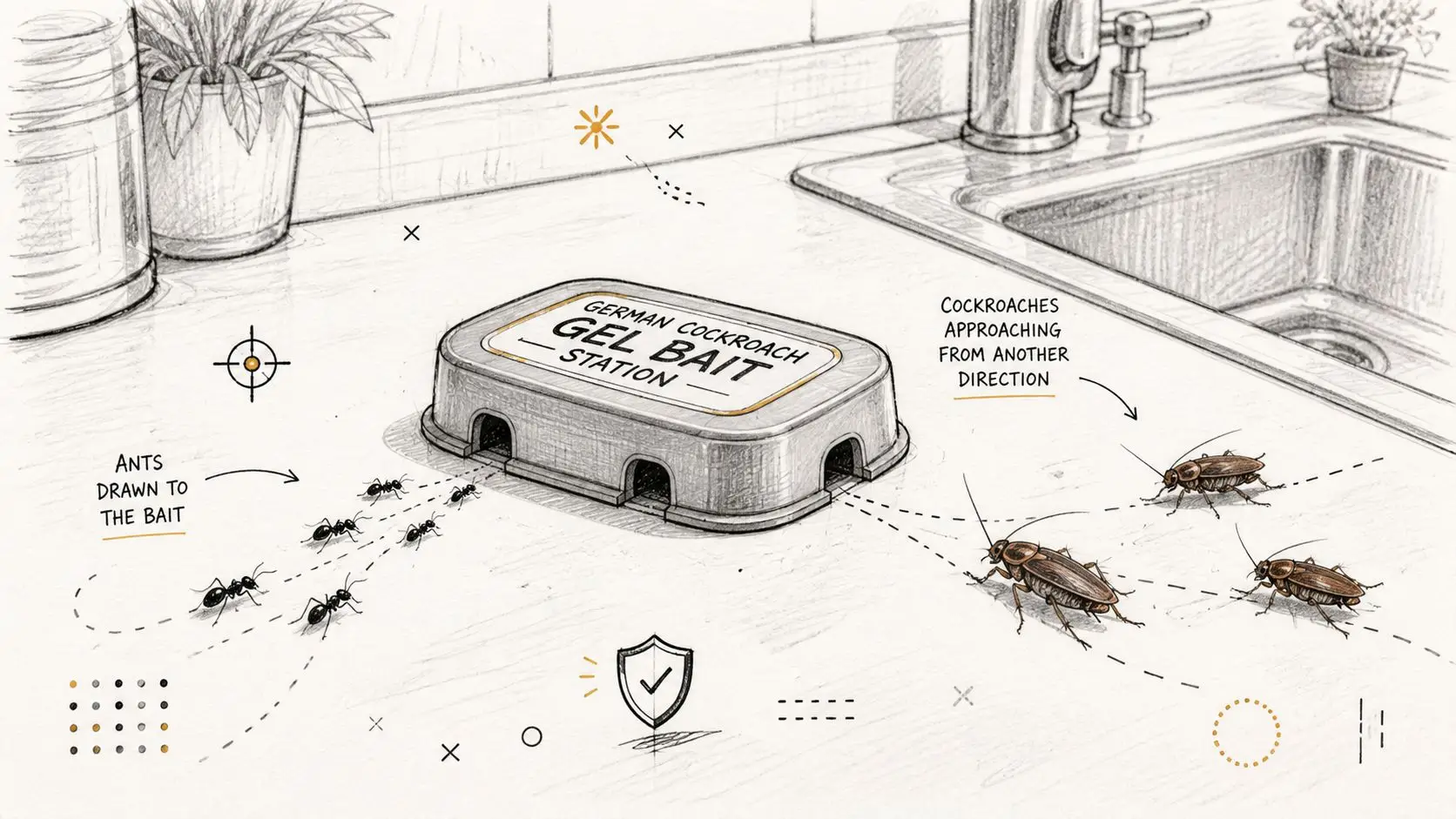
A mixed infestation creates a baiting problem before it creates a product problem. German cockroach gel placed beneath a cabinet may attract ants because ants will investigate available food, but that doesn't mean the gel will eliminate the ant colony. Workers may consume some of it, avoid it, or carry only a limited amount back to the colony.
The reverse can also happen. Exterior ant stations near a slab edge may draw ants away from a route, while fire ant colonies in adjacent soil continue to compete for food and disturb the treatment area. A treatment aimed at one species can change the movement of the other without solving either source.
Research on bait interaction shows why homeowners should avoid assuming that one treatment solves both infestations. In a 2025 study, Pharaoh ants that fed on German cockroach cadavers killed by commercial gel baits experienced significant queen and brood mortality, but one bait pathway allowed colony recovery after workers switched back to their regular diet. The PubMed record for that study documents the research. The practical lesson is that cross-species transfer can reduce colony health without guaranteeing permanent control.
A workable sequence
A technician usually needs to separate the two problems by location and behavior:
- Confirm the species and map activity. Place monitors in kitchens, bathrooms, utility areas, and suspected ant routes.
- Correct moisture and food access. Repair leaks, remove grease, secure food, and reduce saturated exterior soil.
- Treat cockroach harborages. Use carefully placed bait and targeted applications without contaminating bait zones with repellent spray.
- Treat ant routes and colonies. Follow trails to entry points, wall voids, garden edges, or damp wood rather than killing only visible workers.
- Recheck for rebound. One pest may surface first after treatment because the other has changed the available food, moisture, or shelter.
In Gulf Coast conditions, follow-up timing should respond to rain, humidity, grease accumulation, and leak repairs. A realistic remediation calendar may require an initial inspection, a focused treatment visit, a monitoring check, and further adjustment if activity shifts between indoor and outdoor harborages. A single combined visit can start the process, but it rarely replaces follow-up when both species have established sources.
Choosing the Right Service in Magnolia, Texas
A professional inspection makes sense when the evidence no longer fits a simple, isolated sighting. Persistent activity after baiting, cockroaches appearing in daylight, several ant trails converging at one structural point, or any contamination concern in a food-handling business are practical reasons to escalate.
The same applies when household members have asthma concerns, when a rental has activity in multiple units, or when a business needs a documented response. A technician can inspect behind appliances, under sinks, around water heaters, at attic eaves, along slab edges, and outside at landscaping bridges. Those locations often reveal why a product appeared to work briefly and then stopped.
What the first visit should establish
A useful initial inspection should answer four questions:
- What is the pest: German cockroach, outdoor cockroach, odorous house ant, carpenter ant, fire ant, or another insect?
- Where is the source: Appliance gap, plumbing penetration, wall void, crawlspace, perimeter edge, damp wood, or roofline?
- What is sustaining it: Water, grease, food residue, saturated soil, leaking trim, mulch, or an unsealed bridge?
- What happens next: Baiting, monitoring, exclusion, moisture correction, targeted treatment, or a combination?
FullScope Pest Control serves Magnolia and surrounding communities including Pinehurst, Todd Mission, Stagecoach, and the fringe of The Woodlands, along with other north Houston and Southeast Texas locations. Its residential and commercial pest services include inspection-based treatment options for ants and cockroaches, with plans that can be structured around one-time remediation or ongoing maintenance.
Ask how the provider sequences treatment, what follow-up cadence applies, and what guarantee or retreatment policy is written into the agreement. A quarterly or biannual plan may suit a property with recurring exterior pressure, while a one-time service may be reasonable only when the inspection finds a limited, correctable entry event.
Magnolia's service market is expanding, although population estimates vary by source and method. One local source projects 5,557 residents for 2026, while other estimates list about 4,988 for 2025 and 5,836 for 2024. The U.S. Census QuickFacts page for Magnolia provides the relevant local reference. For homeowners, those differences are less important than choosing a provider that understands the construction and environmental conditions of the actual property.
Book an inspection when you can't confidently identify the pest, when activity persists after a correctly placed bait, or when moisture and structural access are involved. For Magnolia homeowners and businesses, a documented inspection is usually the fastest way to settle the cockroach vs ants question and build a control plan that survives the next round of rain.
Call FullScope Pest Control to schedule a Magnolia inspection, describe the insect activity and locations you've observed, and ask for a written plan covering identification, moisture sources, entry points, treatment sequence, and follow-up.