1500+ reviews

True Arizona crab spiders are harmless to people, while the spiders most often mistaken for them are giant huntsman spiders found on walls at night. The giant form typically spans 2 to 2¼ inches, or approximately 50 to 64 millimeters, across the legs.
You're in bed in Magnolia or Kingwood when a large, flat spider suddenly moves sideways across the bedroom wall. The flashlight catches its pale body, long legs, and quick escape, and the name “crab spider” may immediately raise concerns about venomous species. That reaction is understandable, but the name creates more confusion than clarity.
In Arizona, “giant crab spider” commonly refers to Olios giganteus, a huntsman spider in the family Sparassidae. In agricultural settings, “crab spider” can also describe much smaller true crab spiders, such as Misumenops celer, a member of the Thomisidae family. These spiders differ in size, habitat, posture, and hunting behavior, so identifying the animal matters more than reacting to its common name.
Spotting the Arizona Crab Spider at Home
A bedroom light comes on in Magnolia, and a large, flat spider darts across the wall. In Kingwood, a similar spider may appear on an exterior wall beside a porch light, following insects that gather after dark. It can disappear into a crack, along the ceiling, or behind furniture before you see its details.
The quick movement can be unsettling, but the setting offers a useful clue. A large spider running across a vertical surface at night is more consistent with a huntsman-type spider than with a small true crab spider in the family Thomisidae. Keep your hands away and study its shape, position, and movement instead of relying on the common name.
Start with scale and posture
The giant huntsman has a flattened pale tan-to-gray body with long, hairy legs extending sideways. Its leg span is typically 2 to 2¼ inches, according to the University of Arizona spider resource. The legs spread outward like the spokes of a wheel, creating the crab-like outline behind its common name.
A true crab spider is generally much smaller. It is more likely to sit still on a flower, shrub, or crop plant, holding its front legs ready for prey. It does not usually race across an indoor wall at night.
Practical rule: A large, fast spider crossing a vertical surface after dark is more likely to be a huntsman than a true crab spider.
If it remains in view, take a photograph from a safe distance. Include the body, leg arrangement, and nearby surface. A clear image gives an identifier more useful evidence than color alone, which can change under a flashlight or against a different background.
Understanding the Two Spider Families
Family membership explains why two spiders can share a crab-like nickname yet behave so differently. Use the comparison below as a practical identification key, then confirm the pattern with several traits rather than one color or measurement.
| Feature | Giant Crab Spider | True Crab Spider |
|---|---|---|
| Scientific example | Olios giganteus | Misumenops celer |
| Family | Sparassidae | Thomisidae |
| Typical scale | Broad leg span, commonly about 50 to 64 millimeters | Much smaller than the giant huntsman |
| Body shape | Flattened, pale tan-to-gray body | Compact body with a crab-like stance |
| Leg posture | Long legs extend laterally | Front legs are often prominent and suited to grasping |
| Hunting method | Searches actively at night without a capture web | Waits in ambush on flowers, foliage, and other vegetation |
| Likely setting | Cracks, rocks, walls, garages, and buildings | Crops, flowers, shrubs, and other plants |
| Homeowner interpretation | A wandering insect predator that may enter structures | An outdoor, plant-associated predator |
The key is the whole pattern. A large spider with a flattened body and long, sideways-reaching legs fits the huntsman group. A smaller spider holding its front legs ready on a blossom or leaf fits the true crab spider group. Body proportions work like a measuring tool, while posture and setting show how the animal lives.
The two groups also occupy different roles around a home. A huntsman may appear as a roaming hunter, much like a nighttime patrol moving across open surfaces in search of prey. A true crab spider behaves more like a patient lookout, remaining on vegetation until an insect comes within reach. Those habits help explain why one may turn up on a wall while the other is more likely to be found among plants.
Common names create much of the confusion. “Arizona crab spider” can refer to a giant huntsman in a homeowner's conversation, while a field guide may reserve “crab spider” for a small member of Thomisidae. The name alone cannot settle the identification.
For a confident field check, record three observations: approximate scale, leg arrangement, and location. Note whether the spider is moving across a vertical surface or waiting on vegetation. A photograph taken from a safe distance should include the full body and legs. These combined clues are more dependable than a flashlight-altered color impression, and they can help distinguish a wandering huntsman from a true crab spider without handling either animal.
Habitat Preferences and Behavioral Patterns
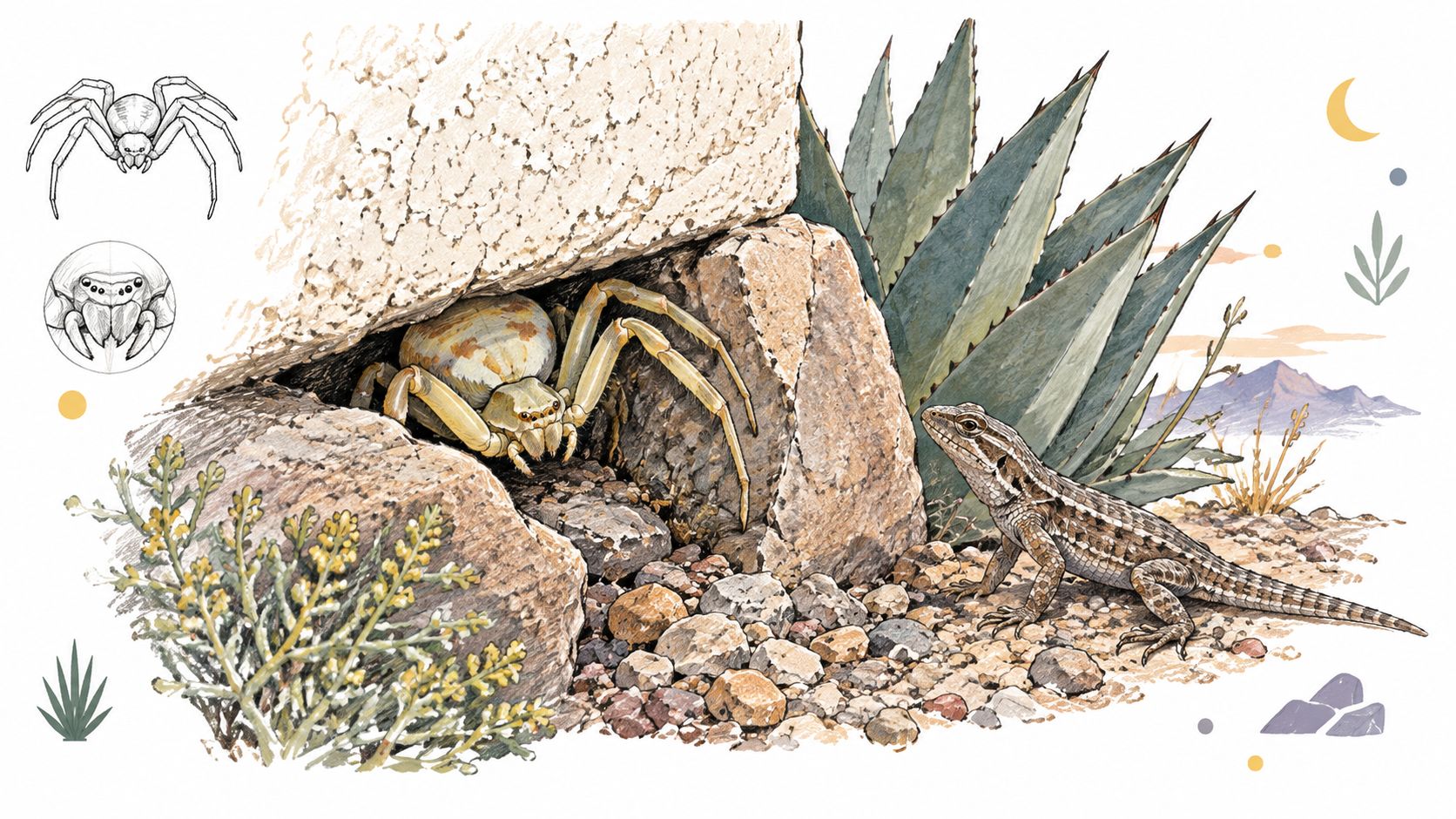
After sunset, a giant huntsman may leave a sheltered daytime resting place and patrol for insects. It does not rely on a capture web. A homeowner may instead see it moving across a wall, ceiling, garage door, or other exterior surface. This roaming habit is a useful clue when separating the large nocturnal huntsman from a smaller true crab spider waiting on vegetation.
Why a Texas home can still produce an Arizona name
The common name reflects an identification tradition, not a precise Texas service-area classification. Magnolia and other Southeast Texas communities do not share Arizona's desert setting, yet houses provide useful shelter for a wandering huntsman. Wall voids, garage clutter, door gaps, and narrow spaces around utilities can all support daytime concealment.
Outdoor lighting helps explain sightings. Insects gather around illuminated walls, entryways, and garages, creating a concentrated food source. A hunting spider may follow that activity and patrol nearby surfaces. Its presence beside a light does not show that it has established a web colony indoors.
True crab spiders follow a different pattern. They are commonly associated with vegetation, particularly flowers and crop plants, where they wait for insects to approach. A small, motionless spider on a blossom fits that pattern better than a large, active spider crossing a bedroom wall.
The food source also explains why removing one spider may not prevent another sighting. Insects that continue gathering around lights or entering through gaps can keep the area attractive to a roaming hunter. Reducing those attractants addresses the reason for the visit, rather than only removing the visitor.
Here is a short visual reference for the giant huntsman's shape and movement:
Differentiating from Dangerous Species
A large spider's size can make it look threatening, but size alone doesn't identify a brown recluse. The giant huntsman and brown recluse differ in eye arrangement, leg texture, body proportions, and typical behavior.
The giant huntsman has eight eyes, long hairy legs, and a flattened body. Its fang bases may appear dark reddish-black. It actively hunts and can climb walls and ceilings. The brown recluse is smaller, has six eyes, smoother legs, and is associated with a distinct fiddle-shaped marking.
The Texas venomous spider identification guide can provide additional context, but homeowners shouldn't rely on a single marking viewed under poor lighting. A photograph that captures the eyes, body, legs, and approximate scale gives an expert more useful evidence.
Identification Checklist
| Trait | Arizona Crab Spider | Brown Recluse |
|---|---|---|
| Example species | Olios giganteus | Brown recluse |
| Eye count | Eight eyes | Six eyes |
| Body | Flattened, pale tan-to-gray | Smaller body with a different profile |
| Legs | Long, hairy, oriented laterally | Smoother-looking legs |
| Marking | Darker abdominal median marking may be visible | Distinct fiddle-shaped marking |
| Movement | Active hunter that may cross walls and ceilings | Different behavior and web association |
| Common concern | Usually a non-dangerous insect predator | Medically significant identification concern |
What to do when the view is unclear
Don't handle an unidentified spider with bare hands. Keep children and pets away, use a container only if you can do so without contact, or ask a pest professional to identify it.
Color is a weak guide because shadows, paint, flooring, and nighttime lighting can change how the spider appears. Eye arrangement, leg texture, body shape, and behavior together offer a more dependable comparison.
A large, fast spider on a wall at night isn't automatically a brown recluse. At the same time, reassurance should follow identification rather than replace it. If the animal is flattened, laterally legged, and active on a vertical surface, the evidence leans toward a huntsman-type spider, but a clear image remains the safest way to improve confidence.
Assessing Bite Risks and Medical Response
Giant crab spiders are generally non-dangerous and defensive rather than aggressive. A bite is most likely when the spider is trapped against skin, such as inside clothing, bedding, or a person's hand. The expected effects are usually localized pain, redness, and mild swelling, according to the available guidance summarized by giant spider safety information.
That doesn't mean every unexplained bite should automatically be blamed on a crab spider. Many bites and skin reactions look alike, and the spider may not have been correctly identified.
Immediate care
If a bite may have occurred:
- Move away from the spider. Don't try to catch it with your hands.
- Clean the area gently with soap and water.
- Apply a cool compress to help limit discomfort and localized swelling.
- Photograph the spider only if it can be done safely. Don't risk another contact.
- Monitor the symptoms. Note whether the affected area stays localized or begins to change.
The bug bite identification resource can help homeowners organize observations, but it can't replace medical evaluation when symptoms are severe or uncertain.
Most spider venom is no more potent to people than a bee sting, but allergic reactions can occur rarely. Treat the person's symptoms, not just the suspected spider's name.
Seek prompt medical attention for spreading swelling, breathing difficulty, severe or worsening pain, systemic symptoms, or signs of infection. Don't dismiss a serious reaction because the spider looked harmless. Identification can be uncertain, and symptom progression is more important than winning an argument about the common name.
Avoid unverified home remedies, cutting the skin, or attempting to remove venom. Calm handling, basic cleaning, observation, and appropriate medical advice are safer responses.
Preventing Encounters in Your Home
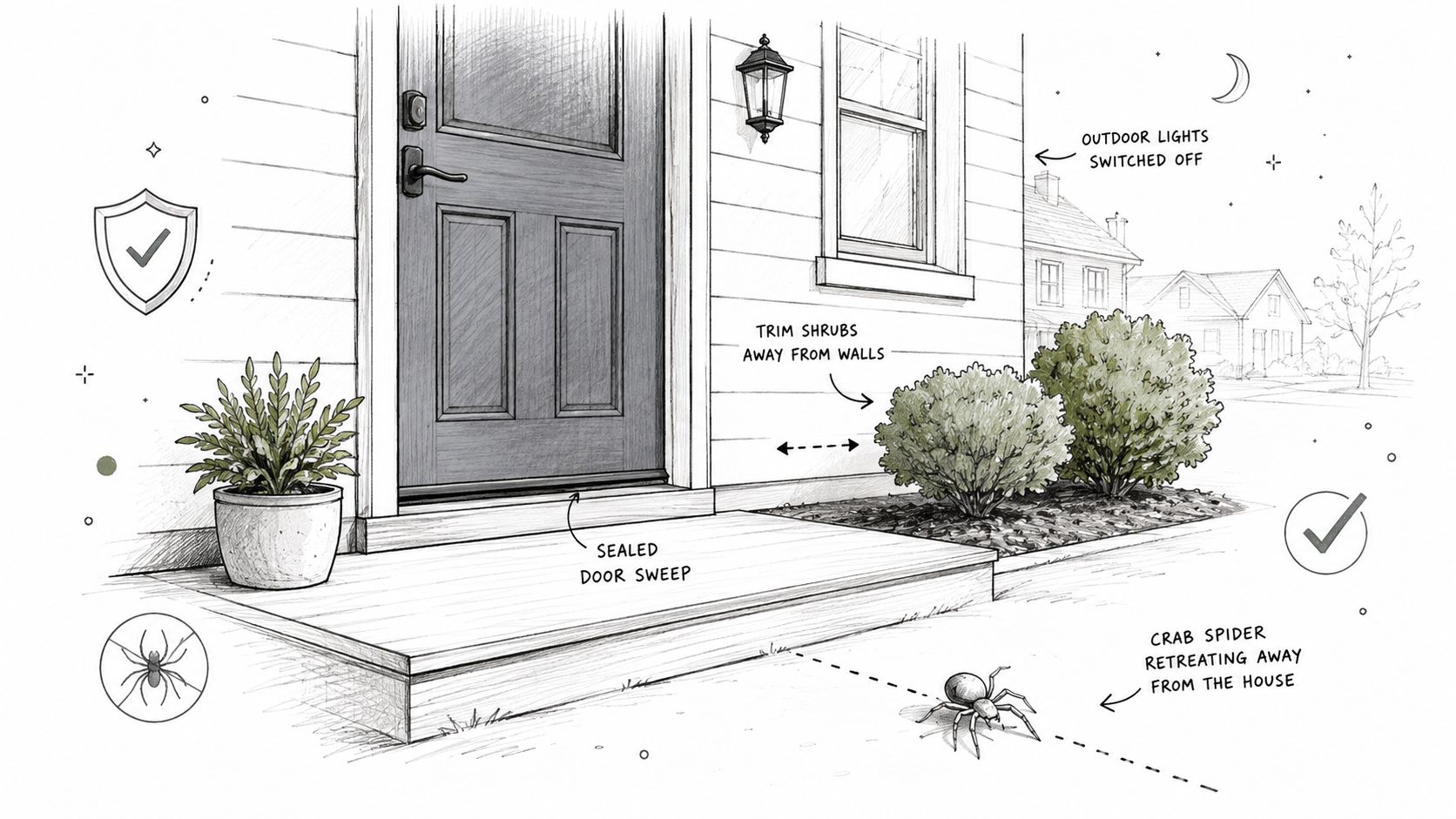
Targeted exclusion is usually more useful than indiscriminate indoor spraying. A wandering huntsman enters because the building offers access, shelter, or prey. Addressing those conditions reduces the reason for repeated encounters while preserving the ecological role of spiders outdoors.
Start outside and work toward the interior. Inspect the places where insects and spiders can move between the yard and the structure.
- Check exterior harborage. Look beneath stored materials, around dense vegetation, and near cracks that provide sheltered daytime hiding places.
- Review outdoor lighting. Lights around doors, garages, and patios can concentrate insects, which may attract hunting spiders to the same walls.
- Seal access points. Examine door sweeps, window screens, garage seals, and utility penetrations for openings.
- Reduce indoor prey conditions. Repair moisture problems, store cardboard and clutter carefully, and keep food debris from accumulating in hidden areas.
- Remove visible webs safely. Regular sweeping and exterior cleaning can make sheltered edges less attractive without coating indoor surfaces in unnecessary pesticide.
Why the perimeter matters
A spray applied only to bedroom walls may kill an individual spider but leave the entry route and insect activity unchanged. A perimeter inspection can reveal whether the recurring issue begins at a garage threshold, a utility opening, a damaged screen, or a lighted exterior wall.
For homeowners who want practical cleaning guidance, cobweb removal advice for Phoenix homeowners explains how to distinguish visible cobwebs from active spider webs and approach exterior cleanup. The climate differs, but the housekeeping principle remains useful: remove accumulated web material while also checking why insects and spiders are using that location.
For additional guidance on removing web material and addressing recurring activity, see how to control spider webs in a home. The strongest plan combines cleaning, exclusion, lighting adjustments, and focused treatment where inspection shows a real need.
Serving Magnolia and Surrounding Areas
Magnolia sits in southwestern Montgomery County at the junction of FM 1774 and FM 1488, within the northwestern Houston-area service market rather than inside Houston proper. The city is approximately 45 miles northwest of Houston and 25 miles southwest of Conroe, with Interstate 45 and U.S. 290 each about 20 miles away, according to the City of Magnolia location profile.
Those road connections make Magnolia a practical reference point for service visits across nearby residential and commercial communities. A homeowner should describe the property location clearly, especially when the address falls outside the incorporated city and into the broader southwest Montgomery County area.
Choosing the right response locally
For one isolated sighting, photograph the spider, avoid direct contact, and inspect the nearby entry point. Repeated sightings call for a broader look at exterior lighting, insect activity, vegetation, garages, door seals, and utility penetrations.
Local service coverage can include Magnolia, Kingwood, Conroe, and Cleveland, along with nearby communities in the north Houston and Southeast Texas market. The relevant question isn't only, “What spider is this?” It's also, “Why can it reach this part of the home, and what conditions keep bringing prey near the structure?”
Population figures for Magnolia vary by reference year and geographic definition. The incorporated city had 2,359 residents in the 2020 U.S. Census, while estimates and city reporting list different 2024 figures, so service-area planning is clearer when described as Magnolia and surrounding southwest Montgomery County communities rather than by one population number, as summarized in the Magnolia demographic reference.
If a spider cannot be identified confidently, sightings continue, or exterior access points are difficult to assess, contact FullScope Pest Control for an inspection. FullScope serves Magnolia, Kingwood, Conroe, Cleveland, and surrounding Southeast Texas communities with residential and commercial pest services, including targeted spider control, exclusion guidance, termite protection, mosquito management, and rodent services. Share photographs, the exact room or exterior location, time of activity, and whether sightings are isolated or recurring so the technician can focus on the conditions that matter.
If you've found a large, fast spider on a wall in Magnolia, Kingwood, Conroe, or nearby communities, don't guess from the common name alone. Photograph it safely, check likely entry points and insect attractants, and contact FullScope Pest Control to arrange a professional inspection and targeted treatment plan.