1500+ reviews


You picked up the keys this week. Boxes are still in the garage, the builder's stakes are sitting in the flower bed, and last night's storm left a dark line of water along the slab. A new house can look finished and still hand pests food, water, and a way in.
Pest control for a new home is a moisture and construction audit across the first months, not one spray around the eaves. A pretreatment record and a clean report tell you what happened at build time. They do not prove that grading, mulch, or a gap at the garage will stay harmless after you move in.
Walk the property with a flashlight and a notepad. Match each sign to the pest it suggests, and change the plan only when that trigger shows up.
First-Week Pest Checklist for a New Home
Use this order in the first week. Live insects, fresh droppings, or soft wood mean you call a technician instead of treating the spot alone.
| Check area | Sign to look for | Pest it points to | First action |
|---|---|---|---|
| Foundation perimeter | Gaps where soil meets siding, mud tubes, soft or hollow wood | Subterranean termites | Request a WDI inspection before other steps |
| Under sinks and utility openings | Droppings, gnaw marks, gaps wider than a pencil | Cockroaches, rodents | Seal gaps with caulk or foam, set monitoring traps |
| Garage threshold and exterior doors | Daylight under the door, trails of ants | Ants | Add foam and weatherstrip, place bait along the trail, avoid broad spraying |
| Yard and gutters after rain | Standing water, clogged gutters or downspouts | Mosquitoes, moisture-loving pests | Clear gutters, extend downspouts, fill low spots |
| Attic and crawl space | Damp insulation, musty odor, stained framing | Termites, carpenter ants, wood-boring beetles | Measure humidity and find the moisture source |
| Mulch and construction debris | Mulch or lumber touching siding, wood scraps in soil | Termites, carpenter ants | Pull mulch back to a visible gap, remove scraps |
What each sign means
Soil against the siding, mud tubes, or hollow-sounding wood means you request a WDI inspection before landscaping or storage.
Droppings, gnaw marks, or a gap wider than a pencil mean cockroaches or rodents, so seal the opening and set a monitoring trap.
Daylight under the door plus an ant trail means foam, weatherstrip, and bait on the trail, not a broad spray.
If you can see daylight under a closed door, pests already have a map. Close the gap before you buy a can of spray.
Puddles and a clogged gutter after rain mean you clear the gutter, extend the downspout, and fill the low spot.
Damp insulation, a musty odor, or stained framing means you measure humidity and find the wet source before you load the attic with boxes.
Mulch or lumber on the siding means you pull it back to a visible gap and haul scraps out of the soil.
A room-by-room cleaning plan before moving in from Top Cleaners clears packing debris and food film that would feed pests using those gaps.
Termite Risk and Documents to Verify Before Closing
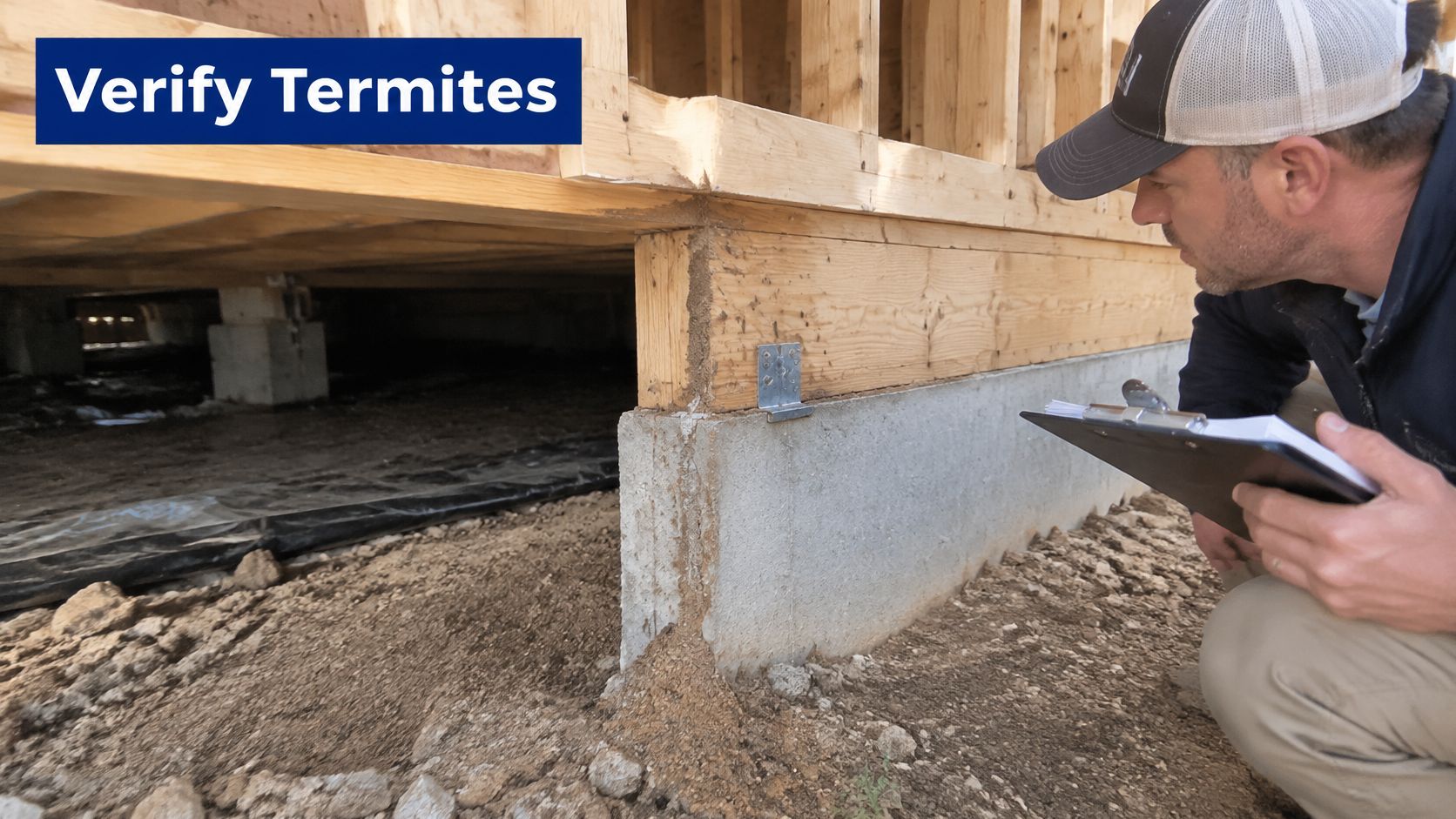
Termites are a construction-interface problem. Subterranean termites use continuous paths between soil and structural wood at foundation walls, slabs, porches, utility penetrations, and backfill. An interior spray cannot close a gap that was poured into the slab.
USDA Forest Service research, set out in HUD guidance on wood protection, identifies subterranean termites as the most important wood pest in the United States, and warm, moist conditions around foundations raise the risk. That same guidance estimates that approximately 1 in 20 newer homes may be infested with termites to some degree, compared with about 1 in 10 homes in older developments. A new house is lower risk. It is not risk-free. Soil-applied insecticides, pressure-treated lumber, wood kept off soil, and periodic inspections are the layered protections, and each one fails if a later change opens a route.
Look for mud tubes where the slab meets soil before you accept a verbal "we treated it."
Pretreatment zones to confirm
Purdue University Extension names four pretreatment zones, in this order:
- The full soil surface beneath slabs and enclosed concrete.
- Soil along foundation walls and beneath interior walls.
- Soil around sewer and utility openings.
- Footings and backfill on both sides of foundation walls where a technician can still reach them.
Wood forms, stakes, stumps, and scraps should have been removed before soil or concrete covered them. Structural wood should not touch soil. Those steps cut concealed routes that are hard to see after the patio and beds go in.
Verification steps before you sign
- Request the pretreatment record and treatment map, because they show which zones were treated.
- Confirm structural wood sits clear of soil with a visible gap, because wood in soil is an open route.
- Check that utility penetrations are sealed, because pipes are a common concealed entry.
- Ask whether later drilling, an added slab room, or soil piled against siding would void the protection.
- Order a WDI report. Lenders often require one, and it is your baseline, not a lifetime guarantee.
Practical rule: Put the bond or warranty renewal date on the calendar the day you close. Missed renewal is how a treated house becomes an untreated one.
| Document | What it confirms | When to request |
|---|---|---|
| Termite pretreatment record | Soil or barrier treatment applied during construction, with treated zones | Before closing |
| WDI inspection report | Visible evidence of active or past termite and wood-boring damage | Before closing, often requested by lenders |
| Termite bond or warranty | Coverage terms, renewal date, and retreatment obligations | At closing and at each renewal |
| Treatment map or diagram | Exact locations of treated soil, penetrations, and barrier | Before any landscaping or additions |
| Builder grading and drainage specs | Grading, downspout routing, and moisture barrier details | Before closing |
A termite inspection report for closing records what is visible. It does not replace the map, and it does not survive undisturbed if someone later trenches the treated soil.
Moisture and Entry-Point Fixes That Come First
After a storm, water pooling beside a new home can reveal more than a drainage problem. The first months are a chance to check how the house handles moisture and where pests could get in. Fixing those conditions helps a treatment plan work as intended.
EPA guidance for housing managers recommends sealing entry points, maintaining screens, correcting leaks, removing trash and overgrown vegetation, and eliminating standing water before pesticide use. Persistent moisture can create conditions that attract subterranean termites, carpenter ants, and some wood-boring beetles. Where crawl-space or foundation conditions call for it, a six-mil polyethylene moisture barrier may be appropriate. Exterior grade should slope away from the building, and joints at porches and planter boxes should be sealed.
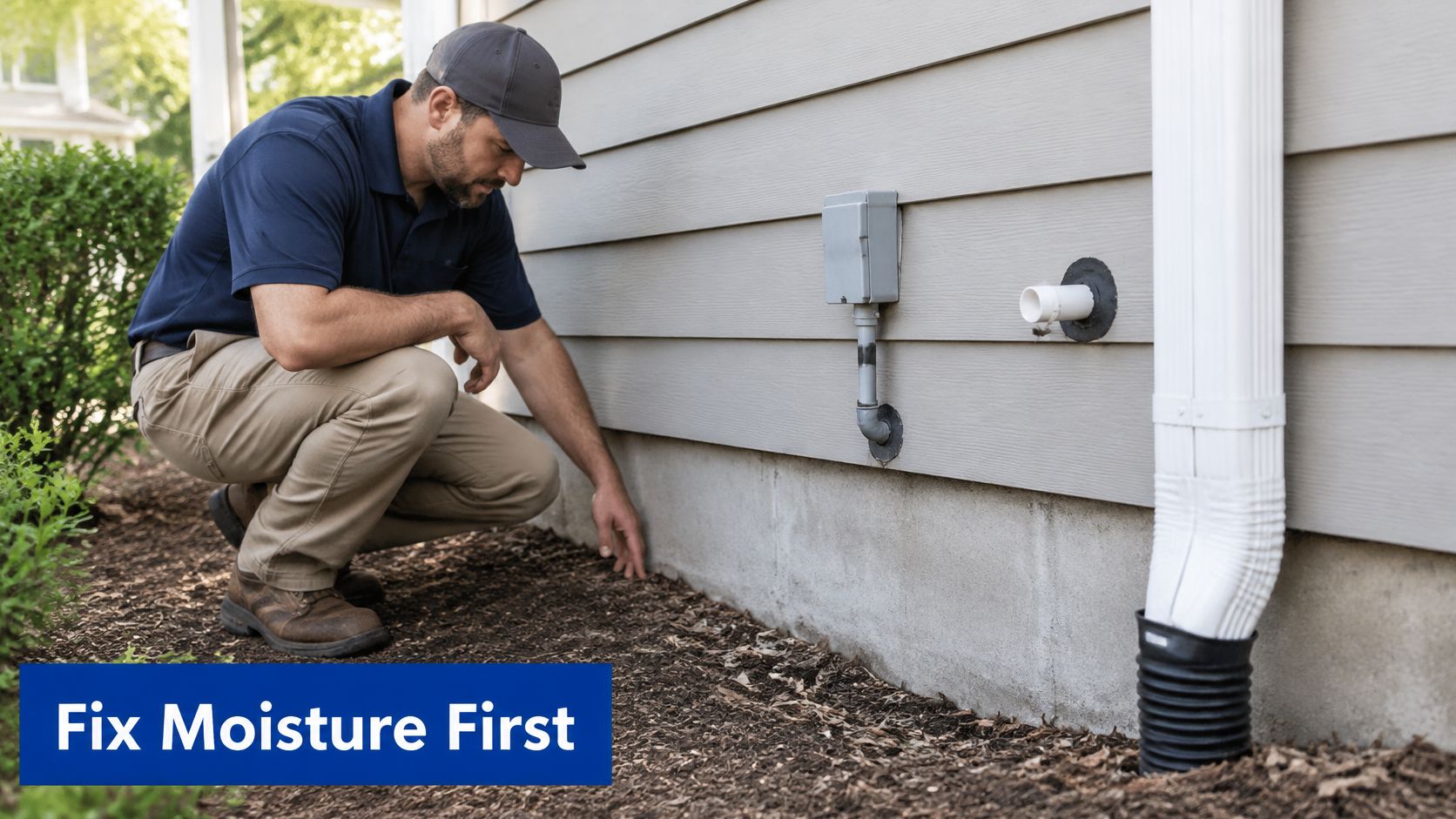
If a downspout sends water toward a slab corner after every storm, extending it and correcting the grade addresses the source. Repeatedly treating a wall that stays wet does not fix the drainage problem. Pooled water near the foundation can also affect liquid termiticide performance and interfere with bait stations.
A technician examining the grade and gaps along a wall is tracing how water and pests move around the structure.
Order of the fixes
- Repair roof and plumbing leaks first. Damp wood can attract subterranean termites, carpenter ants, and some wood-boring beetles.
- Extend downspouts so water discharges away from the foundation, then confirm the grade slopes away from the house.
- Screen vents with fine mesh and keep the foundation perimeter visible, so shrubs do not hide gaps or termite tubes.
- Once the moisture source is controlled, seal remaining utility and conduit gaps. Sealing a wet wall can conceal the underlying problem.
Condensation on glass can be a clue that indoor humidity is reaching surfaces where moisture may collect. Learn how to reduce window moisture from indoor humidity.
When a product is the next move
If pests remain active after entry points are addressed, monitoring can help determine whether a trap, bait, or targeted treatment is appropriate. Treatments should be placed where pests travel and nest, rather than across open rooms. Exclusion pest control focuses on closing access points; treatment can then address activity that continues. Recheck the home after seasonal changes and heavy rain.
Setting Up a Trigger-Based Protection Plan
A useful plan runs on triggers, not a spray booked because the calendar flipped. EPA integrated pest management principles define the loop as removing food, water, shelter, and entry points, then using monitoring to update what you do next. Least-toxic methods and structural exclusion come before pesticide reliance.
| Pest group | Routine monitoring | Escalate when |
|---|---|---|
| Subterranean termites | Documented inspection each year and after heavy rain | Live termites, mud tubes, or damaged wood found |
| Ants | Check bait stations and trails monthly in warm months | Trails return after bait, or mounds appear near the foundation |
| Cockroaches | Sticky-trap counts every 1 to 3 months | Trap counts rise, or droppings appear in kitchen or bath |
| Rodents | Inspect exterior seals each season | Droppings, gnaw marks, or noises in walls |
| Mosquitoes | Check standing water after storms | Biting activity limits yard use |
| Fleas | Check pet bedding and the yard after warm months | Adult fleas found on pets or in carpet |
Why the intervals differ
Termites and other wood-destroying insects stay hidden, so a documented inspection each year, plus a look after heavy rain, is the minimum. Ants show themselves. In warm months, check bait stations and trails monthly. On a recent Kingwood, TX ant treatment, we applied granular bait along the perimeter, a liquid barrier around the foundation, treated two active mounds, and sealed the garage threshold with foam. That mix matched trails and mounds, not a blanket indoor spray.
Cockroaches are a counting problem. Sticky traps every 1 to 3 months show whether numbers are falling. Rodents need the seals checked each season because a new gap at a conduit is enough. Mosquitoes track storms: if biting keeps you off the patio, standing water was missed. Fleas show up on pets and in carpet after warm months, so bedding and the yard are the check, not the kitchen.
A rising trap count, droppings in the kitchen or bath, ant trails that return after bait, live termites, or mosquitoes that limit yard use are the moments the plan changes.
A scheduled quarterly visit can be the right choice where pressure stays high. Review the plan each year and after any remodel, addition, or drainage change. Keep a simple log: date, location, count, and action taken. That record is what tells you inspection-only monitoring is enough, or that the next visit should escalate.
What to Expect From Technicians and Child- and Pet-Safe Options
During the first visit, a technician should inspect the home and yard, then explain what is active, where pests may be entering, and which conditions could keep the problem going. The treatment plan should connect each action to a specific finding. Products belong where pests travel, nest, or remain active, while practical prevention helps reduce the chance of a return.
Questions worth asking on the walk-through
Ask which products are planned, where they will be applied, and what the product label says about children and pets. Confirm how long they should stay away from treated areas and whether follow-up is included. Re-entry guidance should come from the label, not guesswork.
A child- and pet-conscious plan can combine several approaches:
- Sealing and exclusion: Close gaps that pests use to enter or shelter.
- Bait stations: Place them where children and pets cannot reach them.
- Gels and traps: Use them in cracks or voids when they suit the pest.
- Targeted treatments: Apply products where pests travel, rather than across floors and counters.
- Green solutions: FullScope Pest Control offers completely green pest extermination solutions.
A broad spray treats open surfaces. A targeted placement focuses on a pest's route or nesting area, which can reduce unnecessary application. For more information, see eco-friendly pest control for homes with kids and pets.
Ventilation openings also need tight screens. A small, deliberate opening, such as one created through persiana trickle vent installation, should not become an unscreened route for pests.
Magnolia Service Area and Scheduling a First Visit
A Magnolia mailing address does not necessarily mean a property is within FullScope Pest Control's service area. The company serves north Houston and nearby Southeast Texas communities, including Conroe, Kingwood, Cleveland, Porter, and Humble. Confirm the full property address before booking, since nearby streets and rural lots can fall outside a community's coverage.
A postal city name is a little like a label on a map: it helps identify an area, but it does not establish service coverage. Share the street address and ZIP code when requesting a visit.
What to have ready on the first call
- Full street address with ZIP code.
- Foundation type: slab, pier-and-beam, or crawl space.
- Yard size and any exposed soil, especially new beds or bare grade.
- Home age and the builder's pretreatment record, if you have it.
- Whether children or pets live there.
These details help clarify what the property needs. For example, foundation type and exposed soil can guide where an inspection should focus, while the home's pretreatment record can provide useful context. Share what you know, and confirm the address before scheduling.
Confirm Your Plan and Book the First Inspection
A new home's first inspection should turn the paperwork and visible conditions into a practical plan. Check whether the termite file includes the pretreatment record, map, WDI report, and renewal date. Note any moisture or entry-point fixes still outstanding, then decide whether the property calls for scheduled visits or a plan adjusted to pest activity.
Most homes benefit from quarterly or biannual treatments, though the right frequency depends on the property and its pest risk. A quote can help set a schedule around the home's conditions rather than assuming every house needs the same cadence.
FullScope Pest Control offers residential pest control for ants, termites, fleas, roaches, bed bugs, mosquitoes, rodents, and other pests, as well as wood-destroying insect inspections for home purchases. Residential pest control service includes a free quote.
Before booking, gather the termite documents and make a short list of unfinished moisture or exclusion work. Then request a quote for the property address and, if needed for the purchase, ask about a WDI inspection. Schedule the first visit with the home's inspection points and records ready.
Request your free residential quote for your home address this week, and have the pretreatment record and grading notes ready before the first inspection so it starts with the building, not with guesswork.