1500+ reviews

Most homeowners are told that pest control means spraying chemicals around the baseboards. That advice is incomplete, and following it can leave the actual cause untouched. What is included in pest control should start with finding how pests entered, why the property supports them, and whether activity is established or temporary. Treatment is only one part of a professional program.
A durable service may include inspection, pest identification, monitoring, sanitation guidance, exclusion work, habitat modification, targeted treatment, and follow-up verification. The right combination depends on the pest, the building, the surrounding conditions, and the level of risk. A quick application may suppress visible activity, but it won't necessarily stop pests from returning through an unsealed gap, a leaking pipe, standing water, or an accessible food source.
Redefining Modern Pest Control Services
Pest control goes beyond applying insecticide. The foundational approach is integrated pest management, or IPM, which combines inspection, monitoring, prevention, and multiple control methods. The U.S. Environmental Protection Agency describes IPM as the coordinated use of efficient methods to keep pest populations at tolerable levels instead of relying on one tactic, as explained in this EPA overview of integrated pest management.
That distinction changes what a technician should do during a visit. A professional may look for entry points, moisture, food sources, nesting areas, droppings, shed skins, wood damage, and conditions that support breeding. The technician then determines whether treatment is justified, which control method fits the situation, and what the homeowner or facility manager must correct.
Practical rule: If the service report only says “sprayed,” it hasn't told you enough about the pest problem or the plan to prevent its return.
IPM can involve sanitation and habitat modification, physical exclusion, trapping, monitoring devices, biological controls, cultural practices, and carefully targeted chemical treatment. Chemical applications still have a place, especially when pest activity is confirmed and lower-risk controls aren't sufficient. The professional standard is to use them deliberately, at the treatment location and quantity appropriate for the situation.
This approach became increasingly important as pest management moved away from heavy dependence on pesticides. U.S. pesticide production rose from less than 200 million pounds in 1945 to approximately 1.6 billion pounds in 1975, according to the historical EPA document linked above. A national IPM research effort began in 1972, involving the National Science Foundation, EPA, USDA, and scientists at 19 universities over seven years. Those historical facts don't tell a homeowner which product to use, but they do explain why modern pest management emphasizes prevention and monitoring.
For a homeowner, the difference is concrete. A technician treating ants may identify the trail, locate the entry route, recommend sealing a gap, correct an attractant, and use a targeted product rather than coating every room. A rodent service should address access and sanitation as well as the existing animals. A mosquito program should consider standing water and harborage, not just apply a perimeter treatment.
A useful explanation of the broader service concept is available in this resource about modern pest control and its practical scope. The key point is simple: professional pest control manages conditions and risk, not just visible insects.
The Core Service Process and Integrated Pest Management
A competent service visit follows a diagnostic sequence. The technician shouldn't reach for a sprayer before understanding what is present, where it is active, and what will keep it there.
The inspection comes first
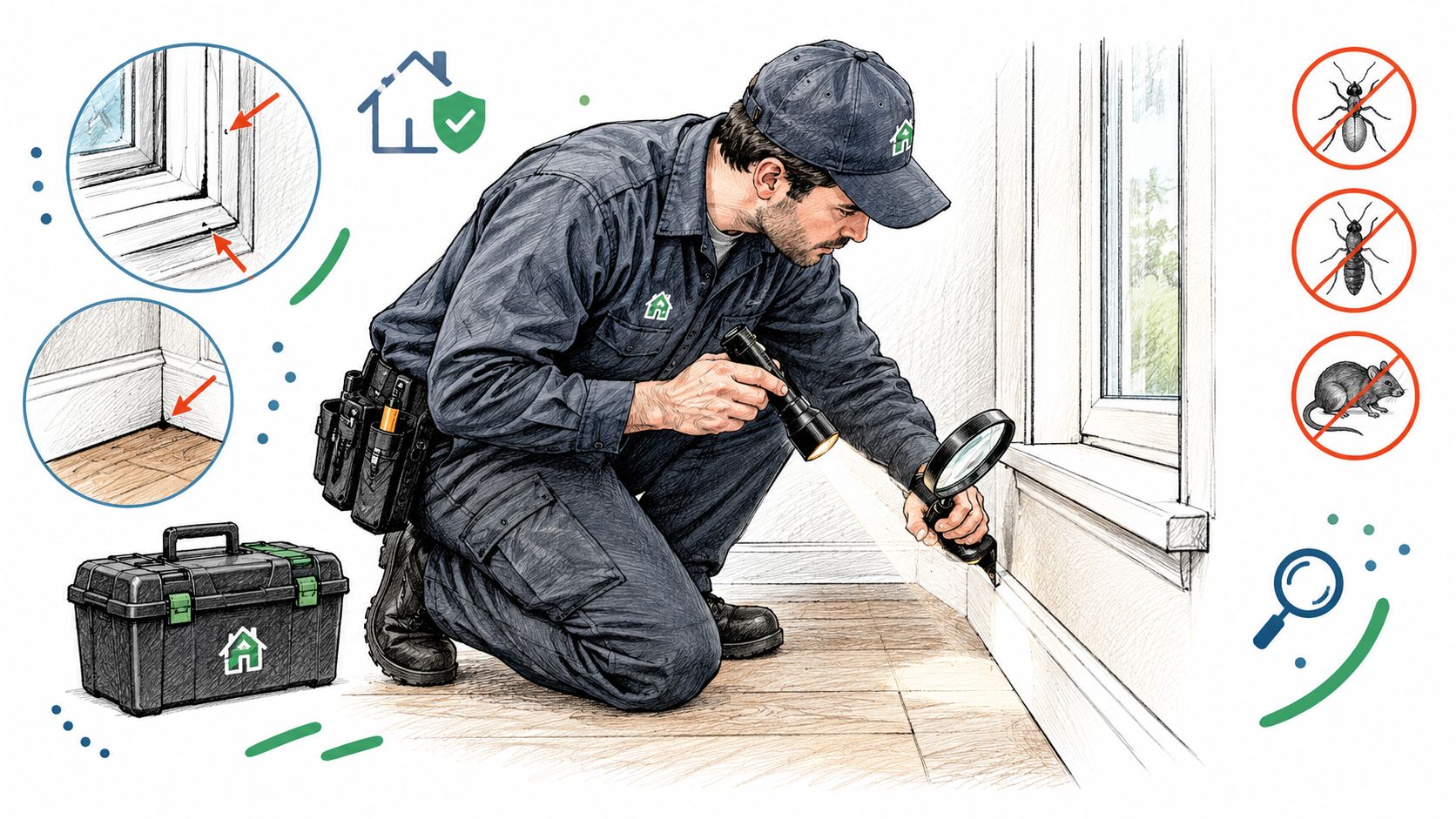
The first stage is a structured inspection of the building and its surroundings. Depending on the problem, that can include kitchens, utility rooms, attic spaces, crawl spaces, garages, roof-wall junctions, plumbing penetrations, vents, doors, windows, exterior walls, landscaping, and areas where moisture collects.
The technician looks for direct evidence, such as live insects, droppings, gnaw marks, nests, cast skins, damaged wood, trails, or trap captures. They also look for indirect evidence, including gaps, clutter, leaking fixtures, unsealed food, dense vegetation against the structure, and water sources. A moisture meter, flashlight, inspection mirror, traps, monitors, and documentation tools can all support the diagnosis.
Accurate identification matters because similar signs can point to very different pests. Ants, termites, cockroaches, and beetles don't require the same control plan. A seasonal invader that entered through a door may need a different response from an established infestation supported by moisture and concealed harborage.
Monitoring sets the treatment threshold
IPM uses an action threshold, meaning the level of pest activity or environmental risk at which control becomes justified. The threshold isn't identical for every property. A single insect in a home may call for observation, while repeated activity near food-handling areas can require immediate intervention.
The professional sequence includes identification, monitoring, evaluation, prevention, selection of control methods, and follow-up. The EPA IPM toolkit describes these elements as core parts of building IPM.
A technician may install sticky monitors for cockroaches, tracking patches for rodents, pheromone traps for certain stored-product pests, or other devices suited to the site. Monitoring reveals where activity is concentrated and whether the population is declining. It also prevents a provider from treating blindly.
Here is where building maintenance and green space management intersect. Vegetation touching a structure, stressed ornamental plants, and unmanaged plant health can create shelter or attract insects near a building. A facility manager dealing with recurring outdoor pressure may also benefit from reviewing plant health care for commercial properties alongside the pest plan.
Treatment is selected, then verified
Once the technician understands the problem, control may involve sealing openings, removing food and water, improving sanitation, using traps, adjusting storage, changing irrigation, applying heat or other physical controls, or using a targeted pesticide. Spot treatments, gels, baits, and crack-and-crevice applications can be more appropriate than broad area-wide spraying, particularly in sensitive indoor spaces.
The service shouldn't end when the product is applied. Follow-up verification checks for continuing droppings, captures, live insects, fresh damage, new entry points, or other signs of activity. If the evidence doesn't support control, the provider should reassess the identification, threshold, treatment method, or environmental conditions.
A clear explanation of this workflow appears in this guide to integrated pest management. For a visual example of how inspection and treatment fit together, the following video provides additional context.
Standard Residential and Commercial Pest Coverage
A general pest package usually groups common invaders that respond to similar preventive methods. Ants, cockroaches, spiders, fleas, and seasonal invaders are common residential targets, but grouping them in one plan doesn't mean every pest receives the same treatment.
For ants, the technician may trace activity to an entry point and use a targeted bait or treatment that addresses the trail. Cockroach service depends heavily on sanitation, harborage reduction, monitoring, and carefully placed products. Spiders often require exterior web removal, reduction of insect prey near the structure, and attention to cracks or sheltered areas. Flea control may require treating the environment and following instructions for cleaning and pet-related management.
The property type changes the operating standard. A home visit may focus on the exterior perimeter, interior harborage, garages, kitchens, utility penetrations, and conditions the resident can correct. A commercial program must account for facility operations, employee access, food handling, storage, receiving areas, waste management, and vulnerable zones that change over time.
Commercial service also requires mapped inspection areas, records, treatment documentation, and periodic reassessment. Those records help a facility manager identify recurring locations, verify that service occurred, demonstrate corrective action, and coordinate pest work with sanitation and maintenance teams. A warehouse, restaurant, office, or multi-site operation can't be managed like a single-family home.
The contract language matters as much as the pest list. Ask whether interior service is included, whether exclusion repairs are separate, which pests are excluded, how emergency calls work, and what follow-up the provider supplies. A package may cover routine general pests while treating termites, rodents, mosquitoes, and wood-destroying insects as specialty services.
The following comparison shows the practical difference:
| Service Feature | Residential Coverage | Commercial Coverage |
|---|---|---|
| Initial inspection | Interior and exterior review, entry points, moisture, food, and harborage | Site assessment with mapped risk areas, facility processes, sanitation, and vulnerable zones |
| Routine treatment | Perimeter protection, targeted interior work, traps, baits, or spot applications | Scheduled treatment tied to documented activity, facility risk, and operational requirements |
| Customer guidance | Food storage, leak repair, clutter reduction, sealing gaps, and yard conditions | Sanitation procedures, waste handling, storage practices, staff coordination, and corrective actions |
| Documentation | Service notes and recommendations | Inspection records, treatment records, trend review, and compliance documentation |
| Follow-up | Recheck or service response when activity continues under the agreement | Periodic reassessment, verification, reporting, and escalation when activity persists |
Homeowners can review how recurring services may be structured through residential pest control plans. The right plan is the one whose stated coverage matches the property and the actual pest risk, not just the one with the broadest list of insects.
Specialty Add-Ons and Targeted Exclusions
A general spray won't solve every pest problem. Termites, mosquitoes, and rodents require different evidence, equipment, and control decisions, so they commonly appear as specialty services rather than automatic parts of a basic maintenance package.
Termite protection addresses hidden structural risk
Termite work starts with inspection and identification. The technician examines accessible wood, foundation areas, crawl spaces, moisture conditions, expansion joints, plumbing penetrations, and other locations where termites may enter or remain concealed.
The treatment plan may involve monitoring, targeted applications, soil treatment, localized wood treatment, moisture correction, or recommendations for repairs. The correct method depends on construction, access, termite species, evidence of activity, and the level of structural risk. A routine exterior application for ants isn't a substitute for a termite inspection or a termite-specific control plan.
Real estate transactions create another reason to request dedicated documentation. Wood-destroying insect inspections and reports are specialized services used to identify relevant findings for a property sale or purchase. Home buyers and agents should ask what the report covers, whether inaccessible areas are identified, and whether recommendations are separate from treatment.
Mosquito control combines outdoor treatment and source reduction
Mosquito service is more than a single perimeter application. Professionals may inspect breeding conditions, identify standing-water sources, reduce harborage, apply appropriately registered products, and recommend ongoing prevention.
The public-health dimension explains why vector management belongs within professional pest control. CDC data show that reported U.S. illnesses from mosquito, tick, and flea bites more than tripled from 2004 through 2016, with more than 640,000 cases reported during that period and nine new germs identified or introduced in the country, as documented in the CDC vector-borne disease summary.
Barrier sprays can reduce outdoor mosquito pressure around areas where people gather. Automated systems such as MistAway may provide another option for properties where recurring outdoor activity is a concern. Neither approach replaces source reduction. The CDC recommends eliminating containers that hold small amounts of water because they can become egg-laying sites. A provider should explain the treatment area, service interval, limitations, and the homeowner's role in removing water-holding objects.
Rodent control requires an access plan
Trapping or baiting alone often leaves the reason for the infestation intact. Rodent service should identify access routes, remove or reduce attractants, place and service control devices, and verify whether new activity has stopped.
Small rodents can use narrow openings. CDC guidance specifically identifies openings larger than 1/4 inch as gaps that should be sealed, along with recommendations for rodent-resistant food storage, sanitation, removal of shelter, trapping, and rodenticides where necessary. The CDC guidance on rodent control describes these measures as parts of an integrated approach.
Inspection should include utility penetrations, door thresholds, vents, roof-wall junctions, crawl spaces, and plumbing openings. Sealing blocks new entry, sanitation reduces the site's appeal, and trapping or baiting addresses the animals already present. If droppings or gnaw marks continue, the provider should revisit the exclusion work and monitoring results rather than just add more bait.
Safety Protocols and Homeowner Preparation
“Eco-friendly” isn't a complete safety explanation. The useful questions are where the product will be applied, how much will be used, what must be removed, and when people can return.
Before an indoor treatment, homeowners should follow the provider's preparation instructions. Common steps may include moving furniture away from walls, removing toys from treatment areas, securing food, covering or removing pet dishes, protecting aquariums as directed, and giving the technician access to cabinets, utility rooms, garages, or other inspection points. The exact preparation depends on the product and treatment location.
Before the technician arrives
Preparation improves both safety and inspection quality. A crowded cabinet or blocked wall can hide activity and prevent the technician from reaching a crack, pipe penetration, or harborage area. Removing unnecessary items also helps the provider apply a precise treatment instead of compensating with a broader application.
Use this checklist as a starting point:
- Clear treatment areas: Move furniture and stored items as instructed so walls, corners, and floor edges can be inspected.
- Protect food and dishes: Remove or cover food, utensils, pet food, and water dishes in the treatment zone.
- Secure children and pets: Arrange for them to remain away from the work area during application and the label-defined reentry period.
- Report sensitive conditions: Tell the technician about children, pets, aquariums, respiratory concerns, food preparation, and rooms that must remain occupied.
- Expose evidence: Don't discard traps, droppings, insect activity, or damaged materials before the inspection unless the provider tells you to do so.
After treatment
Reentry isn't determined by a generic promise that a product is safe. EPA guidance advises using nonchemical methods where possible, applying only label-specified quantities, ventilating indoor areas when instructed, and keeping children and pets away during application and for the label-defined reentry period. The EPA guidance on pesticides and indoor air quality explains why product handling and ventilation matter.
Ask for the product name, treatment location, label directions, expected odor or residue, and reentry instructions. In sensitive areas, the plan may use sealing, sanitation, traps, gels, or baits to reduce the need for broad applications. Those choices should be explained, not hidden behind vague language.
Rodent cleanup needs extra care. Droppings, urine, and saliva can transmit disease through contaminated air, surfaces, or food, so don't sweep or vacuum contaminated material casually. Follow the provider's cleanup procedure, disinfect as directed, and address the opening or sanitation condition that allowed the rodents to remain.
Local Service Coverage in Southeast Texas
A service plan only works if the provider understands the buildings, roads, surrounding properties, and pest patterns in the area. For homeowners asking about pest control in Magnolia, Texas, the city is in southwestern Montgomery County at the junction of FM 1774 and FM 1488. Magnolia is approximately 45 miles northwest of Houston, 25 miles southwest of Conroe, and about 20 miles from both Interstate 45 and U.S. 290, according to the City of Magnolia location information.
Those geographic markers help clarify what “local service area” means. A provider serving Magnolia may also work in nearby communities such as Conroe, Kingwood, Cleveland, and Porter, along with Atascocita, Coldspring, Huffman, Humble, Livingston, Montgomery, New Caney, Splendora, Spring, and Willis. Coverage can vary by provider, branch, and service type, so confirm the address before scheduling an inspection.
Local work should still follow the same operational standard described earlier. A technician should inspect the structure, identify the pest, document conditions, recommend prevention, and explain whether exclusion, repairs, or recurring monitoring are included. Regional familiarity is useful, but it doesn't replace evidence at the property.
Verify the provider before treatment
Texas requires each structural-pest-control business location, including branch offices, to obtain a business license from the Structural Pest Control Service. Texas Department of Agriculture rules also require a commercial business license holder to designate a responsible certified applicator. A business may not advertise or solicit pest-control work before obtaining the required license and having an applicator certified in each category in which it operates, as explained by the Texas Department of Agriculture business licensing requirements.
The state's definition of structural pest-control services is broader than spraying. It can include identifying infestations, preparing inspection reports, making recommendations, submitting estimates or bids, contracting, and performing services to prevent, control, or eliminate infestations. The Texas licensing explanation also covers compensated work involving buildings, structures, and adjacent areas.
Ask for the business license information, the responsible certified applicator, proof of insurance, service categories, and a written scope of work. A provider such as FullScope Pest Control offers residential and commercial pest control, termite protection, mosquito management, rodent services, and lawn-related treatments across its listed Southeast Texas locations. Treat that as one option to evaluate against the same licensing, documentation, safety, and follow-up standards.
Choosing the Right Service Frequency and Provider
Service frequency should follow risk, not habit. A one-time response may suit an isolated urgent problem, while recurring quarterly or biannual service can make sense when a property has repeated pest pressure or conditions that take time to correct. The provider should explain why the proposed schedule fits the building instead of presenting a routine interval without inspection findings.
Look for a written plan that identifies:
- The target pests: Confirm which pests are included and which require specialty service.
- The workflow: Ask whether inspection, monitoring, exclusion recommendations, treatment, and follow-up are included.
- The safety details: Obtain preparation, product, ventilation, and reentry instructions.
- The credentials: Verify Texas licensing, certification, insurance, and any stated QualityPro certification.
- The guarantee: Read the response window, callback terms, exclusions, and conditions attached to follow-up service.
- The documentation: For commercial work or real estate needs, confirm what reports and records you'll receive.
The best program isn't the one that promises the most spraying. It's the one that connects evidence to action, corrects the conditions that support pests, uses targeted chemistry when justified, and checks whether the problem has actually stopped.
If you're in Magnolia, Conroe, Kingwood, Cleveland, Porter, or a nearby Southeast Texas community, request an inspection that clearly separates general pest coverage from termite, mosquito, rodent, and wood-destroying insect services. Ask the provider to identify entry points, moisture or sanitation concerns, included repairs, treatment locations, reentry requirements, and the follow-up date before you approve the work.
Contact a licensed local pest management provider and request a written inspection-based plan for your property. Before scheduling treatment, confirm that the provider serves your Magnolia-area address, carries the required Texas credentials, explains what is included, and gives you specific preparation and follow-up instructions.