1500+ reviews

After a Gulf storm, a Magnolia homeowner may spot a loose mound in the St. Augustine, notice dark ants crossing the patio, or find a thin trail along the kitchen baseboard. The first question is usually, “Are these black ants or red ants?” In Southeast Texas, that question can send treatment in the wrong direction.
I've seen the same color-based mistake play out around Magnolia and Conroe homes. A reddish mound may be an imported fire ant colony, while a line of dark ants near a fascia board may be carpenter ants following moisture. Odorous house ants can look like harmless outdoor ants until they reach a pantry, and pavement ants may be using a driveway crack.
Species behavior matters more than color. Use this early comparison as a practical starting point, not a final identification.
| Ant you may see | Typical location | Main concern | Fastest field clue |
|---|---|---|---|
| Imported fire ant | Open lawn, sunny soil, mound | Stings and invasive colony activity | Workers erupt aggressively when disturbed |
| Carpenter ant | Moisture-damaged wood, wall voids, fascia | Wood damage and hidden nesting | Large workers, nighttime activity, frass |
| Odorous house ant | Mulch, soil, kitchens, wall voids | Persistent indoor trails | Sweet-seeking trails and rotten-coconut odor when crushed |
| Pavement ant | Driveway cracks, slab edges, under stones | Outdoor nuisance and indoor entry | Slow movement from joints and cracks |
What Magnolia Homeowners Actually See in Their Yards
A Magnolia resident walks the back fence line near FM 1488 after rain and notices a fluffy mound rising through the St. Augustine. Dark workers move around the mulch, and from ten feet away the colony looks ordinary. The homeowner wonders whether it's just black ants working through damp landscaping or a fire ant mound that needs immediate attention.
That uncertainty is common here. Magnolia sits in southwestern Montgomery County within the Houston metropolitan area, with service-area relevance around ZIP codes 77353, 77354, and 77355 (Magnolia location and community details). The city is positioned at FM 1774 and FM 1488, about 45 miles northwest of Houston and 25 miles southwest of Conroe, while the greater Magnolia area extends about 12 miles in all directions and has an estimated population above 138,000 (City of Magnolia location information). That means a pest inspection may involve wooded lots, newer subdivisions, open acreage, irrigated lawns, and homes near heavy traffic corridors.
A mound-shaped disturbance on a Magnolia lawn can be a hybrid imported fire ant colony. A dark trail along the patio can instead be carpenter ants moving toward a moisture-damaged fascia board. Those ants need different decisions, even if a homeowner describes both as “black ants.”
Field rule: Don't identify an ant from a phone photo alone. Watch where it nests, how it reacts when disturbed, and what the surrounding moisture conditions look like.
Color is only a clue. Body shape, nesting depth, trail behavior, and disturbance response provide more useful information. The yard itself is the identification field, not a cropped image that removes the mound, slab, tree line, or damaged wood.
Why Black Ants and Red Ants Are Not Real Categories
A reddish ant crossing a Magnolia patio may be a fire ant, while a dark ant trail may belong to a carpenter ant, odorous house ant, or pavement ant. Color helps with a first impression, but it does not identify the pest or determine the treatment.
In pest management, “red ants” commonly refers to red imported fire ants, Solenopsis invicta, or related fire ant species. “Black ants” covers several unrelated species. One overview groups about 24 black-ant species under that broad label, including Lasius ants, carpenter ants, and odorous house ants (overview of red ants and black ants). Their nesting sites, food preferences, and response to disturbance can differ sharply.
Southeast Texas homeowners should treat the red category with more caution. Red imported fire ants are a widespread nonnative species across the eastern two-thirds of Texas. Texas A&M guidance identifies five fire ant species in Texas and distinguishes the widespread nonnative red imported fire ant from other species (Texas A&M fire ant identification guide). Fire ant workers can also combine reddish-brown and darker coloring, so a colony may not look uniformly red.

The dark-ant category creates a different set of mistakes. Carpenter ants may occupy damp or damaged wood. Odorous house ants can spread satellite colonies through mulch, wall voids, and other moisture zones. Pavement ants commonly use cracks beneath driveways or slabs. A fire-ant treatment may kill exposed workers while leaving the condition that supports the colony.
For example, dust applied to carpenter ants in a wall void does not correct wet siding, a leaking gutter, a soft soffit, or a compromised window frame. Odorous house ants often need bait placed along active trails, combined with correction of food and moisture access.
The practical question is which species is present, and what behavior is it showing? Fire ants build mounds and sting when disturbed. Carpenter ants associate with wood and may point to moisture trouble. Odorous house ants form persistent trails, often toward sweets indoors. Pavement ants stay closely tied to soil, cracks, and slabs.
Comparing the Ants You Meet in SE Texas
The four ants below cover many of the calls homeowners describe as black ants vs red ants in Magnolia, Conroe, and nearby Montgomery County communities. Treat the size descriptions as field estimates, because coloration and worker size can vary, especially in fire ant populations.
| Trait | Imported Fire Ant | Carpenter Ant | Odorous House Ant | Pavement Ant |
|---|---|---|---|---|
| Approximate size | Workers range from 1/8 to 1/4 inch | Workers can reach 1/2 inch | Around 1/8 inch | Small, commonly dark workers |
| Common nest | Sun-exposed soil mound | Wall voids, damp wood, rotting wood, fascia | Shallow soil, mulch, wall voids, moisture zones | Driveway cracks, slab edges, under stones |
| Reaction to disturbance | Aggressive swarming and stinging | Usually retreats or stays concealed | Scatters and may produce a rotten-coconut odor when crushed | Slow response, often in tight groups |
| Sting or bite risk | Workers can swarm and sting together | May bite, but rarely stings | Nuisance-level activity | Nuisance-level activity |
| Property damage | Primarily a stinging and invasive-pest concern | Can hollow structural wood | Usually nuisance activity | Usually nuisance activity |
| Best first clue | Mound erupts when disturbed | Large ants, nighttime foraging, frass | Indoor trails toward sweets | Activity from pavement joints |
Imported fire ants are the urgent outdoor identification. When a mound is disturbed, workers can leave the nest by the hundreds and climb vertical surfaces quickly to sting. Tennessee fire ant guidance describes this response as nearly instantaneous under roughly 55 to 95 degrees Fahrenheit conditions (University of Tennessee fire ant identification). That reaction is far more useful than deciding whether the workers look red, black, or mixed.
Carpenter ants deserve a different inspection. They forage more often at night, may appear near roof edges or windows, and can leave frass, a sawdust-like material, below an active area. The ants don't eat wood like termites, but they can hollow it for nesting when moisture has weakened the material.
Odorous house ants are smaller and commonly follow established trails toward sugar, spilled drinks, pet food, or honeydew-producing insects outside. Pavement ants are often tied to hardscape, with activity emerging from expansion joints, cracks, and slab edges. For a broader Texas species reference, compare the different types of ants in Texas.
Why Magnolia Conditions Change the Risk
A Magnolia homeowner can see ants in the same yard after rain, yet the response depends on the species and location. Sandy soil near FM 1488 and the Woodlands corridor can support fire ant nesting. Heavy rain may flatten a mound while leaving the colony active below ground. Red imported fire ants also occupy a broad area across the southeastern United States, as summarized in this red imported fire ant distribution summary.
One mound is not always an isolated nuisance. Fire ants are invasive, and their impact extends beyond an untidy lawn. A peer-reviewed review estimates U.S. management and medical costs at about USD 6 billion per year (peer-reviewed fire ant impact research). Treat activity around play areas, patios, pet runs, and work areas more seriously because a disturbed colony can create a direct stinging hazard.
Moisture creates a separate ant problem
After a storm, indoor ant activity deserves a different diagnosis. Carpenter ants may use damp wall voids, soffits, window frames, and fascia when rain reaches behind siding or failed flashing. A surface spray can remove visible workers temporarily, while the moisture source continues to support nesting.
Pine straw, leaf litter, and decorative mulch retain shade and moisture beside the structure. Those conditions can support odorous house ant satellite colonies, which send trails toward kitchens, utility areas, and pet-feeding stations. Patios, fireplaces, grills, and AC condenser pads add food residue and condensation, making entry easier.
Pavement ants use cracks and hardscape for protection. Inspect driveway expansion joints, garage slab edges, cracks around foundations, and gaps beneath stones. Treating the foundation may reduce entry, but it will not correct a protected nest inside those openings.
Warm, humid weather increases outdoor activity and makes mounds easier to spot during spring and early fall. Match the response to the setting: an open-lawn mound, ants beneath mulch, and ants emerging from a damp soffit point to different control decisions. Hybrid imported fire ants, moisture-associated carpenter ants, and indoor-trailing odorous house ants should not receive the same treatment.
A Two-Step Field Test You Can Run Today
A mound beside a Magnolia play area can look harmless until the soil shifts and workers surge onto your boot. A useful first identification needs no microscope. Watch the colony, keep your hands away, and treat the reaction as a clue rather than a final diagnosis.
Step one, watch the disturbance response
Use a stick or boot edge against the outer mound or trail. Stand back, avoid kneeling beside it, and do not touch the ants.
- Fire ants: Workers may rush out, climb the stick or grass, and move onto nearby surfaces. That fast upward response is a strong warning sign, especially around children, pets, and frequently used paths.
- Carpenter ants: Workers commonly retreat or remain concealed, particularly near a wall void, damp joint, soffit, or other wood connection.
- Odorous house ants: Workers often scatter along an established trail. Crushing one can produce a rotten-coconut odor, but odor alone does not confirm the species.
- Pavement ants: Activity is usually slower and concentrated around a crack, joint, or tight ring.
Record where the ants came from before disturbing anything. A lawn mound, a mulch edge, and a wall opening point to different problems even when workers appear generally black or reddish.
Step two, check whether they climb
In warm Magnolia weather, fire ants commonly climb grass blades, sticks, and the side of a disturbed mound. That behavior helps separate them from many ordinary black ants, which may scatter without aggressively climbing exposed objects. Color can vary among imported fire ants, related species, and hybrids, so behavior and location deserve equal attention.
Inspect the structure as well. Large dark ants near a soffit, window frame, porch beam, or fascia justify a moisture check. Frass below wood matters more than worker color. Winged ants near windows or baseboards in spring may indicate a mature carpenter ant or odorous house ant colony indoors, not an outdoor fire ant mound.
Self-identification is reasonable when one mound reacts aggressively and consistently, or when a short indoor trail plainly follows food. Arrange a professional inspection when body size is unclear, trails continue after baiting, frass appears near wood, or anyone is being stung. A technician can distinguish imported fire ants from related species and hybrids, then match the response to the colony's location rather than its color.
Species-Specific Control That Actually Works
Ant control works when the treatment follows the colony's behavior. A product applied to the wrong location may kill visible workers while leaving the nest, moisture source, food supply, or satellite colony untouched.
Imported fire ants need colony-level treatment
For a broad lawn problem, use a labeled slow-acting fire ant bait, such as a product based on indoxacarb or hydramethylnon, across the active yard area. The foragers carry bait back into the colony, which is why broadcast bait can outperform mound-only treatment when colonies are spread through sandy Montgomery County soil.
After the bait has had time to work, inspect the property again and treat surviving mounds with a labeled mound drench or granular product. The exact product label controls application, reentry, irrigation, and pet-safety requirements. Don't disturb mounds immediately before baiting. A disturbed colony may relocate instead of feeding.
Fire ant treatment guidance from FullScope Pest Control provides another reference for colony-targeted control.
Carpenter ants require moisture correction
A carpenter ant treatment should include the structure, not just the perimeter. Inspect fascia, soffits, window frames, roof penetrations, gutters, and wall voids for damp wood or water entry. A technician may use a granular foundation treatment, targeted applications into accessible wall voids, and direct treatment around moisture-compromised wood.
Repairs are part of control. Replacing damaged wood, correcting gutter discharge, improving flashing, and drying a wall void remove the conditions that let satellite colonies persist. Surface spraying alone is often the least durable option because it treats the ants you see rather than the nest and the reason they chose the building.
Odorous house ants respond to bait and sanitation
Use gel bait along active interior trails, with exterior bait stations or labeled outdoor placements where trails enter. Avoid spraying directly across the trail while baiting. Repellent applications can disrupt the route and reduce feeding, leaving the colony active elsewhere.
Remove the attractant at the same time. Wipe syrup and drink residue, secure pet food, clean under appliances, and trim vegetation that touches the structure. If the ants are feeding on honeydew outdoors, indoor sanitation alone won't solve the pressure.
Pavement ants generally benefit from granular bait placed along expansion cracks, slab edges, and active entry points. Seal practical gaps after activity declines, but don't close an active route before the colony has been addressed.
Prevention Built Around the SE Texas Climate
Prevention is more reliable than chasing trails after they reach the kitchen. Hybrid imported fire ants, carpenter ants, and odorous house ants exploit recurring Southeast Texas conditions, including wet soil, shaded mulch, storm-driven moisture, and food residue around outdoor living areas.
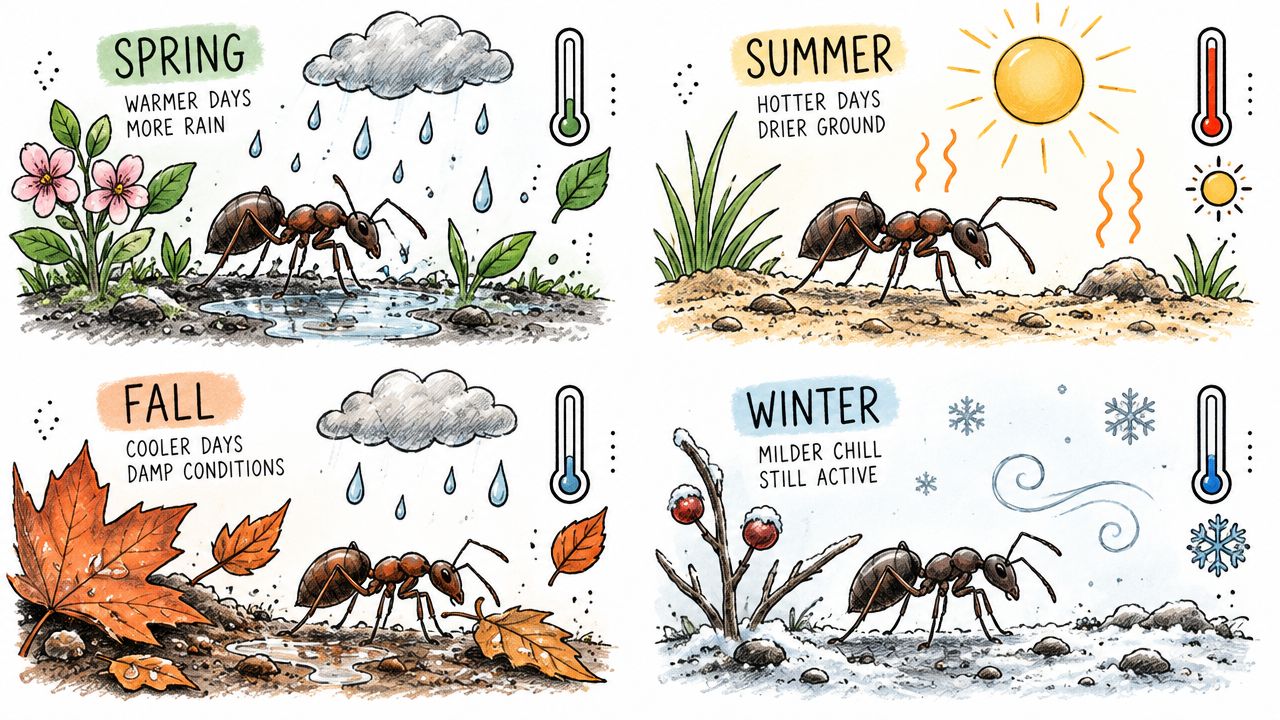
A practical seasonal rhythm looks like this:
- Spring: Watch for the spring mound surge, especially around lawn edges, play areas, and sunny soil.
- Summer: Inspect after drought-then-rain cycles, when foraging activity can shift quickly.
- Fall: Check wall voids, porch beams, and roof edges for carpenter ant swarmers after saturated weather.
- Winter: Look for odorous house ant trails moving indoors toward warmth, food, and protected voids.
Reduce the conditions ants use
Pull mulch and pine straw back 12 inches from the slab so the foundation edge can dry and remain visible. Repair gutter runoff before major storm periods, store firewood off the ground, and use stainless mesh where appropriate to protect weep-hole openings without blocking necessary drainage.
Keep tree limbs and dense vegetation from touching siding or roof edges. Clean food residue from patios and outdoor kitchens, and check AC condenser areas for persistent condensation or organic buildup.
Homeowners who want broader garden maintenance ideas can also review this practical guide on how to prevent garden pests. It's useful for reducing shelter and attractants, although fire ant mound management still requires species-specific treatment.
A Magnolia inspection-first plan should evaluate the whole property, not just the room where ants appear. Quarterly perimeter inspections and bait rotations can be timed around local fire ant activity, while each visit also checks moisture, mulch depth, slab cracks, and new entry points. See these simple prevention tips for reducing ants before activity becomes an indoor infestation.
When to Call a Local Pest Professional
Call a licensed Southeast Texas technician when the pattern exceeds a simple, isolated nuisance. Three triggers deserve prompt attention:
- More than four fire ant mounds within a 50-foot radius of the home: The issue is no longer one mound. A broader colony-treatment plan can reduce sting exposure around walkways, play spaces, and patios.
- Recurring carpenter ant frass near a wall void or porch beam: Repeated frass points to an active or recurring wood-associated problem. The inspection should look for moisture and hidden nesting, not just visible workers.
- Odorous house ant trails returning within ten days of gel bait treatment: Recurrence may indicate multiple satellite colonies, an untreated exterior route, competing food sources, or bait placement that doesn't match the trail.
Fire ants bring sting risk. Carpenter ants can point to structural moisture trouble. Odorous house ants can repeatedly cross food-preparation surfaces. A Montgomery County technician can compare the location, trail direction, nest conditions, and disturbance response instead of treating every dark ant the same way.

For Magnolia homeowners, the immediate plan is straightforward. Photograph the mound or trail from a safe distance, note whether workers swarm or climb, check nearby wood and moisture, and avoid scattering bait with random sprays. If you're in Magnolia, Conroe, or the surrounding Montgomery County service area, schedule a same-week inspection with FullScope Pest Control for species confirmation, a treatment plan matched to the ant present, and follow-up timed to local fire ant activity.
If you're seeing red mounds near the lawn, black trails inside, frass near wood, or winged ants around windows, request a local ant inspection this week. The right treatment starts with identifying the species and the condition attracting it, not guessing from color.