1500+ reviews

You step onto the back porch of your Magnolia home in July and notice a fresh fire ant mound beside the walkway. You spray it, rinse the nozzle, and assume the problem is handled. Hours later, ants are rebuilding the mound a short distance away, and now you're wondering whether the product failed or whether the treatment addressed only what you could see.
That frustration is exactly why integrated pest management services focus on the whole property, not just the visible pest. A quality program identifies how pests enter, what conditions support them, how activity changes over time, and which treatment creates the least disruption. For Southeast Texas homeowners, that means paying attention to moisture, vegetation, foundation gaps, drainage, stored goods, and the seasonal pressure that comes with warm weather.
What Integrated Pest Management Services Actually Mean
Integrated pest management, or IPM, is a coordinated service strategy that combines inspection, prevention, monitoring, and targeted control. It doesn't mean refusing to use pesticides. It means using treatment after the technician understands the pest, the source of activity, and the level at which action makes sense.
A one-time pest control visit usually responds to a complaint. A technician may identify the insect, apply a treatment, and leave. An ongoing IPM program works differently. The provider creates a property history, records findings, checks whether previous actions worked, and changes the plan when new evidence appears.
The service is a system, not a spray
A real IPM visit should answer practical questions:
- Where is the pest active? Is a roach trail connected to a plumbing penetration, pantry storage, or an exterior gap?
- Why is it getting inside? Foundation cracks, damaged screens, standing moisture, and vegetation touching the structure can all affect pressure.
- What evidence supports treatment? Traps, droppings, damage, live sightings, and conducive conditions help the technician choose the next step.
- What happens after treatment? The service report should identify follow-up actions and the next monitoring point.
The technician's work should be visible in the documentation. A report can show which areas were inspected, what was found, what was treated, and what the homeowner needs to correct. Without that record, repeated visits can become a cycle of spraying without learning.
Practical rule: If a provider can't explain what will be inspected, recorded, and reviewed at the next visit, you're probably buying an application rather than an IPM program.
This distinction matters in Magnolia, where wooded lots, warm temperatures, carefully maintained yards, and moisture around foundations can create recurring pest opportunities. The rest of this guide focuses on the history behind IPM, the principles technicians use, what a meaningful inspection looks like, and how to evaluate providers serving Magnolia and nearby Montgomery County communities.
How IPM Evolved Into a Modern Service Model
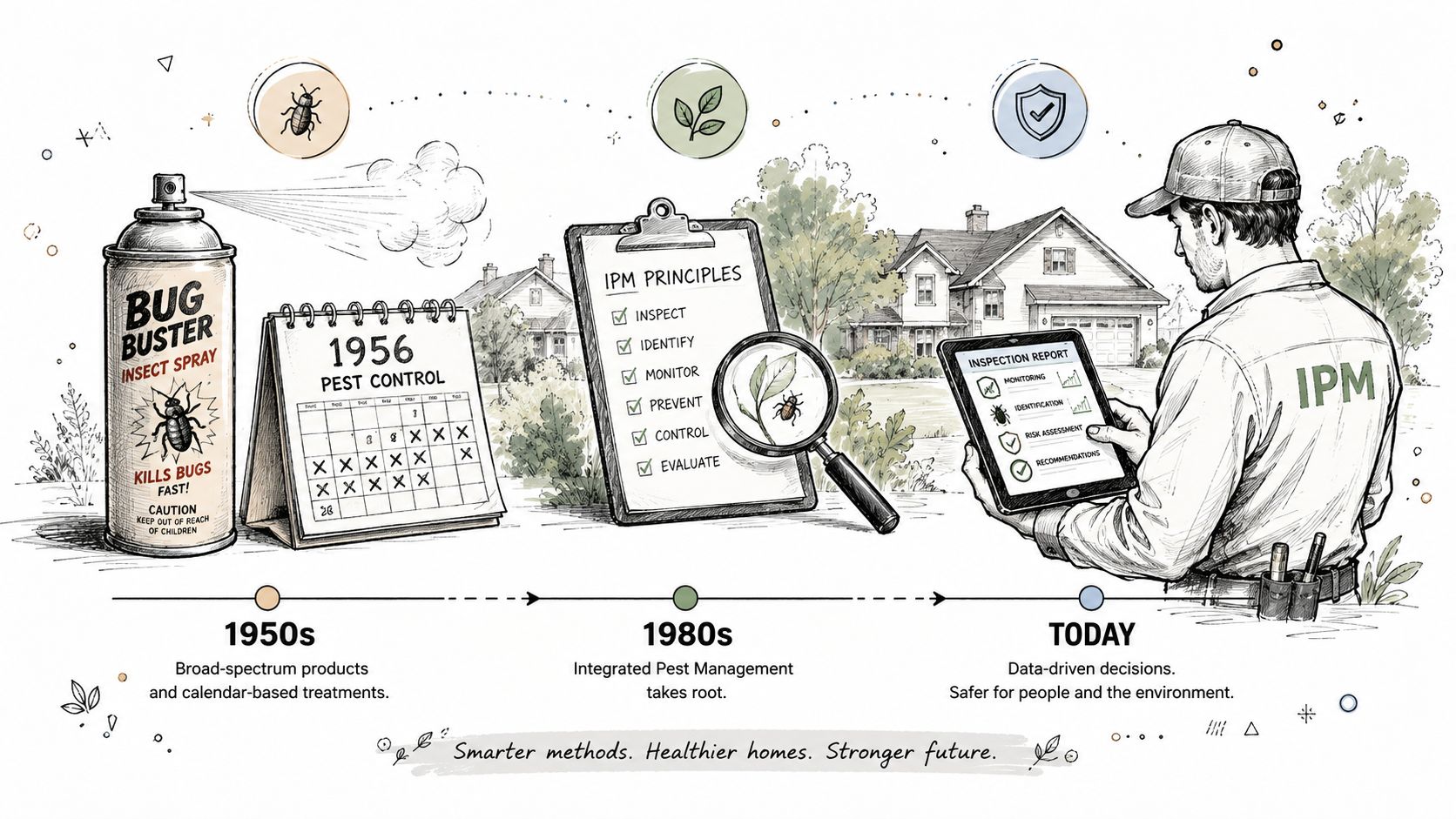
For much of the twentieth century, pest control often centered on scheduled chemical applications. A property received treatment because the calendar said it was time, not necessarily because monitoring showed a defined pest problem. That approach created pressure to use pesticides repeatedly, even when prevention or a more targeted method could have addressed the source.
The need for a coordinated alternative became clear in agriculture. IPM was formally defined in 1965 at a Food and Agriculture Organization symposium in Rome, where 87 delegates from 34 countries and seven international agencies gathered around the emerging concept of coordinated pest management. EPA records and its historical summary describe how the concept expanded during the 1970s in response to pesticide resistance, pest resurgence, and growing health and environmental concerns linked to intensive chemical use.
From crop fields to homes and facilities
The United States then developed IPM research at a broader national scale. From 1972 to 1978, the EPA was the principal funder of a major national IPM research project. The related EPA summary describes an intensive seven-year study begun in 1972, involving scientists at 19 universities and covering six major crops, including cotton, soybeans, alfalfa, citrus, pome fruits, and stone fruits. The work helped establish a service mindset based on identification, monitoring, thresholds, and coordinated controls rather than routine chemical dependence.
That framework now appears in residential and commercial pest management. A technician may combine exclusion, sanitation recommendations, sticky monitors, traps, bait formulations, and carefully selected chemistry. The product still matters, but it becomes one tool within a documented decision process.
IPM also moved beyond theory into policy and service delivery. FAO reports that 83% of countries consider IPM a high priority in agricultural policy, while its Integrated Production and Pest Management programme, launched in 2001 in three West African countries, expanded to 10 countries and worked with more than 180,000 farmers. FAO's overview of IPM adoption and programme development records those milestones.
That history explains why IPM should be treated as a professional operating standard, not a trendy label. In a Magnolia home, the same logic applies on a smaller scale. Inspect first, prevent entry, monitor activity, treat only when justified, and evaluate the result.
The Core Principles That Guide Every IPM Service
A dependable IPM program follows a connected set of principles. Each one answers a different question, from how pests enter to how the provider decides whether the plan is working.
Prevention starts before the first treatment
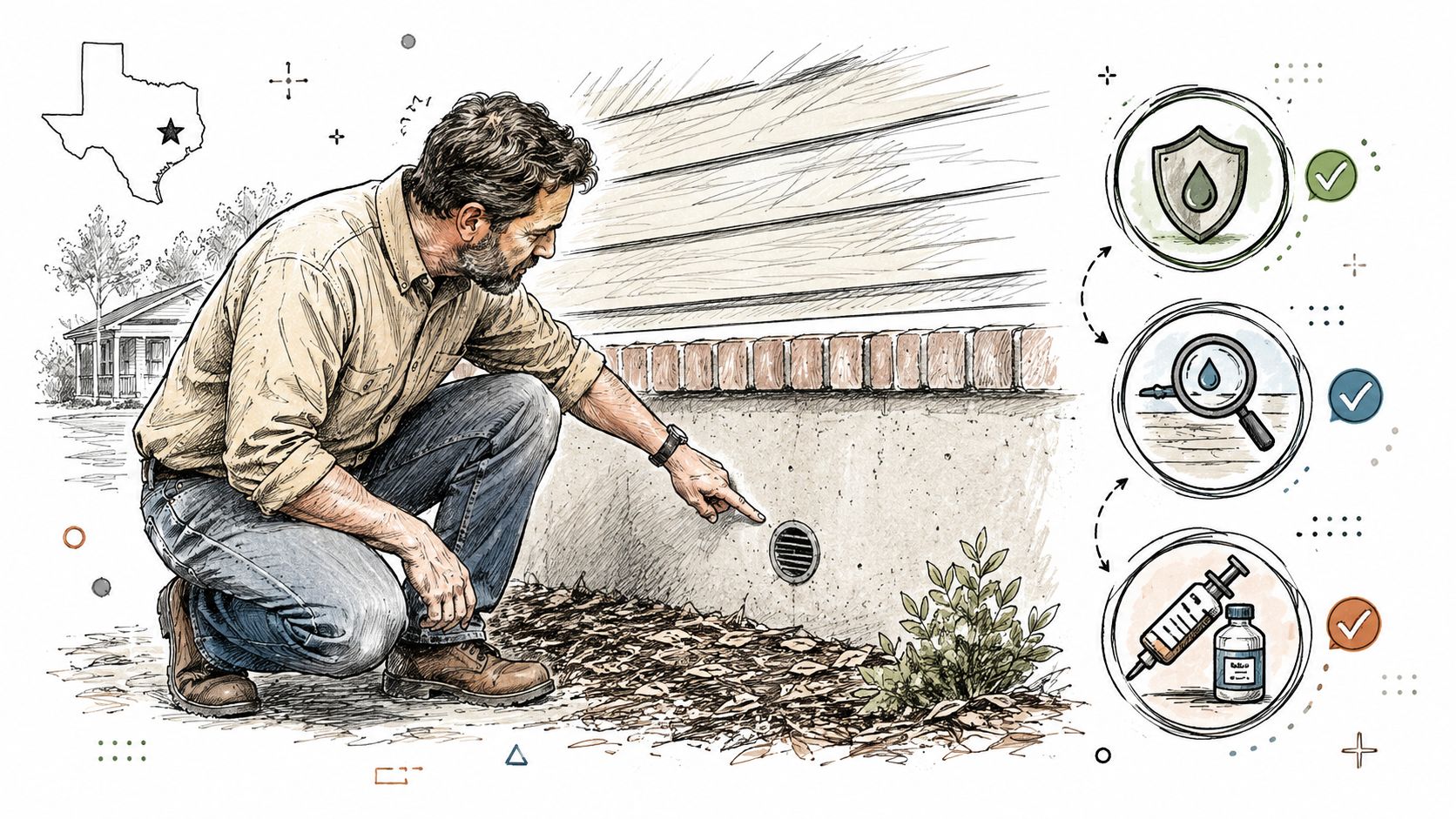
A technician may find roaches entering through weep holes, gaps around utility penetrations, or openings where siding meets the slab. Sealing those routes can reduce access more reliably than repeatedly treating the same interior edge. Rodent prevention may involve repairing a damaged vent screen, closing a shed gap, or correcting a door that doesn't seal.
The property itself also needs attention. Leaking hose connections, dense groundcover, clutter beside the foundation, and poorly managed waste can create shelter or moisture. IPM calls for correcting those conditions where practical.
Monitoring turns suspicion into evidence
Sticky traps in a garage can help confirm whether a suspected rodent route is active. Glue boards, pheromone monitors, visual inspections, and documented observations give the technician a clearer picture than a single sighting.
Identification matters, too. A fire ant, carpenter ant, termite swarmer, and pavement ant don't call for the same response. The correct species and location guide the control decision.
Thresholds prevent unnecessary treatment
A threshold is the point at which activity creates enough risk to justify action. For example, a fire ant mound beside a child's playset deserves a different response from a mound at the far edge of a rarely used wooded area. The decision considers location, exposure, damage potential, and whether activity is increasing.
Control should then be targeted. Rats in a shed may call for tamper-resistant bait stations, trapping, sanitation changes, and exclusion. A space spray across the entire shed would provide less useful information and may create avoidable exposure.
Lower-risk methods come first
Physical barriers, traps, sanitation, habitat changes, and targeted baits can reduce reliance on broad applications. Chemical treatment remains available when monitoring shows it is needed, but the technician should select the least disruptive effective option and apply it according to the product label.
Recordkeeping closes the loop. A technician can note trap counts, locations, conditions, treatments, and follow-up findings so the next visit starts with evidence rather than memory. For properties with extensive landscaping, readers may also find commercial landscape health programs useful because plant stress, dense growth, and irrigation conditions can influence pest pressure around buildings.
For homeowners comparing service philosophies, this explanation of why professional pest control is more effective long-term than DIY strategies provides additional context. The central principle remains simple: prevent what you can, measure what remains, and treat based on evidence.
What a Professional IPM Inspection and Monitoring Visit Looks Like
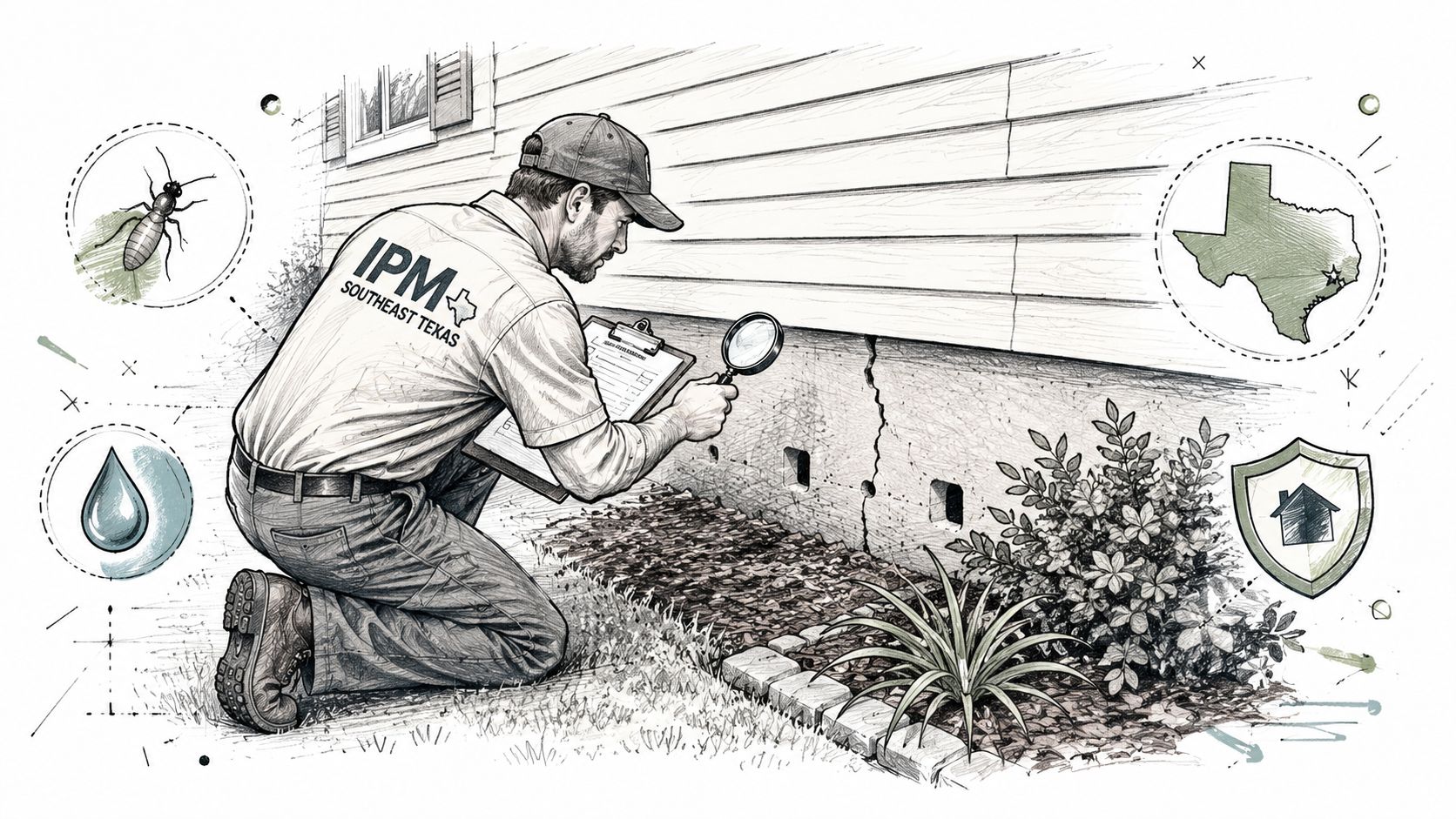
A meaningful visit starts outside. In Southeast Texas, the technician should examine foundation cracks, weep holes, pipe penetrations, vegetation touching the structure, drainage patterns, and the gap where siding meets the slab. Those areas can reveal how fire ants, roaches, spiders, and rodents reach the building.
What happens inside
Indoors, the technician should move beyond obvious sightings. Plumbing penetrations beneath sinks, attic access points, garage storage, pantry goods, utility rooms, and wall-floor junctions can all provide clues. A flashlight helps reveal droppings, shed skins, trails, and damaged seals. A moisture meter can help identify damp areas that support insects or encourage structural conditions associated with pest activity.
Monitoring devices belong in logical locations, not random corners. A technician may place stick monitors in a kitchen, garage, or utility room where activity is plausible, then label each station so future visits can compare results. Rodent evidence may require traps or monitoring points near walls, behind stored materials, or along travel routes.
The technician should record each station and finding. A service report might include:
- A property map: The report identifies inspected rooms, exterior zones, and monitoring locations.
- Observed conditions: Notes describe live pests, evidence, entry points, moisture, sanitation, and structural concerns.
- Action thresholds: The provider explains what level or location of activity would trigger treatment.
- Treatment decisions: The report states what was done, where it was done, and why that method fit the finding.
- Follow-up cadence: The next visit reflects the risk and the monitoring results rather than an unexplained routine.
A report is part of the treatment. It gives the homeowner and technician a shared record of what changed and what still needs attention.
The value of regular inspections comes from detecting conditions before they become larger problems. Homeowners can also review the importance of regular pest inspections for your home when deciding how often their property needs professional attention.
A short application with no inspection notes, no monitoring locations, and no follow-up plan isn't a complete IPM service. It may be a spray visit, but it doesn't create the feedback needed for long-term management.
Here is an example of the kind of visual explanation homeowners may find useful:
How IPM Compares With Conventional Spray-Only Pest Control
The difference isn't just “chemicals versus no chemicals.” IPM changes when decisions are made, what evidence supports them, and how the provider evaluates results. Conventional spray-only service may follow a preset perimeter schedule, while IPM uses inspection findings and monitoring to determine whether treatment is necessary.
| Factor | Conventional Spray-Only | Integrated Pest Management |
|---|---|---|
| Decision process | Often follows a scheduled application pattern | Uses identification, monitoring, prevention, and thresholds |
| Primary tools | Relies heavily on perimeter or broadcast sprays | Combines exclusion, sanitation, traps, baits, habitat changes, and targeted chemistry |
| Follow-up | May focus on the next scheduled application | Reviews records and adjusts the plan after each visit |
| Exposure control | Can apply product even when activity is not documented | Seeks to limit treatment to justified locations and conditions |
| Labor profile | Usually simpler per visit | Requires inspection, documentation, skilled evaluation, and homeowner cooperation |
| Problem-solving | Often reacts to visible pest activity | Addresses entry points, food, moisture, shelter, and recurring sources |
Chemical reduction and exposure
Evidence syntheses support the practical logic behind this approach. A review reported that more than 70% of sources measured a decrease in chemical pesticide use, with average reductions of 37% for herbicides, 47% for fungicides, and 60% for insecticides. Those figures come from broader IPM evidence, including agricultural settings, so they shouldn't be treated as a guarantee for every Magnolia residence. They do show why monitoring and thresholds can reduce chemical dependence. The IPM evidence review also describes IPM as a management system rather than a simple product substitution.
Building-wide evidence is especially relevant to multifamily and institutional properties. A public-housing cockroach study found that one IPM intervention reduced cockroach populations and allergen levels more effectively than regular pesticide application alone, while also reducing residents' use of more harmful pesticides and improving satisfaction with building maintenance. In a separate school study, IPM required more time because of monitoring and nonchemical controls, but total costs were similar to conventional treatment, while organophosphate residues were significantly higher under conventional spraying. The building IPM evidence supports a cautious conclusion: more labor can substitute for unnecessary chemical input without automatically increasing total spend.
Cost and participation
IPM can require more work at the beginning. The provider may need to inspect thoroughly, install monitors, recommend repairs, review sanitation, and return to evaluate trends. A spray-only visit can look cheaper per appointment because it includes less diagnostic labor.
The tradeoff is that IPM aims to solve the conditions creating repeat activity. Homeowners must participate by correcting leaks, reducing clutter, sealing openings, and reporting sightings accurately. IPM isn't passive maintenance, but it gives both sides a clearer basis for decisions.
Residential and Commercial IPM Service Plans Explained
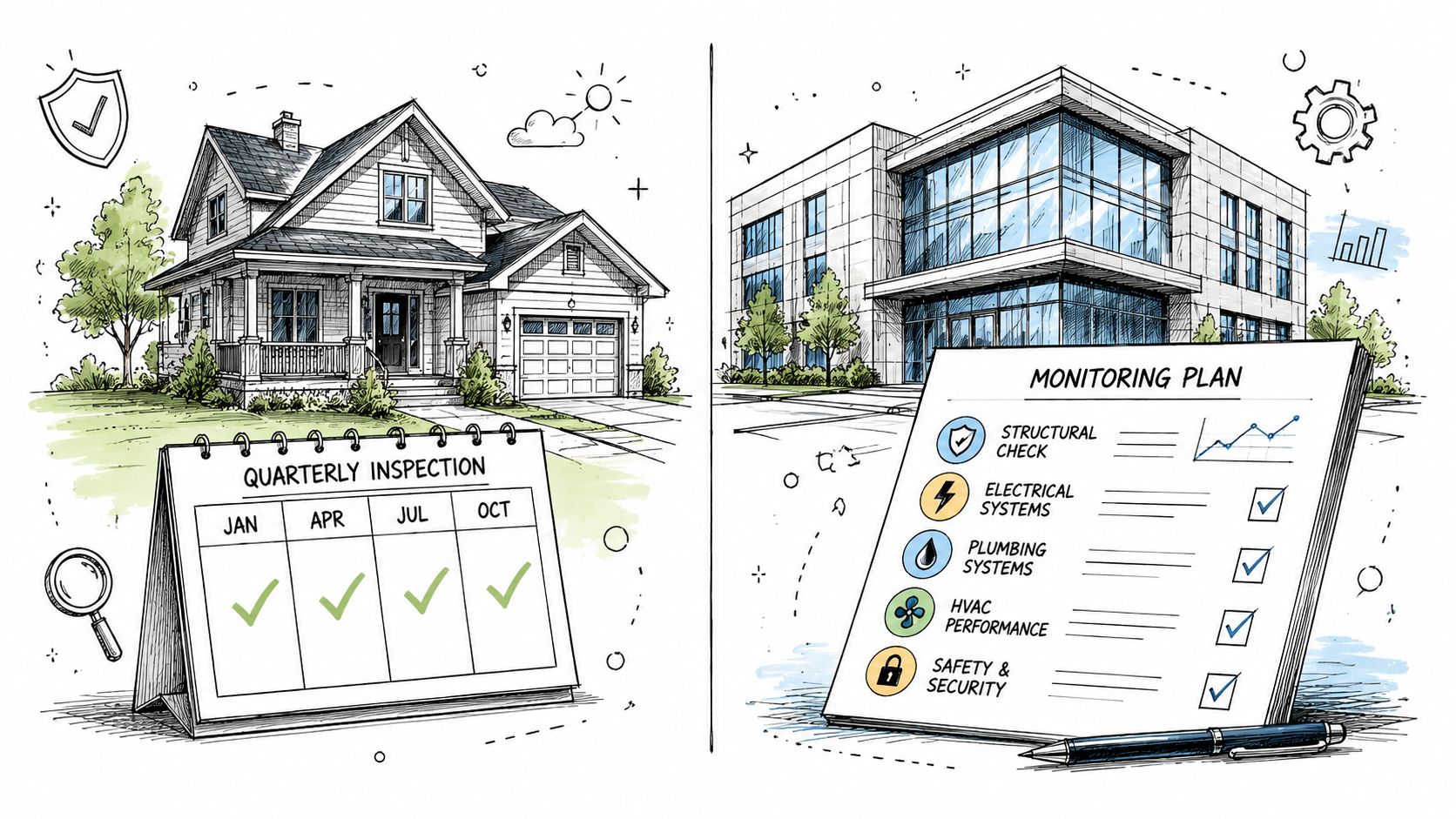
A residential plan and a commercial plan may use the same basic IPM principles, but the property risks and documentation demands differ. A Magnolia homeowner may need exterior inspections, targeted interior service, termite monitoring, or rodent prevention around a wooded lot. A commercial facility may need documented sanitation findings, staff communication, monitoring maps, and records ready for review.
Residential programs
A home plan commonly centers on exterior inspection and prevention, with targeted interior service when evidence supports it. A provider may inspect doors, windows, foundation transitions, roofline penetrations, garages, crawlspaces, and moisture-prone areas. Termite and rodent monitoring can be added when property design, vegetation, storage, or prior activity increases concern.
The homeowner should know what the recurring visit includes. Ask whether the technician checks monitors, documents conducive conditions, updates entry-point recommendations, and responds to new sightings between scheduled appointments. A plan that only promises a perimeter spray doesn't provide the same information as a documented IPM service.
Commercial programs
Commercial work usually adds operational controls. A restaurant may need sanitation and food-storage observations. A warehouse may need dock-door checks, pallet practices, rodent monitoring, and records tied to receiving and storage areas. Healthcare and hospitality sites may require discreet monitoring and careful treatment placement around occupants.
Thresholds depend on risk. A food facility may treat any rodent evidence as unacceptable, while a warehouse may use a defined activity level tied to its risk assessment and operating requirements. The threshold should be written into the program so staff understand when the provider escalates.
Commercial plans may also include employee or staff training, inspection maps, corrective-action records, and documentation for third-party audit frameworks such as AIB, SQF, or LEED. Compliance conversations can involve Texas Department of Agriculture licensing, pesticide application records required under the Federal Insecticide, Fungicide, and Rodenticide Act, and OSHA Hazard Communication requirements where applicable.
The right plan is the one that matches the property's exposure, not the one with the most frequent product application. Ask for a sample report before signing. It should show how findings become decisions.
Why Service Quality Depends on People, Not Just Products
Two providers can carry similar baits, traps, monitors, and pesticide formulations yet produce very different results. The difference often comes from the technician's ability to interpret evidence and connect today's finding with the property's service history.
A licensed Magnolia technician who recognizes an early termite swarming sign, understands a sticky-trap count, or moves a bait station based on prior activity can make a better decision than an inexperienced crew applying the same product everywhere. IPM depends on judgment because pest pressure changes with weather, construction, landscaping, moisture, sanitation, and occupant behavior.
Three operational factors deserve attention
- Technician training and turnover: Frequent staff changes can produce inconsistent inspections. Ask how the company trains technicians to identify pests, use monitoring devices, document findings, and explain corrective actions.
- Inspection cadence: Visits need to occur often enough to catch changes before activity escalates. The appropriate schedule depends on property risk, pest type, and prior findings.
- Recordkeeping: Per-service logs should connect trap locations, counts, thresholds, treatments, conditions, and outcomes. Without that history, the next technician starts over.
A provider that skips written reports or rushes through a brief stop can't deliver the full value of IPM, regardless of the chemistry in the truck. Homeowners should ask how long a typical inspection takes, whether the same technician can return, and what documentation arrives afterward.
Ask before you enroll: Who reviews the service records, and what causes the treatment plan to change?
The staffing issue isn't theoretical. A 2025 review found that IPM technical staff were especially scarce across U.S. states and territories, with evaluators and communicators totaling just 18 and 32 personnel, respectively. The review of IPM staffing and capacity helps explain why buyers may hear the term IPM without receiving clear guidance about monitoring, thresholds, or follow-up. The organizational layer matters as much as the product selection.
Choosing an IPM Provider in Magnolia and Southeast Texas
Start with the service area. Magnolia is in southwestern Montgomery County within the Houston metropolitan area, and the 2020 census population was 2,359. The city uses ZIP codes 77353, 77354, and 77355, so a provider should explain coverage by city and postal zone rather than treating Magnolia as one compact ZIP-code market. The Magnolia location reference confirms the city's county and ZIP-code details.
Postal boundaries add another layer. 77353 is a PO Box ZIP, while 77354 and 77355 are standard ZIP codes. Portions of 77354 extend into Pinehurst and The Woodlands, so ask whether the company's routing includes those nearby communities or only selected Magnolia addresses. This ZIP-code reference provides useful context for clarifying boundaries.
Questions that reveal service quality
- License: Can the provider verify a Texas Department of Agriculture Structural Pest Control license?
- Program type: Does the company use IPM principles, or does it follow a routine spray schedule?
- Documentation: Will you receive a report with findings, monitoring locations, treatments, and recommendations?
- Cadence: How often will residential or commercial inspections occur, and what changes the schedule?
- Continuity: Will the same technician or team handle recurring visits?
- Urgent response: What happens when a wasp nest, rodent intrusion, or sudden infestation appears between appointments?
- Local reputation: What do Southeast Texas neighbors report through referrals, Google reviews, and Better Business Bureau listings?
For a broader example of how a multi-location service company presents regional coverage, you can review SuperiorPRO's Atlanta locations, while remembering that a Magnolia provider should explain its own Montgomery County routes and licensing. You can also use this guide to find companies that solve the root problem when comparing proposals.
A low monthly quote tells you very little by itself. Choose the provider that can clearly describe inspection work, technician capacity, records, response procedures, and coverage for Magnolia, Conroe, The Woodlands, and surrounding Southeast Texas communities.
If pests keep returning around your Magnolia property, request an IPM-focused inspection before authorizing another routine spray. Ask the provider to document entry points, monitoring locations, action thresholds, treatment decisions, and follow-up timing, then use that report to choose a service plan built around your home's actual conditions.