1500+ reviews

Apple cider vinegar can disrupt ant trails for about 30 to 60 minutes, but it does not eliminate the colony. It is a short-lived surface treatment, not a complete answer to ongoing activity. The bottle under your sink will scatter visible workers, yet it cannot reach the queen, larvae, or nest beneath a slab, in soil, or inside a wall void.
In a Magnolia kitchen, you may wipe the counter, spray the trail, and watch the ants disappear. The same route, or a nearby one, can return the next morning around the baseboard.
That quick result can make the problem harder to judge. Vinegar alters the workers' route, while food residue, moisture, landscaping, foundation gaps, and utility penetrations still give the colony access to the home. Magnolia's growing mix of established neighborhoods and newer construction creates plenty of these entry points across Southeast Texas.
Use vinegar for cleanup, then monitor the area. Repeated trails, ants in multiple rooms, or activity that returns after several treatments are the point to stop experimenting and call FullScope Pest Control for a targeted inspection and treatment plan.
Why Vinegar Makes Ant Trails Disappear Temporarily
A worker ant crossing your counter is usually following a chemical route, not wandering at random. Scout ants leave pheromone signals that guide other workers toward food and back toward the nest. Apple cider vinegar's acetic acid and strong odor interfere with those cues, so the established path breaks down and the visible ants scatter.
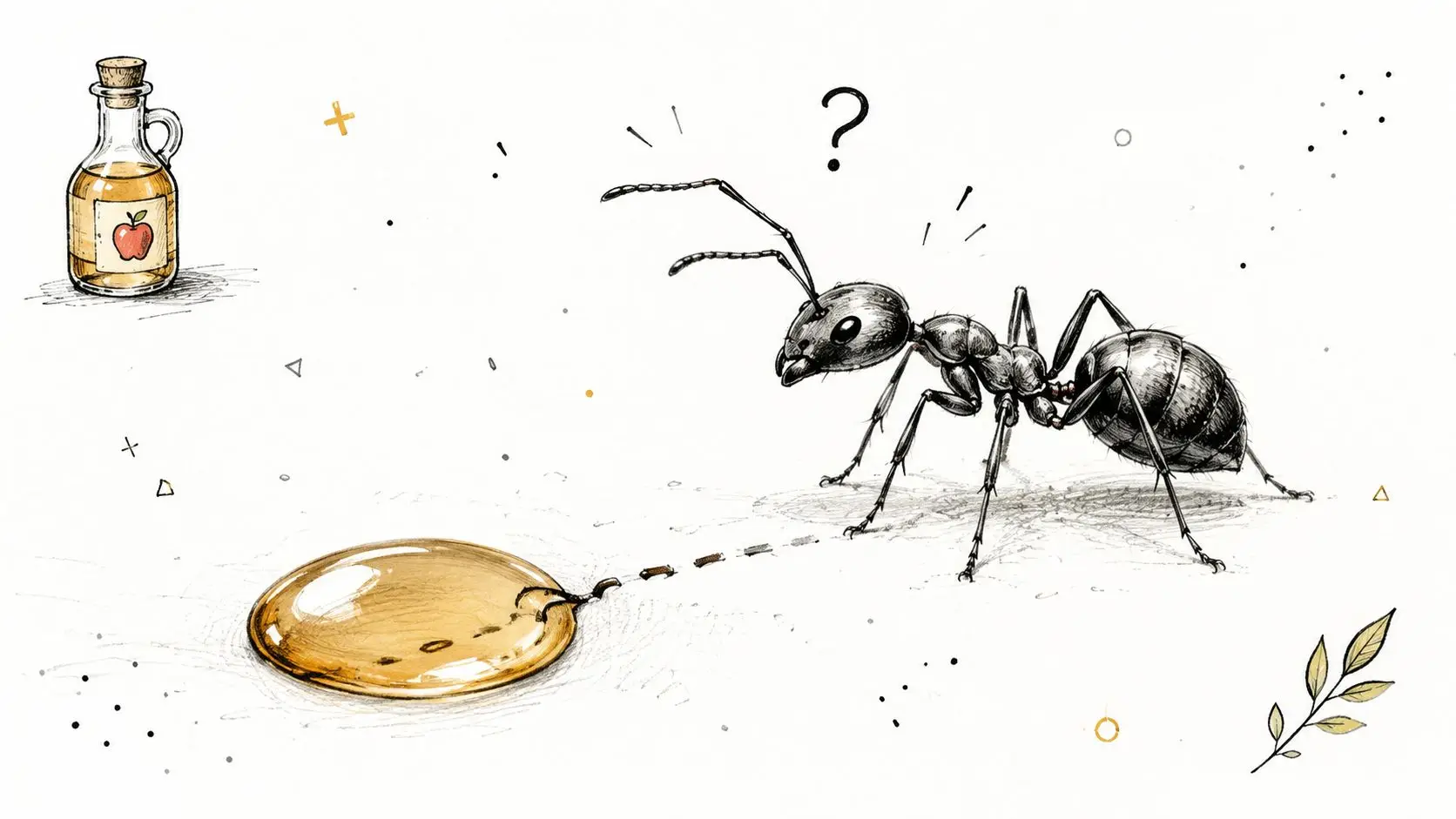
The quick disappearance is easy to misread. Spraying changes the signals on the surface, but it does not treat the nest, kill the queen, or reach larvae and eggs protected under a slab, in soil, or inside a wall void.
Why a vanished trail can mislead you
Once the treated residue dries, workers can rebuild the route, detour around the cleaned area, or use another opening. Food residue, moisture, landscaping, foundation gaps, and utility penetrations still support access into the home. In Magnolia, established neighborhoods sit alongside newer construction, so homes can have very different entry conditions even on the same street.
Vinegar can also make diagnosis harder. The original trail disappears, but activity may shift to a baseboard, another room, or an exterior wall. If you keep wiping each new route without locating the entry point and colony, you may spread the activity rather than solve it.
Practical rule: A vanished trail means the ants lost their route. It does not mean the colony lost its home.
The treated surface is only one part of the problem. Queens, larvae, eggs, and satellite nests remain protected, and some colonies may split or establish nearby activity after their route is disturbed. That pattern makes follow-up inspection more important, particularly when ants return after cleaning or appear in several rooms.
Use vinegar as a cleanup measure, then watch what happens. Compare the insects with FullScope's guide to common ant types, because small indoor trails, outdoor mounds, and large ants emerging from damp wood call for different control decisions. If activity continues after repeated surface cleaning, review when to call ant control pros and have FullScope Pest Control inspect the entry points, moisture conditions, and likely nesting areas.
This short video gives a visual overview of why vinegar affects trails without reaching the colony:
Apple Cider Vinegar Ants Recipes and Safe Application Methods
If ants are using a kitchen threshold or windowsill, apple cider vinegar can clean the route and interrupt activity long enough to inspect it. Use it as a cleaning and disruption step, not as a replacement for bait, exclusion, or professional treatment.
Two practical mixtures
For a light trail, mix equal parts apple cider vinegar and warm water in a clean spray bottle. Shake gently and apply a thin mist to the visible route, windowsills, door thresholds, and the gap where ants enter.
For heavier activity, mix one part vinegar with two parts water. Apply only enough to wet the route. Do not leave a puddle. Excess moisture can leave residue, damage sensitive finishes, or create another water source for insects.
Vinegar may scatter ants immediately after cleaning, yet its effect is temporary and does not remove the colony. In ordinary household conditions, the disruption typically lasts under two hours. If ants return or establish a route nearby, the spray has changed their path rather than solved the infestation.
Apply it as preparation, not the finish
- Remove the attractant. Wipe away crumbs, syrup, grease, pet food residue, and standing moisture before spraying.
- Treat the route. Mist the baseboard, sill, threshold, or crack where ants travel. Avoid spraying the entire room.
- Let the surface dry. Do not place bait into wet vinegar, because the odor may interfere with feeding behavior.
- Inspect again. Check for a replacement route after the treated area dries. A rerouted trail confirms that activity remains.
- Address the entry point. Caulk or repair accessible gaps after checking whether ants are still moving through the structure. Sealing too early can push them into another interior void.
A vinegar wipe can prepare a surface for baiting by removing the visible trail. It should not be the final treatment when ants return repeatedly. For households managing pets, review pet-conscious ant control without harsh chemicals before choosing bait placement or other products.
Keep sprays away from pets, children, food, and food-preparation areas. Test the mixture on an inconspicuous spot first, especially on natural stone, sealed wood, painted trim, or flooring that could discolor or lose its finish. Rinse kitchen surfaces thoroughly afterward. Never mix vinegar with bleach or other cleaning chemicals.
Comparison of Vinegar Sprays, Bait Stations, and Professional Treatments
If you spray apple cider vinegar and the ants return within the hour, the difference between methods is where the treatment reaches. Vinegar disrupts activity on the exposed surface. Bait allows workers to carry an active ingredient back toward the colony. Professional service adds inspection, targeted applications, exclusion recommendations, and residual protection.
| Method | Visible Results | Duration | Colony Elimination | Safety Profile |
|---|---|---|---|---|
| Apple cider vinegar spray | Fast scattering or temporary trail disappearance | Short-lived, often until the trail is reestablished | No, it does not reach queens, larvae, or nests | Generally low risk when used correctly, but protect food, pets, and sensitive surfaces |
| Commercial bait stations | Slower visible change because workers must feed and return | Longer-lasting when placed correctly and kept available | Can suppress a colony more effectively than a repellent spray | Enclosed stations reduce exposure, but placement and label directions matter |
| Professional treatment | May reduce activity after targeted work | Residual protection can continue beyond immediate contact | Designed to address entry routes and colony pressure, not only visible ants | Licensed application and household instructions guide safe reentry and use |
Match the tool to the pattern
Vinegar fits a single, occasional trail when the immediate goal is surface cleanup or short-term observation. It can make activity appear solved while leaving the colony and access route untouched, so repeated spraying may scatter ants into nearby gaps or rooms.
Bait stations work more slowly. Workers must feed and return before the colony is affected. Repellent spray near a station can keep ants away, and placing bait on a contaminated or frequently cleaned surface reduces its usefulness. Follow the label, keep stations inaccessible to children and pets, and leave them in place rather than moving them every few hours.
Professional treatments address a broader pattern. A technician can inspect likely entry points, identify moisture or structural conditions supporting activity, and choose perimeter or crack-and-crevice work instead of relying only on direct contact. For households weighing service costs, this explanation of how exterminators price ant removal provides useful context, although local pricing depends on inspection findings and service scope.
A practical threshold helps. One isolated trail can justify cleaning and observation. Repeated returns, ants in multiple rooms, or indoor activity that continues after correctly placed bait indicates that the colony or its access route needs a more complete plan.
For a broader explanation of why professional pest control can work better over the long term than DIY strategies, review how residual treatment differs from repeated home remedies. The point is not that every ant requires a service visit. Visible speed and lasting control measure different outcomes.
Understanding Ant Pressure in Southeast Texas Markets
In Southeast Texas, ants can return quickly after a homeowner wipes away a trail. A global assessment in the Proceedings of the National Academy of Sciences estimated about 20 quadrillion ants worldwide in 2022, with dry biomass of roughly 12.3 million metric tons of carbon. Its database included 51,388 ant abundance and occurrence records from 4,212 locations, showing how widely ants occupy different environments. The global ant abundance assessment provides the ecological context.
That global scale does not prove a Magnolia property has an infestation. It does explain why warm suburban homes repeatedly meet ants where food, moisture, landscaping, and small structural gaps overlap. Apple cider vinegar may erase a trail in one room for a while. It does not reduce the outdoor colonies or close the routes that bring workers back, so repeated spraying can make the problem look solved while pressure continues.
Magnolia has a wider service footprint than the city label suggests
Magnolia's municipal area has changed quickly. The 2020 Census recorded 2,359 residents across 4.844 square miles, according to Magnolia's municipal background information. The city lists a 2024 population of 5,836 and approximately 5.7 square miles on its Magnolia demographics page.
For pest work, the surrounding service market matters as much as the city boundary. Magnolia describes the greater Magnolia area as extending about 12 miles in every direction, with an estimated population exceeding 138,000, on its location and regional development page. A local guide places Magnolia in Montgomery County, about 40 miles northwest of downtown Houston, along FM 1488 and FM 1774, and identifies ZIP codes 77354 and 77355 for the broader area. Those details appear in this Magnolia relocation guide.
For homeowners, the takeaway is practical. Wooded lots, new construction, older homes, commercial properties, and connected neighborhoods create different entry conditions. If ants return after vinegar treatment, cleaning was not necessarily done poorly. The activity may reflect regional pressure that requires inspection and a control plan reaching beyond the countertop.
When DIY Methods Fail and Professional Help Is Needed
A vinegar spray can clear a trail from view, yet the same ants may return from a wall gap, slab joint, or exterior route. DIY remains reasonable when activity is limited, the entry point is visible, and sightings stop after cleaning and observation. Repeating the same spray cycle without reducing the source is the point where it stops making sense.
Use these warning signs
- The trail returns within days. Workers still have access to food, water, shelter, or a protected route.
- Ants appear in several rooms or levels. Activity in separate areas can indicate multiple entry points or movement through wall, ceiling, plumbing, or foundation voids.
- Activity continues during dry weather. Interior sightings when outdoor foraging is less convenient deserve a closer inspection.
- You see large black ants or wood damage. Large ants near damp wood, window frames, roof edges, or structural voids should not be treated as ordinary countertop pests.
- Bait fails or gets ignored. Poor placement, competing food, species preferences, or a hidden route can make a suitable product seem ineffective.
- The source is inaccessible. Spraying visible workers will not expose a nest inside a wall, attic area, slab joint, or sealed utility penetration.
A technician starts by tracing the activity, not by spraying every visible ant. The inspection should identify entry points, indoor resources, likely nesting areas, and outdoor conditions that keep pressure high. A treatment plan may then combine targeted applications, crack-and-crevice work, exterior protection, sanitation changes, and follow-up monitoring.
A practical threshold is simple: call for an inspection when the remedy becomes repetitive. If you are spraying every few days, finding ants in new rooms, or seeing large ants near possible structural nesting areas, increasing the vinegar concentration is unlikely to solve the problem. Heavy repellent use can also scatter workers and make the original route harder to trace.
The Magnolia decision point
Magnolia's expanding residential area and broad surrounding service market put homes beside varied conditions, including wooded lots, vacant spaces, construction zones, established neighborhoods, and commercial properties. That mix gives ants several ways to move between outdoor harborage and indoor food or moisture. Recurring sightings are therefore a control problem, not a housekeeping failure.
Judge success by whether activity declines after the entry route and colony pressure receive the right treatment, not by how quickly ants vanish after a spray.
FullScope Pest Control is one local option when the pattern exceeds a surface-cleaning problem. Its stated process includes inspection, a targeted treatment plan, and ongoing protection options, including quarterly or biannual schedules and emergency response. Licensed professionals may also recommend lower-toxicity or integrated pest management approaches for households with children and pets.
Contacting FullScope Pest Control for SE Texas Home Protection
If vinegar only buys a short pause, take four practical steps before contacting a pest professional:
- Document the pattern. Note the rooms, entry points, time of day, ant size and color, and whether activity returns after cleaning.
- Remove competing attractants. Seal food, clean spills, correct leaks, and manage pet food so an inspection reflects the actual access problem.
- Avoid flooding active areas with repellent. Heavy spraying can scatter ants and make the original route harder to trace.
- Request an inspection. Ask what the technician found, which treatment areas are planned, what preparation is required, and how follow-up works.
FullScope Pest Control serves north Houston and nearby Southeast Texas communities, including Kingwood, Conroe, Cleveland, Porter, and Magnolia. Its broader Magnolia coverage includes ZIP codes 77354 and 77355, along with surrounding communities such as Montgomery, New Caney, Splendora, Spring, Willis, Huffman, Humble, Atascocita, Coldspring, and Livingston.
The company describes a service model built around licensed Texas professionals, QualityPro certification, integrated pest management, targeted chemistry, and eco-friendly options for households with children and pets. Service choices include one-time remediation, recurring maintenance, and urgent response, with quarterly or biannual scheduling for homes facing repeated seasonal pressure.
Choose a one-time inspection when you're unsure whether the activity is isolated or structural. Consider ongoing maintenance when trails repeatedly return, outdoor pressure remains high, or the property has conditions that make reentry easy. A scheduled plan can also make sense for commercial sites and rental properties where recurring ant complaints need documented attention.
Visit FullScope Pest Control to request an inspection for your Magnolia, Kingwood, Conroe, Cleveland, Porter, or surrounding SE Texas property. Bring your activity notes and photos if you have them, and let the technician determine whether the next step is targeted baiting, exclusion, residual treatment, or ongoing protection.
If ants have returned after your vinegar treatment, contact FullScope Pest Control through its website today and schedule an inspection. A short-lived trail disruption may clean up the symptom, but a site-specific plan can address the route that keeps bringing ants back.