1500+ reviews

The first clue is usually small. A torn carton at the dock, a few droppings near a pallet jack lane, a greasy mark along a wall, and suddenly the whole shift is asking the same question, how long has this been going on? In a warehouse, pests don't just create a sanitation issue, they threaten inventory, audit readiness, and the steady flow of product through the building.
That's why warehouse pest control has become a real commercial category, not a side task. One market report estimates the global pest control services for warehouses market at USD 2.12 billion in 2024, with growth projected to USD 3.71 billion by 2033 (market overview). That scale tells you what operators already know, controlling pests in storage and logistics facilities is part of protecting supply chains, not just reacting to a nuisance.
A useful way to think about it is the same way you think about preventive maintenance. You don't wait for a conveyor to fail before you inspect it, and you shouldn't wait for a pest sighting before you inspect the building. A practical framework from SaberTask's guide to preventive maintenance fits warehouse pest work well, because both depend on routine checks, documentation, and early intervention. If your facility handles commercial freight in Southeast Texas, a customized program matters even more, which is why many managers look for a plan shaped for their site, not a generic spray-and-go visit. For a deeper look at that approach, see why commercial properties need tailored pest control plans.
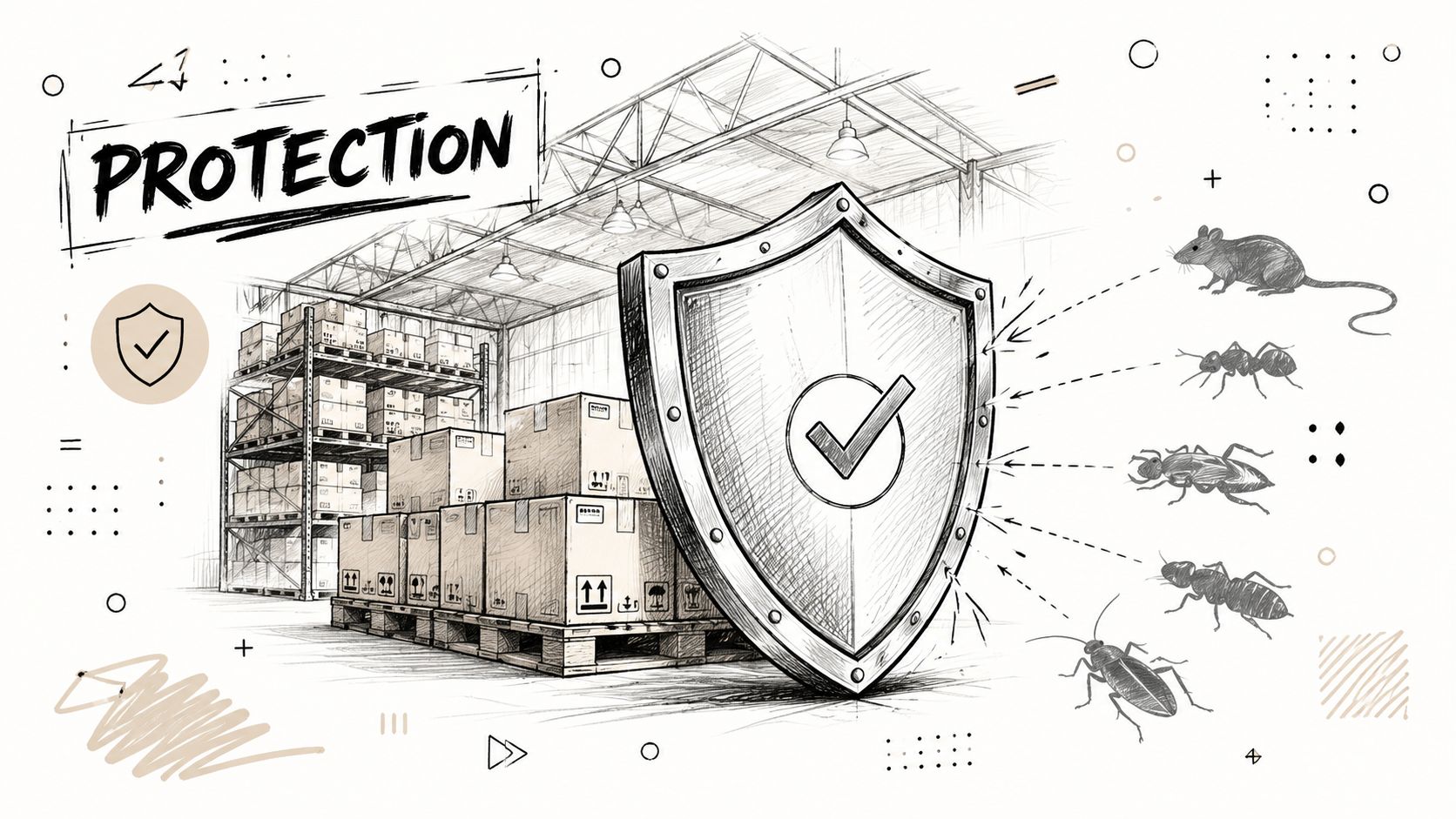
Beyond Extermination Proactive Warehouse Pest Control
A warehouse manager usually doesn't call after a calm, orderly week. The call comes after a discovery, maybe a mouse run along a wall, insect activity in a receiving bay, or damage in a stored shipment. That's the wrong moment to start building a response plan, because by then the issue has already moved from prevention to containment.
Integrated Pest Management, or IPM, is the standard for a reason. It starts with initial hazard analysis, routine inspections, monitoring, structural exclusion, sanitation, and supply-chain controls, including checking incoming shipments and pallets before pests spread deeper into the building (warehouse IPM guidance). That sequence matters because warehouses create movement, clutter, and blind spots, which gives pests more ways to hide than a small retail space ever would.
Why the business case is bigger than pest sightings
Pests affect more than cleanliness. They can force rework, disrupt receiving schedules, create audit problems, and damage customer confidence long before a manager sees a formal complaint. In food distribution, retail logistics, and cold storage, the question isn't whether pests are unpleasant, it's how much operational risk they add to every pallet, rack, and shipment.
Practical rule: if the program only starts after someone sees live pests, it's already too late for prevention and too early for confidence.
The best programs treat pest control as a documented business process. That means the same kind of discipline you'd expect from safety checks or equipment maintenance, only focused on points where pests enter, feed, or hide. For a warehouse, that usually means the receiving area, dock doors, storage edges, and waste zones get more attention than the office ever will.
The biggest mistake is thinking a treatment visit alone solves the problem. A targeted application can reduce activity, but only a prevention-first system keeps the problem from cycling back. That's the difference between temporary relief and a defensible IPM program that stands up to audits and day-to-day pressure.
Your Foundation Warehouse Inspection and Risk Assessment
A good inspection starts with a simple question, where would a pest go first if it entered tonight? The answer usually isn't random. It is the places with food residues, moisture, harborages, and repeated traffic, because pests follow opportunity, not convenience.
Build a risk map before you build a treatment plan
Walk the facility during normal operations, not when it is empty and polished for visitors. Look at receiving zones, loading docks, dumpsters, drains, and storage racks, because those are high-risk areas in warehouse programs and they are the places where movement hides warning signs. Check pallet staging, broken packaging, and any place where product sits too long. The more dwell time and inbound goods flow you have, the more likely a missed issue becomes a facility-wide one.
Use a simple checklist and mark what you see in each zone. That record becomes the starting point for your IPM plan, and it helps separate a one-off issue from a pattern. A facility team that maps activity can spot recurring trouble long before it becomes an infestation.
| Warehouse Pest Hotspot Checklist | | |
| Zone | What to Look For | Common Pests |
| Receiving docks | Torn cartons, pallet debris, standing doors, spill residue | Rodents, flies, cockroaches |
| Storage racks | Droppings, webbing, gnaw marks, damaged product edges | Rodents, stored-product insects |
| Waste and dumpsters | Overflow, leakage, missed pickup, odors | Flies, rodents |
| Drains and wet areas | Moisture, organic buildup, damp corners | Cockroaches, flies |
| Exterior perimeter | Gaps, burrows, damaged seals, clutter | Rodents, ants |
Use the perimeter as an early warning line
An effective inspection also has to include the outside of the building. Rodents, ants, and other pests usually show up at gaps first, then work their way inside through weak seals, door edges, utility penetrations, and cluttered exterior zones. A careful review of identifying and sealing common entry points for rodents gives you a direct way to reduce that pressure before it reaches product areas.
That outside inspection matters even more in Southeast Texas, including Magnolia, where heat, humidity, and storm-driven moisture can turn small defects into active pest problems fast. Standing water near pads, damaged weatherstripping, and loose dock seals all create conditions that keep pests active and make control harder inside the building. I look for those conditions first because they tell me where the building is already losing ground.
A warehouse inspection is only useful if it changes decisions. If the notes never change sanitation, repairs, or monitoring placement, the inspection was just paperwork.
For facilities that also need broader asset protection, a security-minded inspection process helps. The logic behind protecting warehouse assets applies here too, because both pest control and physical protection depend on identifying weak points before they become losses.
Fortifying Your Defenses Sanitation and Structural Exclusion
The most effective non-chemical controls are the least glamorous ones. Sanitation removes food and moisture. Exclusion removes access. If either one is weak, every trap and treatment has to work harder than it should.
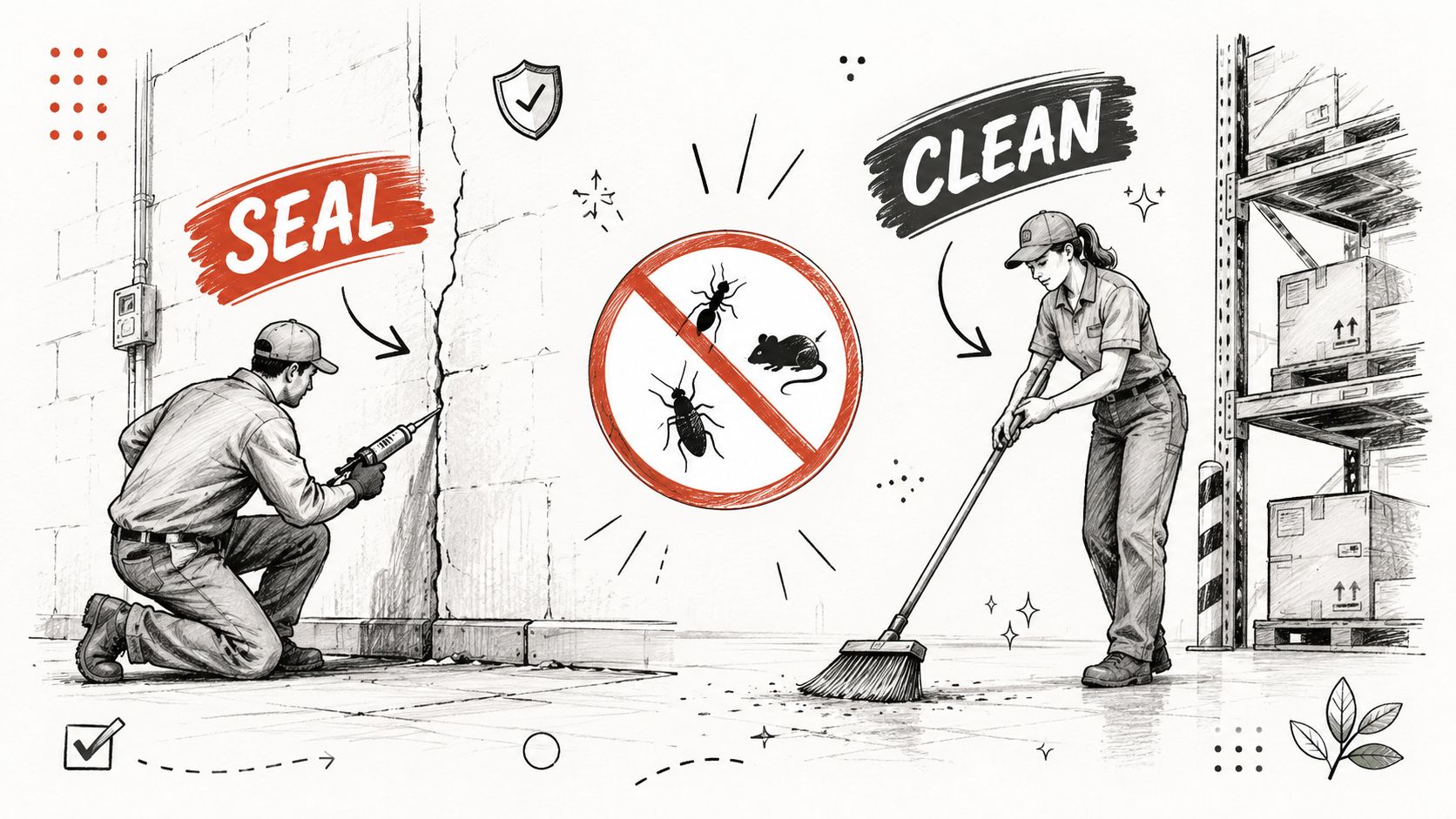
Clean for access, not for appearance
USDA guidance for stored products emphasizes cleaning transport containers, loading areas, and storage bins, sealing roofs and sidewalls to reduce insect entry and moisture ingress, and reducing moisture because many stored-grain insects thrive at 12% to 15% moisture content (USDA stored-product guidance). In practice, that means pests exploit residue, dampness, and sheltered surfaces. A floor can look acceptable to staff and still hold enough food debris to keep insects and rodents active.
Focus cleaning where product moves, not just where people stand. Spills in staging lanes, crumbs in break spaces, residue under racks, and leak points near drains deserve priority. Waste needs covered containers, fast removal, and no overflow sitting near doors.
In Magnolia and across Southeast Texas, humidity changes how long those pressure points stay active. Moist surfaces, sticky residue, and slow cleanup give pests a longer window to feed and breed, which is why sanitation work has to be tied to daily workflow instead of treated as a once-a-shift cleanup.
Seal the building, then keep watching the weak points
For rodent control, the strongest warehouse approach combines exclusion with intensive trapping, with traps commonly placed every 8 to 10 feet in active areas while harborages and food sources are removed to reduce reinfestation, as noted in the same USDA stored-product guidance. That trade-off matters. Traps catch rodents already inside, but sealed entry points and clean conditions keep new ones from replacing them.
A few practical fixes usually pay for themselves fast.
- Door sweeps and dock seals: close the gap where rodents and insects enter most easily.
- Crack repair at foundations and wall penetrations: remove hiding places that become runways.
- Screened vents and protected openings: block flying and crawling pests without restricting airflow.
- Roof and sidewall repairs: stop moisture ingress that supports insect activity.
- Spill response routines: remove food and water sources before pests find them.
Once those repairs are in place, keep checking them. Gaps reopen, seals wear out, and dock traffic shakes loose the same weak points again. For a local example of the repair-first mindset, identifying and sealing common entry points for rodents is the kind of work that keeps a warehouse from treating the same area over and over.
Smart Monitoring Turning Pest Data into Business Intelligence
More traps do not automatically mean better control. If you add devices without reading the pattern they reveal, you can end up with a warehouse full of evidence and no decision. The core value of monitoring is not the station itself, it's the story the counts tell over time.
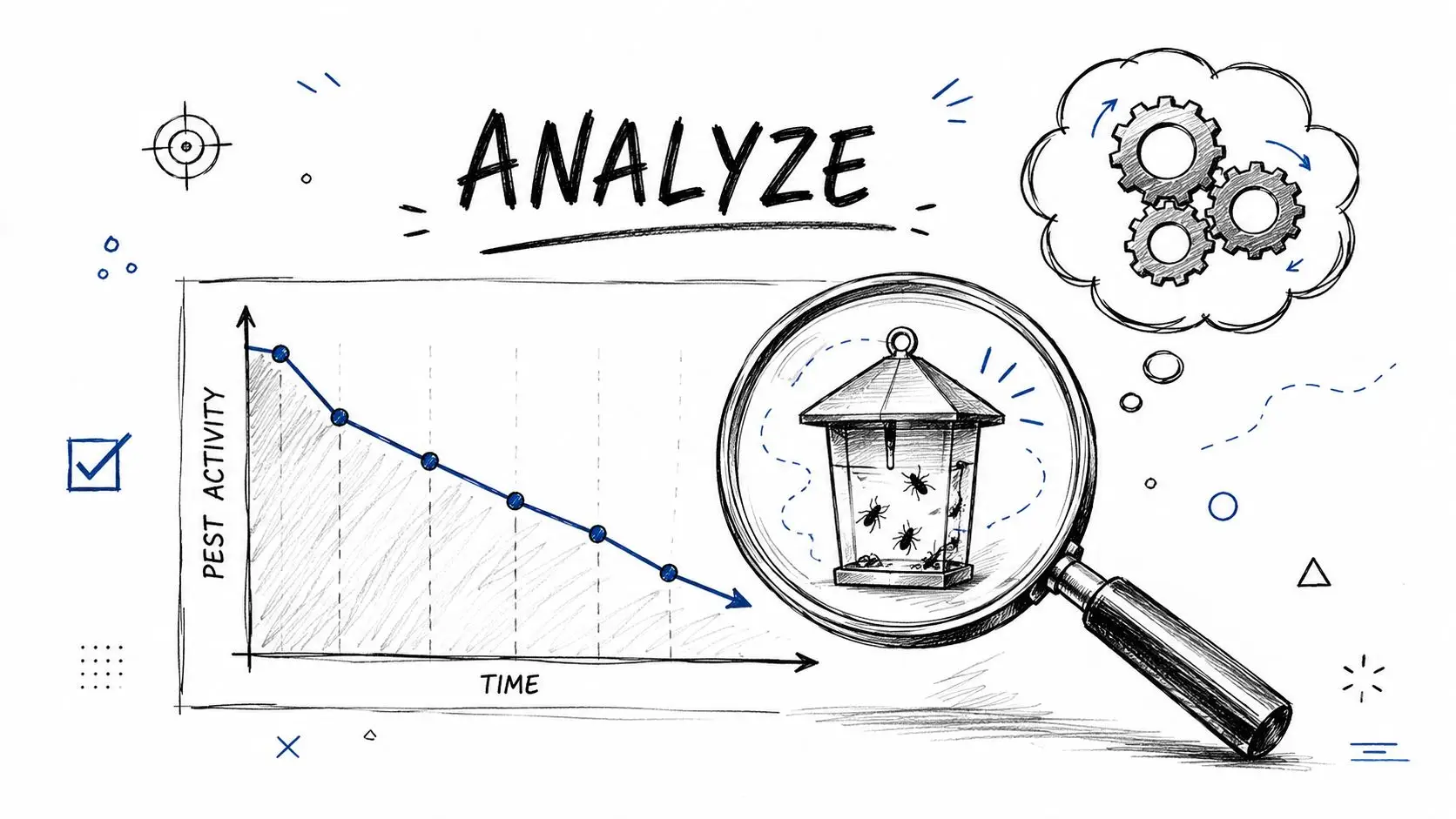
Read the trend, not just the total
A key gap in warehouse pest control is turning monitoring data into decisions. Managers need trend analysis and hotspot mapping so they can prioritize corrective actions when activity rises, instead of adding more traps alone (monitoring gap). That matters because one zone can improve while another worsens undetected, and a flat overall total can hide a developing problem.
Track each device or station by location. Then compare those readings against stock movement, seasonal changes, dock usage, sanitation events, repairs, and new construction. The goal is to answer a practical question, what changed in the facility before the spike?
Useful habit: when counts rise in one area, check the building and the workflow before you check the pesticide label.
Decide what the data should trigger
If activity rises near a dock, the first response is usually not broad spraying. It's a targeted correction, maybe door repair, dock seal replacement, spill cleanup, or a deeper inspection of incoming pallets. If activity clusters near waste handling, the issue may be waste timing or container management. If the hotspot sits near a wall or utility chase, exclusion should move ahead of treatment.
That's why good monitoring logs include more than counts. They should note station location, date, condition, nearby work changes, and whether the issue is growing, holding steady, or moving. Over time, that record helps a manager see whether the program is working or just producing routine visits.
Use monitoring to support operational conversations
The best pest logs don't sit in a binder. They help warehouse leadership decide where to spend labor, maintenance dollars, and response time. A recurring pattern near the same door can justify a dock repair. Repeated activity after specific inbound shipments can trigger supplier conversations. A cluster in one storage lane can lead to a layout change, not just another service ticket.
That's the shift from pest control to facility intelligence. The warehouse stops asking, “How many traps do we need?” and starts asking, “What is the building telling us?”
Targeted Treatments Documentation and Compliance
Treatment still has a place, but it should be the response to documented need, not the first move. In a well-run warehouse, the threshold for intervention comes from monitoring, inspection findings, and the type of pest involved. That keeps the program focused on the affected area instead of turning the whole building into a broad spray zone.
Use the least disruptive effective option
Targeted treatments work best when they stay precise. Direct applications to cracks, crevices, harborages, and hot spots usually make more sense than sweeping, indiscriminate coverage. That's especially true in facilities where product, packaging, and audit expectations make overapplication a real liability.
A good decision process looks like this:
- Confirm the pest and the location. Guessing leads to the wrong treatment.
- Check whether sanitation or exclusion is the primary fix. If so, do that first.
- Use targeted materials only where activity is documented. Keep the footprint small.
- Recheck the area after the corrective action. The result matters more than the application.
Build records that stand up to an audit
Documentation is part of control, not an extra. Keep inspection reports, monitoring data, service records, corrective actions, and safety documents together so you can show what happened, when it happened, and what the facility did about it. That's what demonstrates due diligence when third-party auditors ask for proof of an active program.
A clean logbook should make these questions easy to answer:
- Where was activity found?
- What changed in the area before the finding?
- What corrective action was taken?
- Was the area rechecked after the fix?
- Did activity drop or move elsewhere?
If you serve food, retail, or regulated storage clients, that paper trail protects more than the facility. It protects shipments, customer relationships, and your ability to show that the program is controlled, not improvised. Good records also help the next manager understand the history of the site instead of starting from zero.
Choosing a Local Pro Warehouse Pest Control in Magnolia and SE Texas
A warehouse in Magnolia doesn't face the same pest pressure profile as a dry, inland site with low humidity and little dock traffic. Southeast Texas brings moisture, heavy insect pressure, and steady movement of goods through facilities that often have multiple entry points. That's why the best outside help is usually local, not generic.
What to ask before you hire
Ask whether the provider understands IPM in commercial facilities, how they document monitoring, and whether they've worked around docks, storage racks, and rotating inventory. A solid vendor should also be able to explain how it handles exclusion, sanitation recommendations, and targeted treatment without disrupting operations.
You should also ask about licensing, insurance, technician training, and whether the team uses a documented follow-up process. If you need a compliance-focused partner, those details matter more than a sales pitch. A warehouse needs a service partner that can explain the reasoning behind each visit, not just show up with a sprayer.
Why Magnolia-specific service matters
FullScope Pest Control explicitly says its Magnolia, TX service page covers the Magnolia, TX area and serves local homes and businesses for commercial pest control, termites, and nuisance pests (Magnolia service page). That local presence matters because the company already works across nearby Southeast Texas locations, including Conroe, Humble, Kingwood, Tomball, Huffman, Splendora, New Caney, Porter, and North Houston, and its service footprint also includes areas such as Coldspring, Atascocita, Cleveland, Spring, The Woodlands, Montgomery, and Willis (regional footprint, service map).
Local knowledge helps most when the facility is busy. A provider that already understands Magnolia and the surrounding corridor can build a plan around the way your docks, deliveries, and climate actually behave.
Bluebonnet News also describes FullScope Pest Control as locally owned in Splendora, staffed by 13 pest control professionals, with service across parts of Liberty, Polk, and East Montgomery counties (business profile). For a warehouse manager, that kind of regional reach can be useful because it suggests the team is already working in the same humidity, pest pressure, and logistics environment your facility faces.
If you're building or updating a commercial IPM plan in Magnolia, ask for an inspection that maps risks, documents monitoring, and ties corrective actions to actual findings. A provider like FullScope Pest Control's commercial pest control in Magnolia, TX can be part of that process, but the ultimate win is a plan that keeps your warehouse audit-ready, operational, and harder for pests to exploit.
If your warehouse in Magnolia or the surrounding Southeast Texas corridor needs a stronger IPM program, start with a documented inspection and a written action map. Then build from there with sanitation fixes, exclusion repairs, and monitoring that changes decisions. Reach out to a local commercial pest management provider, review the facility line by line, and put a plan in place before the next pest sighting becomes a shipment problem.