1500+ reviews

You hear it when the house finally goes quiet. A scratch in the wall. A quick scuttle over the garage ceiling. Maybe the dog keeps staring at the pantry baseboard, or you find a torn bag of pet food and realize this isn't your imagination. At that point, most homeowners do what everyone does. They buy one trap, put cheese on it, set it in the middle of the floor, and hope the problem solves itself.
That usually doesn't work.
Rats aren't casual pests. They test new objects, follow edges, learn fast, and keep using the same travel routes if food, water, and cover stay available. If you want to know how to catch a rat, you need more than a trap. You need a plan that matches rat behavior.
This is the same way a technician approaches it in the field. First, confirm what animal you're dealing with. Then choose the right trap for the house, not just the cheapest one on the shelf. After that, focus on bait, placement, and safety. Disposal and cleanup matter too, because the job isn't finished when one rat is gone. And if the activity points to a bigger infestation, it's time to stop guessing and bring in a local rodent pro.
Introduction
A rat problem usually starts with a noise you can't quite place. It happens late, when the dishwasher is off, the TV is muted, and the house settles down enough for you to hear movement where there shouldn't be any. In North Houston homes, I've seen that first sign come from attic eaves, garage walls, under kitchen cabinets, and around HVAC penetrations where rats use the structure like a protected highway.
The first mistake homeowners make is treating every rodent problem the same. They assume one trap will handle it, or they start dropping bait without thinking about pets, kids, or where the rat is traveling. That wastes time and usually teaches the rat to avoid the setup.
A better approach is simple. Read the evidence, use the right trap, and set it where the rat already wants to go. That's what catches rats consistently.
Practical rule: The trap matters less than the route. If the trap isn't on the rat's path, the rat doesn't care that it's there.
A safety-first approach also matters. Rats contaminate surfaces, chew wiring, and leave behind droppings and urine in places people touch every day. You want the problem handled fast, but you also want it handled cleanly. That means no bare-hand cleanup, no sloppy trap placement, and no wishful thinking.
Confirming the Intruder Key Signs of a Rat Problem
Before you set anything, make sure you're dealing with rats. Homeowners often confuse rat activity with mice, squirrels, or even loose ductwork and assume the same fix applies. It doesn't.
The signs tell you what you're up against and where to trap. That second part is what matters most. If the evidence is concentrated along one wall, behind one appliance, or near one utility run, you've just found your target zone.
What to look for inside the house
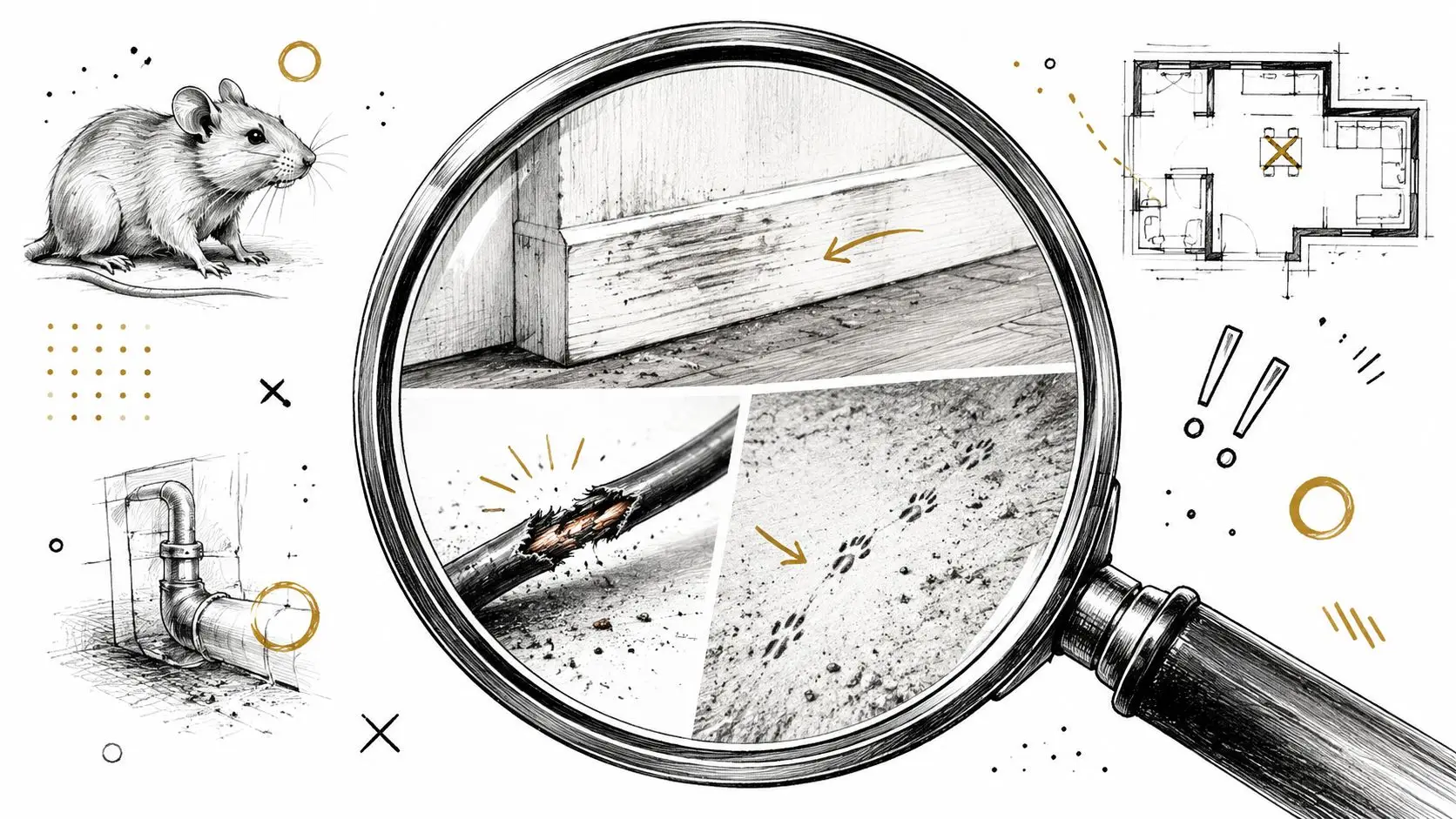
Start with the areas rats prefer because they can move unseen. Check behind the refrigerator, under sinks, inside the pantry, along garage walls, around water heaters, and where plumbing or cable lines enter the house.
Look for these clues:
- Droppings near edges: Rats usually leave droppings along walls, behind stored items, and near food sources rather than out in the open.
- Grease or rub marks: Their fur leaves dark, oily smudges on baseboards, pipe chases, and tight openings they use repeatedly.
- Gnaw damage: Fresh chewing on wood, plastic, cardboard, or wiring is a serious warning sign.
- Tracks in dust: In attics, garages, and storage rooms, rats often leave tail drags and foot tracks in dusty areas.
- Noises at night: Scratching, short bursts of running, and chewing sounds after dark often point to active rodent movement.
If you want a more detailed visual breakdown, this guide to common signs of rodents in and around the home is useful for narrowing down where activity is concentrated.
Why sign intensity matters
One or two droppings don't mean the same thing as repeated evidence in several rooms. Heavy signs in one location usually mean you've found a travel route or nesting area. Light signs scattered randomly can mean the rat is ranging wider and still testing the structure.
A rat infestation is easier to solve when you stop thinking in terms of rooms and start thinking in terms of runways.
That's also why placement matters so much later. According to UC Agriculture and Natural Resources guidance on snap-trap use, when pre-baiting is combined with traps spaced at roughly 15 feet along walls, field studies showed active rat populations could be reduced by 50 to 70% within several nights of intensive deployment.
Rat signs that homeowners miss
A lot of people only look at the floor. That's a mistake in Southeast Texas homes. Check attic insulation near eaves, the top of garage storage shelves, and the back corners of cabinets. Rats like protected lines of movement, and they'll often stay close to structure instead of crossing open space.
Also pay attention to pet behavior. Cats and dogs often key in on one repeated point of activity long before the homeowner sees obvious evidence.
Choosing the Right Trap for Your Home
There isn't one perfect rat trap for every house. The right choice depends on where the rats are moving, how comfortable you are handling the catch, and whether kids or pets can reach the setup. What matters is choosing a trap you'll use correctly and in enough numbers to matter.
The biggest DIY mistake here is relying on a single trap. Rats don't move like targets in a carnival game. They follow established runs, and multiple animals may be using the same structure. Public health guidance summarized in this trap-line overview recommends multiple traps in a linear configuration, with 10 to 15 snap traps in a moderate home infestation. That guidance notes capture time can drop from days to hours, and success rates can exceed 70 to 80% when trap lines are used instead of single-trap setups.
Rat Trap Comparison Chart
| Trap Type | Effectiveness | Pet/Child Safety | Reusable | Notes |
|---|---|---|---|---|
| Wooden snap trap | High when placed well | Lower unless shielded or boxed | Yes | Fast kill, affordable, dependable, but requires careful placement |
| Electronic trap | High in enclosed indoor spots | Better when used as directed in protected areas | Yes | Good for no-touch removal, needs batteries and dry placement |
| Live-catch trap | Variable | Safer if enclosed and checked often | Yes | Requires transport, release decisions, and handling discipline |
Snap traps do the heavy lifting
If you want pure efficiency, the classic rat snap trap still earns its place. It's direct, inexpensive, and works well when you place it tight to a wall or inside a protected box. For homeowners who need to set several traps at once, this is often the most practical starting point.
The downside is obvious. You need to handle the result, and an exposed snap trap can injure a curious child or pet. That's why I prefer snap traps in enclosed spaces, behind appliances, inside garages with restricted access, or inside protective stations.
Electronic traps reduce the handling problem
Electronic rat traps make sense for homeowners who want a cleaner disposal process. They're useful in pantries, utility rooms, or attics where the unit can stay dry and out of reach. They also help if you know you'll hesitate to deal with a traditional snap trap.
The trade-off is cost and maintenance. Batteries fail, electronics don't like moisture, and one trap still isn't a strategy.
Live traps sound better than they usually work
Some homeowners want a non-lethal option. That's understandable. But live trapping creates its own problems. A trapped rat is still a stressed wild animal, and if you don't have a realistic release plan, the trap just delays the hard part.
If you choose live capture, use it because you're prepared to manage the animal safely afterward, not because it feels easier.
Field note: A trap that makes you avoid checking it is the wrong trap for your house.
Safety changes the decision
If children or pets live in the home, don't place any rat trap where accidental contact is possible. Use covered stations, put traps behind fixed appliances, or install them in voids and crawl-access points the household can't reach. FullScope Pest Control offers rodent services that include inspection, trapping, sanitation guidance, and exclusion work, which can help when the house layout makes safe DIY placement difficult.
Mastering Bait and Placement to Outsmart a Rat
Most failed trap jobs come down to one issue. Bad placement.
People obsess over bait flavor and trap brand, then set the trap in the middle of an open floor where a rat would never choose to travel. Rats survive by staying close to cover. If you want to know how to catch a rat reliably, stop trying to lure it into a dramatic scene and start intercepting it on its normal route.
Use bait that sticks and smells rich
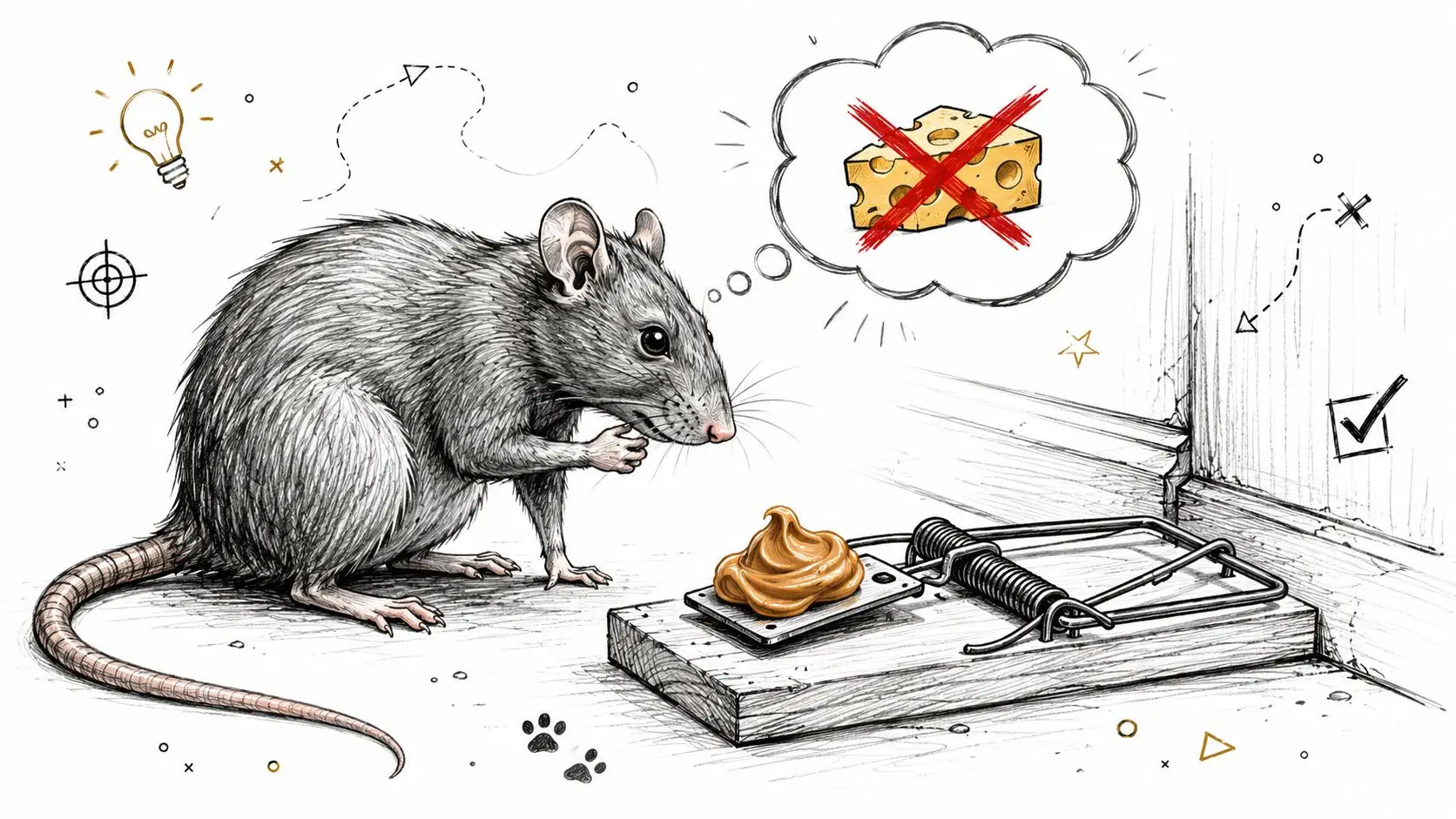
Cheese gets talked about because it's familiar, not because it's the best tool. In houses, rats respond better to sticky, rich baits that stay on the trigger. Peanut butter is common for a reason. It holds well and gives off scent. Small amounts of bacon grease or jerky can also work, especially where food competition is high.
Use a small amount. Too much bait lets the rat feed without committing its full weight to the trigger area. You want investigation to turn into activation.
A good bait setup also looks undisturbed. If you mash on bait with bare fingers and leave the trap wobbling on uneven flooring, the whole thing feels wrong to the animal.
Pre-baiting is the part most homeowners skip
Now, the strategy changes. Instead of setting the trap immediately, place the baited trap where the rat is active and leave it unset for a short period. Let the rat feed from it without a bad experience. Once the bait is being taken confidently, set the trap.
That approach isn't just theory. In a controlled field study summarized by Predator Free New Zealand research on trap pre-feeding, pre-fed traps achieved a 47% capture rate over five days, while non-pre-fed traps yielded 19% over ten days. The study found pre-feeding more than doubled the effective capture rate, because rats learned to treat the trap as a safe food source before it was armed.
Don't rush the set if the rat is cautious. A trap the rat trusts beats a trap the rat avoids.
That's especially important with mature rats that have already survived bad DIY attempts.
Place traps where a rat already feels hidden
Set traps perpendicular to the wall when possible, with the trigger end where the rat naturally approaches from the edge. In tight runs, parallel placement can also work if the trap sits snug to the travel line and doesn't rock.
Focus on locations like:
- Behind kitchen appliances: Refrigerators and freezers create warmth, darkness, and crumbs.
- Along garage walls: Especially behind stored items, tool benches, and pet food bins.
- Under sinks and utility penetrations: Rats follow plumbing and cable routes.
- Attic edge runs: Watch the eaves and insulation paths near access points.
- Near foundation transitions: Exterior-to-interior crossings are prime interception spots.
For Southeast Texas homeowners, generic advice often misses how Norway rats use the structure. They commonly travel along shared utility runs, under decking, and around HVAC units. The better move is adapting traps to those micro-routes with low-visibility enclosures, especially where children or pets are present and where exposed traps won't sit naturally in the rat's path.
A short visual can help if you're mapping runs and orienting traps around travel behavior:
What doesn't work well
Some setups fail so often they're worth naming directly.
- One trap in the middle of a room: Rats avoid open space unless they have to cross it.
- Loose bait hanging off the trigger: The rat can steal it without committing.
- Changing locations every day: If the sign was good, the problem is usually setup, not location.
- Traps near obvious human disturbance: Constant foot traffic and bright exposure reduce confidence.
- Random placement instead of a line: You catch more when you cover the route, not the room.
If the rat is feeding but not firing the trap, reduce the bait amount, steady the trap, and reassess the angle. That's a setup problem, not proof the trap “doesn't work.”
After the Catch Safe Disposal and Critical Cleanup
Catching the rat is only part of the job. The cleanup is where homeowners often take unnecessary risks. Never handle a rat, a trap, or droppings with bare hands. If you're dealing with a carcass or contaminated nesting area, wear gloves and a mask, and keep children and pets out of the space until cleanup is finished.
Handle the rat without direct contact
For a dead rat, place a plastic bag over your gloved hand, pick up the rat through the bag, invert the bag around it, seal it, and place that bag inside a second sealed bag before disposal. Clean the trap according to the manufacturer's instructions before reusing it.
For a live-catch trap, don't open it casually near the home. If you chose live capture, transport and release need to be handled carefully and lawfully, and the trap should still be disinfected afterward.
Safety warning: A trapped rat can still bite, thrash, and contaminate nearby surfaces. Treat the trap area like a contaminated zone until it's cleaned.
Clean the area the right way
Don't sweep dry droppings. Don't vacuum them either. Both actions can kick contaminated particles into the air. Lightly wet the affected area with disinfectant first, wipe it up with disposable material, and bag that waste securely.
In Southeast Texas, trap placement often happens around utility runs, under decking, and around HVAC units because Norway rats use those concealed routes heavily. Those same areas can hold droppings, urine, and nesting debris that are easy to miss if you only clean the visible floor line.
Use this cleanup checklist:
- Wear protection: Gloves and a mask are basic, not optional.
- Bag waste immediately: Rat remains, nesting material, and used paper towels should be sealed.
- Disinfect nearby surfaces: Focus on wall edges, utility penetrations, and any shelf or floor area around the trap.
- Check hidden voids: HVAC closets, crawl access points, and garage corners often need follow-up cleaning.
- Remove food attraction: Clean spilled pet food, secure dry goods, and fix accessible garbage issues.
If contamination is heavy, especially where urine, droppings, or decomposition have spread into insulation or enclosed areas, specialized cleanup may be safer than DIY. Homeowners dealing with that level of mess can review hazmat cleanup services from Restore Heroes for Phoenix hazmat situations as a useful example of what professional decontamination work typically addresses. For household-level prevention steps, this guide on safety precautions while doing pest control is a good practical reference.
When DIY Fails Calling a North Houston Rodent Expert
Some rat problems respond to disciplined trapping. Some don't. The difference usually comes down to scale, access, and whether the structure itself is helping the infestation continue.
If you keep catching rats but still hear fresh activity, that usually means more are entering, nesting in an inaccessible void, or avoiding the areas you can safely trap. Daytime sightings are another bad sign. So is repeated noise across multiple parts of the house, especially walls, attic edges, and garage transitions. At that point, the question stops being how to catch a rat and becomes how to stop the structure from supporting rats in the first place.
Signs you're past the DIY stage
A homeowner should consider professional rodent work when:
- The catches keep coming: If trapping continues but the activity pattern doesn't break, the entry issue likely remains.
- The sounds are widespread: Multiple wall runs or attic zones usually mean the problem is larger than one runway.
- You've got sanitation concerns: Heavy droppings, nesting debris, and carcass odor can turn into a cleanup problem fast.
- You can't place traps safely: Homes with children, pets, cluttered garages, or tight crawlspaces often need controlled placements and exclusion work.

What a technician does differently
A technician doesn't just set traps. The primary value is inspection and exclusion. That means finding how the rats are getting in, identifying the species and travel pattern, locating harborage, and sealing or screening the access points that make the house easy to revisit.
In North Houston communities like Kingwood, Conroe, and The Woodlands, that often includes utility penetrations, garage door gaps, attic construction breaks, crawlspace edges, and exterior clutter that creates protected movement back to the structure. If you're comparing options, this guide on how to find reliable rat exterminator near me services helps sort out what to ask before hiring anyone.
A lot of homeowners also underestimate the cleanup risk after a prolonged infestation. If the idea of handling contaminated materials yourself gives you pause, that's a reasonable instinct. This overview of serious biohazard cleanup hazards explains why DIY cleanup stops being a simple household chore once waste and decomposition build up in hidden spaces.
Sometimes the trap isn't the limiting factor. Access is. If the rat is living where you can't inspect, trap, or clean safely, the job needs to escalate.
A good rodent plan ends with the house being harder to enter than it was before. Without that, trapping becomes maintenance instead of a solution.
If you're in North Houston and the scratching, droppings, or repeat catches aren't slowing down, it may be time for an on-site rodent inspection instead of another round of guessing.